
🌟I used to be fairly cynical about blockchain gaming because the barrier to entry always felt like a chore rather than an invitation. Most projects in this space demand that you understand complex wallet interactions or shell out hundreds of dollars for an asset before you even know if the game is fun. When I first looked at Pixels, I expected more of the same friction. Instead, I found something that felt suspiciously like the simple browser games of the early internet. It is easy to dismiss the pixelated art style as a nostalgic gimmick, but after spending some time digging into how the game actually functions, I realized that the simplicity is the point. It is a deliberate design choice that lowers the psychological and technical hurdles for new users.🌟
🥇The core of the game is essentially a digital homesteading simulator. If you have ever played a farming game or managed a virtual garden, you understand the basic loop. You plant seeds, wait for them to grow, harvest them, and use those resources to progress. In a traditional game, those items exist in a vacuum. In Pixels, they are part of a shared, transparent ledger. The brilliance of the design lies in how it handles land. While there are private plots owned by investors, the game provides public spaces for everyone else. This creates a functional hierarchy where landowners act as service providers and casual players act as the labor force. It mimics a real-world economy where infrastructure and activity must balance each other out to create value.
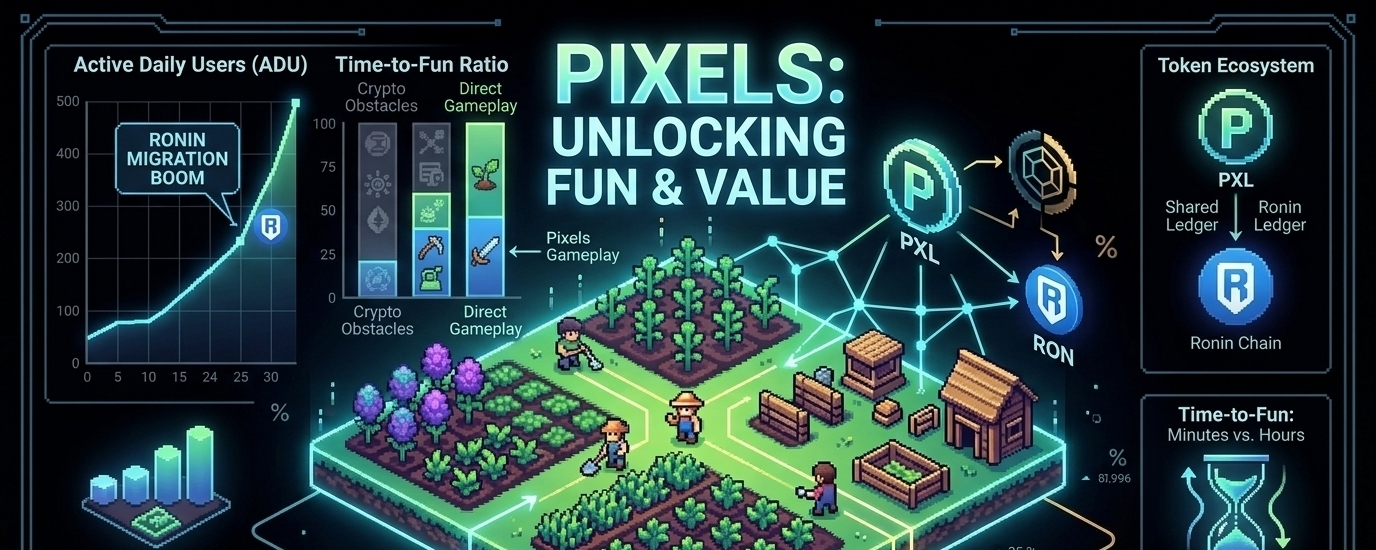
🥳What Pixels does better than almost any of its competitors is managing the "time-to-fun" ratio. Most crypto games are so focused on the financial layer that they forget to be accessible. Pixels prioritizes the social and casual experience first. By moving to the Ronin network, they tapped into an existing community of players who are already comfortable with the ecosystem, which gave them a massive head start in terms of active daily users. They managed to create a sense of "place" rather than just a storefront for non-fungible tokens.
🎊However, I am not entirely convinced that the current economic model is bulletproof. The central challenge for any play-to-earn system is the constant pressure of inflation. When players are motivated primarily by the ability to extract value, the game becomes a race between resource generation and token sinks. If the developers cannot create enough reasons for players to spend their earned currency back into the ecosystem—rather than just selling it on an exchange—the floor eventually falls out. It is a delicate game of psychological engineering. They are trying to shift the player mindset from "how much can I make" to "how much do I want to build," which is a difficult transition to sustain over several years.
One thing that gave me pause while researching this is the realization that Pixels is less of a game and more of a social experiment in digital labor. We are seeing a new kind of structural tension where the "fun" is actually the byproduct of efficient resource management. The real risk isn't just a technical failure or a hack; it is the possibility that the game becomes too much like a job. If the incentive to play is purely financial, the community disappears the moment a more profitable alternative arrives. The project's longevity depends on whether they can deepen the gameplay enough to keep people around for the experience itself.
There is a genuine strength in their ability to iterate quickly and listen to their player base, but the overhead of maintaining a multi-token economy in a volatile market is a massive burden. They have built a vibrant world, yet the foundation still feels like it is being poured while the building is already inhabited. I find the project fascinating because it avoids the over-engineered complexity of its peers, but it still faces the same fundamental questions about sustainability. Whether they can turn this digital gardening experiment into a permanent fixture of the internet remains to be seen. I am watching how this evolves.