

In the quiet rhythm of a digital field, where pixelated crops sway under an eternal sun and little avatars move with a purpose that often looks like simple leisure, something much deeper quietly unfolds. Pixels isn't just a game about farming and exploring; it's an intricate, layered economy where time, a sense of ownership, and player participation all weave together. Beneath its charming, straightforward appearance lies a carefully structured dance between tokens, unique digital items, and the plain old effort players put in, creating what one might call a stacked economy—each part relying on and strengthening the others.
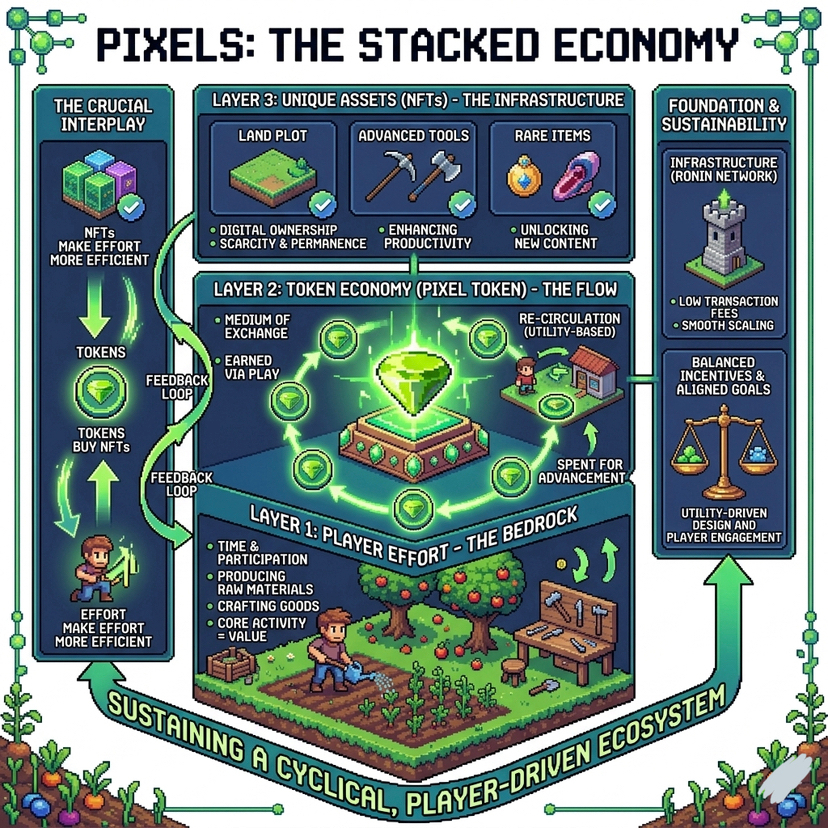
At the very bedrock of this system rests effort, the most organic and truly irreplaceable resource within the world of Pixels. Much like the fertile soil in our own world, effort is the starting point for everything. Players tend to their crops, bring in the harvest, craft new items, and venture out to explore, effectively turning their time into useful things in the game. These outputs—be they crops, raw materials, or finished goods—are more than just items; they're the foundational pieces of an economy. Their value doesn't come from some arbitrary tag, but from the actual time and interaction it takes to produce them. This approach makes sure that simply taking part becomes deeply meaningful, rooting the whole system in human engagement rather than just passively owning something.
Rising above this fundamental layer is the token economy, where all that player effort begins to translate into a measurable kind of value. The PIXEL token acts as a way to trade things, a little nudge to keep players going, and a general signal of the economy’s health within the system. It bridges the small, everyday actions of players with the bigger economic picture of the game. Yet, unlike some systems that live and die by price movements alone, Pixels ties its token flow directly to how people play the game. Tokens are earned through actual activity, spent to advance, and then brought back into the system, forging a circular economy that values practical use over abstract concepts. This loop is vital for keeping things balanced, making sure that value still comes from playing, not just from detached financial speculation.
Right alongside the token layer exists the unique realm of NFTs—those distinctive digital assets that introduce a sense of permanence and true ownership into the game's world. Land plots, various tools, and other things in the game aren't just functional; each is individually owned and can be verified. In Pixels, NFTs serve as the structural backbone of the economy, much like land and buildings in the physical world. They allow players to make their productivity better, unlock new ways to play, and establish lasting footholds within the game. Here, ownership isn't a passive thing; it's deeply participatory. These assets gain value not only from their scarcity but from how well they are put to use within the larger system.
What truly makes this economy "stacked" is the continuous interplay between these different layers—the effort, the tokens, and the NFTs. Effort produces resources, which then feed into the flow of tokens. Tokens, in turn, open up access to assets and upgrades, while NFTs boost the efficiency and overall results of that effort. This creates a kind of feedback loop where each layer strengthens the others. A player who puts in the time gains resources; those resources can then become tokens; tokens might be used to get new NFTs or improve existing ones; and those NFTs, by their very nature, make future productivity even better. The system doesn't move in a straight line but in a circle, designed to reward steady involvement over one-off actions.
Infrastructure plays a quiet but absolutely crucial role in making this interplay possible. Built on the Ronin Network, Pixels benefits from a foundation that prioritizes smooth scaling and very low transaction costs. This means economic interactions—trading goods, transferring ownership, and using tokens—can happen without a hitch, right within the flow of gameplay. The technical bits simply fade into the background, letting players focus on the experience itself while still enjoying the security and transparency that come with blockchain-based ownership.
But the real strength of this stacked economy likely lies in how all its incentives line up. Players aren't just consumers; they're active contributors to a living, breathing system. Every crop harvested, every item crafted, every single transaction adds to the vibrancy of the whole ecosystem. The developers lay down the initial rules, but the economy itself is shaped by what players actually do. This dynamic introduces a bit of unpredictability, where value is created together, rather than simply dictated. It turns the game from a static place into a responsive, evolving marketplace of activity and interaction.
However, with such complexity naturally comes a certain responsibility. A system that blends tokens, NFTs, and player effort has to carefully balance how easy it is to get into with how sustainable it can be. Offering too many incentives might lead to short-term opportunism, while not rewarding effort enough risks players simply losing interest. Pixels tries to navigate this challenge by focusing on design driven by actual utility, where rewards are linked to meaningful gameplay rather than just isolated extraction. The aim isn't just to hand out value but to keep a cycle going where players stay engaged because the system itself is enjoyable and makes sense.
In a broader sense, Pixels represents a shift in how digital economies might operate. Traditional games often keep effort and ownership separate—players invest their time but don't truly control their in-game assets. Pixels, by contrast, brings these elements together, allowing effort to translate into both immediate rewards and lasting positions within the ecosystem. This convergence blurs the line between simply playing and actively participating, introducing a model where value is both experienced and truly retained.
Ultimately, the stacked economy of Pixels is less about sheer financial gain and more about its underlying structure. It’s a system where layers thoughtfully reinforce one another, where value flows through active participation, and where ownership adds to engagement rather than replacing it. Like a well-tended field, it needs balance, careful attention, and continuous interaction. And as players move through this world—planting, crafting, trading—they aren't merely playing a game; they are sustaining an ecosystem, one action at a time.
