

I keep noticing a shift in how we define value distribution. It is no longer about the static release of a single asset.
We are moving into an era of programmable logic where coordination layers react to verified conditions across multiple vectors at once. The old way of thinking—one action, one reward—is becoming a relic.
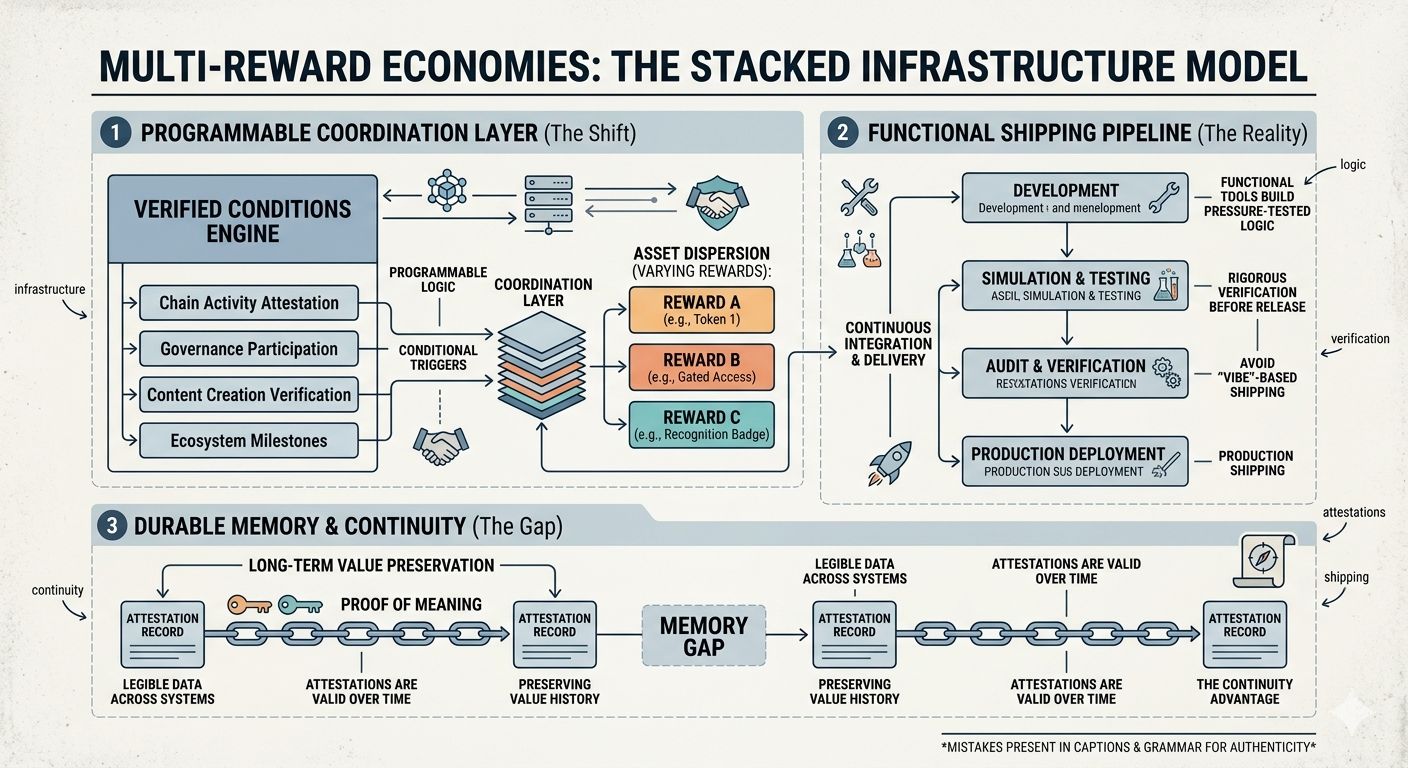
Today, a system must be able to verify diverse forms of participation and trigger rewards across varied layers of the infrastructure. This isnt just about adding more tokens to a dashboard. It is about creating a programmable coordination layer that understands the difference between a bot and a long-term contributor.
the difference is subtle but the implications for how we build are massive.
Most teams talk about "incentive alignment" as if it were a vibe. They use phrases like community engagement to hide the fact that they lack a functional shipping process.
Building a multi-reward economy requires more than a spreadsheet. It requires shipping code that can handle the pressure of complex, stacked logic without breaking the underlying protocol. The shipping reality is often much uglier than the marketing deck suggests.
I see many projects fail because they ignore the unsexy mechanics of verification.
If you cannot prove that an action happened across three different chains or platforms, your reward system is just a hallucination. Shipping functional tools means building the plumbing first.
That gap is larger than it looks.
Even if you ship a functional system, you face the problem of durable memory. Data is useless unless it preserves its meaning and proof across different systems and over time.
If a user earns an attestation in one season, but that record loses its legibility in the next, the economy collapses. A multi-reward system is only as strong as its ability to maintain a continuous record of value.
We often see systems that forget their own history. They trade long-term continuity for short-term hype. This lack of legibility creates a memory gap that prevents real scaling.
Infrastructure must provide a way for these attestations to remain valid for years, not just weeks. Without durable memory, we are just moving numbers around a screen without any actual proof of work.
The logic of the system must be as durable as the assets it distributes.
Scale is no longer about the size of the treasury, but the complexity of the coordination.