
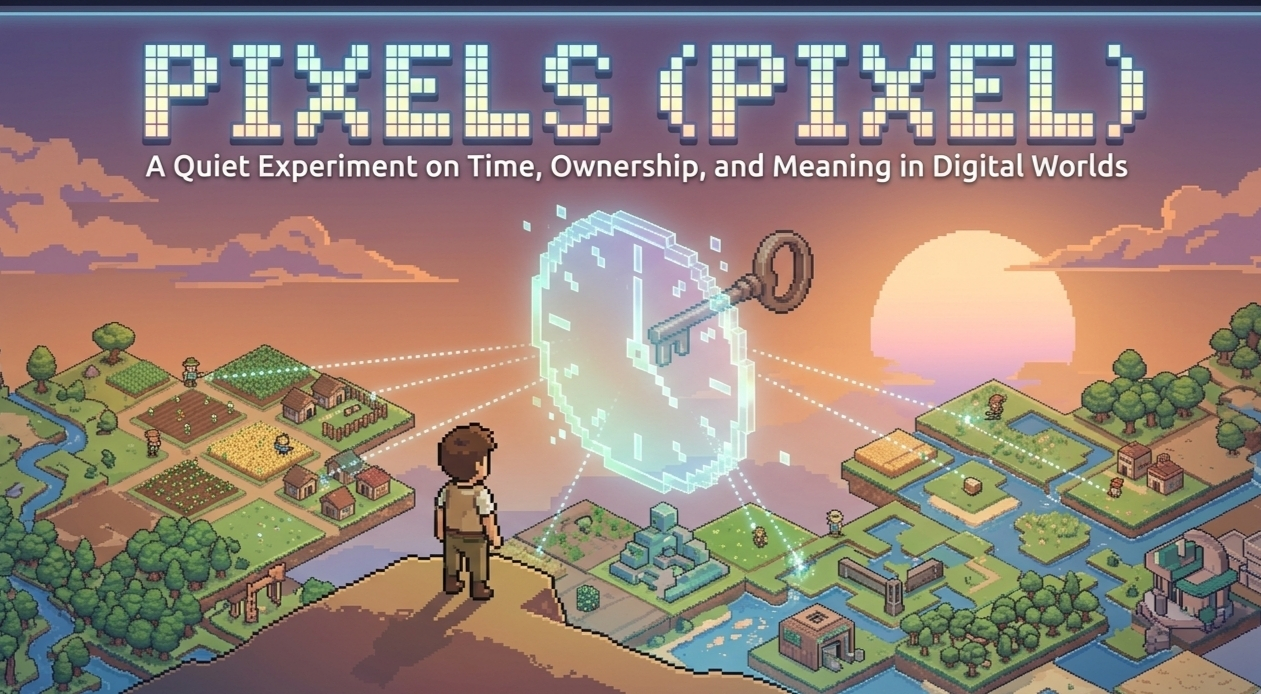

I’ve been thinking about Pixels (PIXEL) a lot lately, and honestly, the more I look at it, the more it feels less like “just another Web3 game” and more like a quiet experiment happening in real time.
On the surface, it doesn’t try to impress you with complexity. It’s a simple, cozy farming and exploration world where I can log in, do small tasks, grow things, and just exist in a relaxed loop. Nothing feels forced or overly technical. And that simplicity is probably why it works at first it doesn’t demand anything from me except time and attention.
But the deeper I go, the more I start noticing that Pixels is trying to answer a question that most games never really deal with: what happens to all the time I spend inside digital worlds?
I mean, I’ve spent hours in games before. Building progress, collecting items, leveling up, grinding systems. And when I really think about it, all of that stays locked inside someone else’s platform. If the game shuts down, everything I built disappears. It’s normal in gaming, but it’s also kind of strange when I actually stop and think about it.
Pixels sits right in the middle of that problem.
It still feels like a game I can enjoy casually, but underneath it, some parts are tied to blockchain-based ownership through the Ronin ecosystem. That means certain things I earn or create aren’t just trapped inside the game’s internal system. They can exist outside of it in a way that doesn’t depend completely on one company.
And I’ll be honest, the first time that idea really clicked for me, it changed how I look at small things in the game.
A simple item doesn’t feel as temporary anymore. A bit of progress doesn’t feel like it only exists while I’m online. There’s this subtle shift where I start thinking: maybe this effort doesn’t just vanish if the game changes one day.
But at the same time, it’s not as simple as saying ownership makes everything better.”
Because when I’m actually playing, I don’t want to be thinking about value all the time. I don’t want every action to feel like a calculation. I play games to relax, to disconnect, to do something without pressure. And once ownership enters the picture, even slightly, there’s always this second layer in the back of my mind what is this worth, does this matter outside the game, should I be doing something else instead?
That’s where Pixels feels interesting but also complicated.
It doesn’t fully remove that comfort of gaming, but it also doesn’t fully avoid the idea of value and ownership either. It sits in between. I can ignore the deeper systems and just enjoy the farming loop, or I can step back and start analyzing what’s actually happening underneath it.
And maybe that’s the real experiment here.
Not just building a game, but testing how people like me react when ownership and gameplay exist in the same space. Whether I still enjoy playing when I know that some parts of my progress might have value outside the game. Or whether that awareness slowly changes the way I experience something that used to be purely for fun.
The truth is, I don’t think Pixels gives a final answer. It doesn’t feel like a finished idea. It feels more like something in progress something still trying to figure out its own identity.
And I think that’s what makes it worth paying attention to.
Because it’s not just about farming or exploring or earning. It’s about something more basic and more human: the way I value my time inside digital spaces, and whether that time should stay locked inside systems or follow me beyond them in some form.
