
Most Web3 games begin with a promise of ownership and end with a race for extraction. Players arrive not to play, but to optimize — to earn quickly, exit faster, and leave behind an empty world. Against that backdrop, Pixels (PIXEL) is interesting not because it claims to solve this problem outright, but because it quietly shifts the starting point: it tries to make the game itself worth inhabiting before making it worth monetizing.
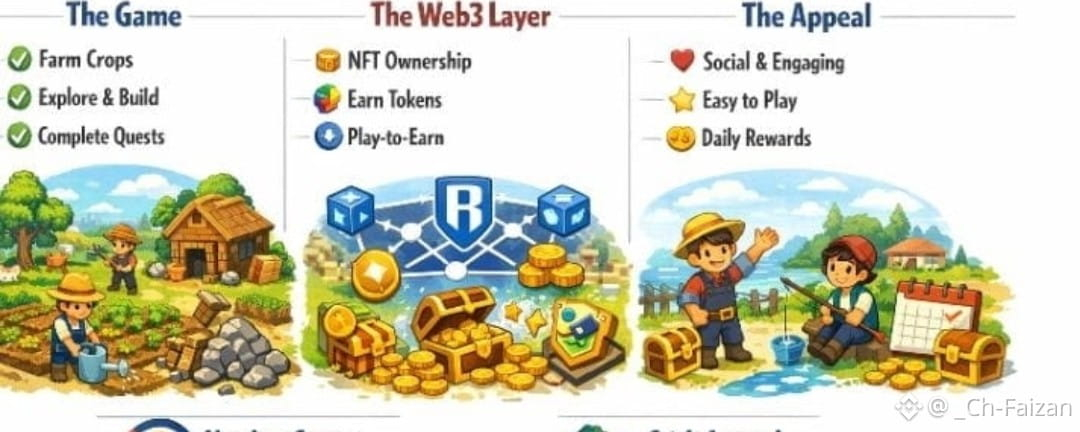
What sets Pixels apart is not its feature list, but its design posture. It leans into familiarity — farming, gathering, decorating — systems that have long worked in traditional games because they create rhythm and attachment. Instead of forcing blockchain mechanics to define the experience, Pixels appears to treat them as a layer that supports an already coherent world. This subtle inversion matters. Many Web3 projects build economies first and gameplay second; Pixels seems to be attempting the opposite, or at least a closer balance between the two.
At its core, the system revolves around a simple loop: players cultivate land, gather resources, complete tasks, and interact with a shared environment. The loop is not complex, but it is persistent. Progress is incremental rather than explosive, which encourages routine engagement rather than one-time optimization. Exploration and social interaction add texture, making the world feel less like a dashboard and more like a place. The simplicity is deliberate — it lowers the barrier to entry while leaving room for layered systems to emerge over time.
The role of the PIXEL token is where the project’s long-term credibility will ultimately be tested. In many Web3 games, tokens feel like external incentives stitched onto gameplay, creating a fragile balance between fun and financialization. In Pixels, the intent appears to be tighter integration — where the token supports in-game actions, progression, or ownership rather than dominating them. Whether this integration holds depends on restraint. If the economy becomes too reward-heavy, it risks attracting extractive behavior; if too constrained, it may fail to justify its blockchain layer at all. The challenge is not designing a token, but designing its absence — ensuring the game remains meaningful even when financial incentives fluctuate.
User behavior within Pixels will likely follow the incentives it sets. If progression is tied to patience, creativity, and social participation, the game may cultivate a slower, more invested community. If rewards skew toward efficiency and repetition, it could drift toward the same short-term farming loops seen elsewhere in the space. The current structure suggests an attempt to encourage longer-term engagement, but this is a fragile equilibrium. Player culture in Web3 tends to adapt quickly to whatever yields the highest return, regardless of the developer’s original intent.
What makes Pixels genuinely interesting is not that it introduces something entirely new, but that it revisits something old with a different constraint. It borrows from the logic of casual, persistent worlds — games that succeed because they become part of a player’s routine — and tests whether that model can coexist with digital ownership. Its open-world structure, combined with a relatively accessible gameplay loop, gives it a broader surface area for organic engagement than many Web3 titles that feel narrowly engineered around yield.
Still, the risks are not trivial. The project must prove that its economy can remain stable without constant external growth. It must show that new players can join without being disadvantaged by early adopters. It must also navigate the tension between accessibility and depth — a simple system can attract users, but it may struggle to retain them if it does not evolve meaningfully. And perhaps most importantly, it must resist the gravitational pull of speculation, which has undermined many otherwise promising Web3 ecosystems.
In the end, Pixels should not be viewed as a finished solution, but as an ongoing experiment in alignment. It is an attempt to see whether a game can be both a place to spend time and a system that carries economic weight without collapsing under it. Whether it succeeds will depend less on its initial design and more on how it adapts — to players, to incentives, and to the unpredictable dynamics of an open economy.
$PIXEL @Pixels #pixel