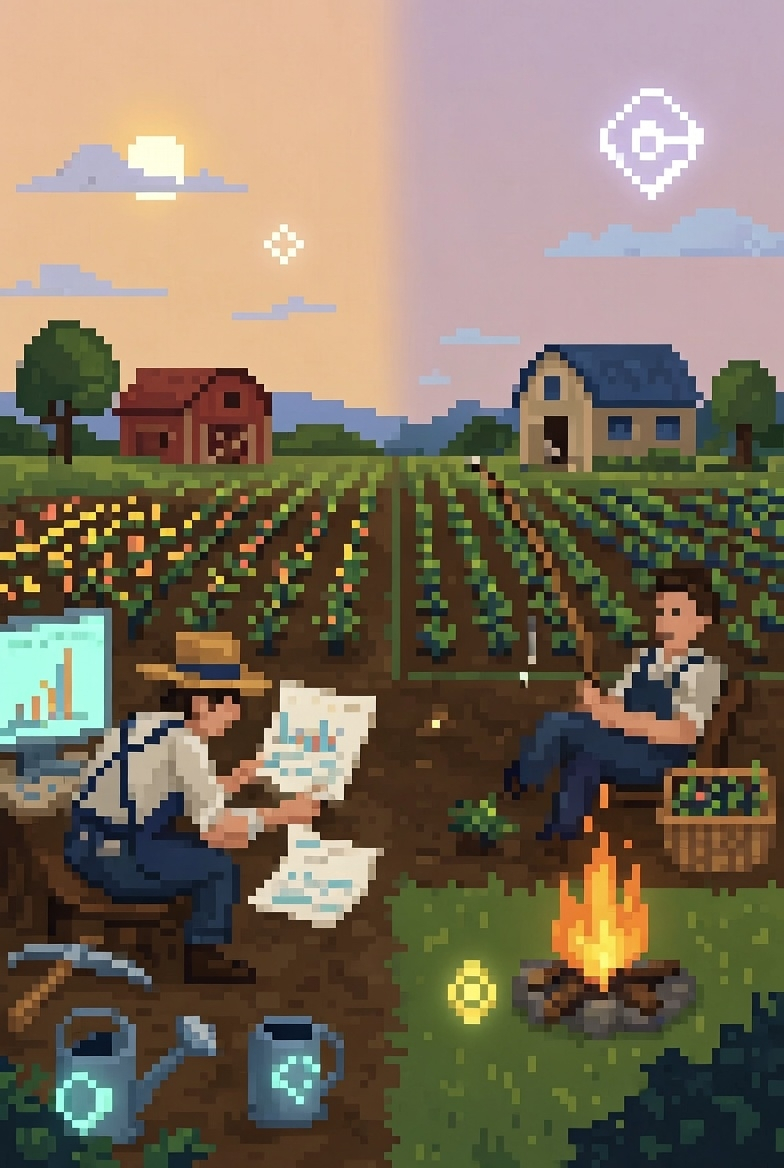

I’ll admit it when I first heard about Pixels, I rolled my eyes a little.
A social farming game. Onchain. Tokenized. Running on Ronin. I’ve seen this movie before. Cute mechanics, soft colors, Discord hype… then the emissions kick in, the token chart does its thing, and suddenly everyone’s a “long-term believer” explaining why inflation is actually healthy.
Maybe that’s too harsh. I’ve just watched too many cycles.
The thing about Web3 games is they usually confuse activity with retention. People show up because there’s yield. They stay because there’s yield. And when the yield shifts, so does the crowd. Underneath the pixel art and community calls, it’s often just financial gravity.
So when Pixels started gaining traction, I didn’t immediately see it as different. Farming carrots. Chopping wood. Crafting items. A familiar loop. Relaxing, sure — but relaxation in crypto usually has a timer attached.
And yet.
I keep coming back to the fact that Pixels didn’t feel frantic. It felt slow. Intentionally so. That’s unusual in this space. Most onchain games push you toward optimization — maximizing output per hour, extracting the most value from stamina systems. Pixels, at least from the outside, seemed to lean into routine instead of urgency.
That’s a subtle difference, but it matters.
Because the real problem with Web3 gaming isn’t graphics or even gameplay. It’s fragility. Economies are bolted onto experiences that were never meant to carry financial weight. As soon as assets have liquidity, behavior changes. Cooperation becomes strategy. Exploration becomes arbitrage.
That’s where things start to feel uncomfortable.
An open world built around farming and social interaction sounds peaceful — until land becomes scarce, until resource flows get modeled in spreadsheets, until someone figures out how to optimize the joy out of it. The more composable the assets, the more extractive the players become. Not because they’re malicious. Because incentives bend behavior.
Ronin gives Pixels a kind of structural advantage — cheaper transactions, a gaming-native audience, fewer UX hurdles. Infrastructure does matter. When friction drops, experimentation increases. But lower friction also means faster exploitation. Systems get stress-tested quickly.
What I find interesting isn’t the token. It’s whether a casual, social loop can survive financialization without losing its tone.
Farming games traditionally work because they’re repetitive in a comforting way. Plant, harvest, expand. There’s no existential risk. In Web3, everything carries market exposure. Even your digital carrots are suddenly part of a broader liquidity cycle.
I wonder how long that balance can hold.
Social dynamics complicate it further. When ownership is real — or at least transferable — communities shift. Early players accumulate assets. Latecomers arrive to a partially settled world. Power structures form quietly. Governance discussions creep in. What starts as a cozy town risks becoming a layered economy with invisible ceilings.

Maybe that’s inevitable.
But I can’t dismiss Pixels entirely. It feels like an attempt to slow Web3 down. To make participation feel habitual instead of speculative. And there’s something stubbornly optimistic about building a farming game in a space obsessed with velocity.
Still, I’ve seen how quickly sentiment flips. Casual becomes competitive. Community becomes factional. Tokens amplify everything — including boredom.
I don’t think the question is whether Pixels is fun. It probably is. The harder question is whether a social, open-world economy can remain gentle once real value seeps into every interaction.
Can a game about tending crops resist the pressure to become a machine?
I’m not sure. But I keep watching it anyway.