A lot of games, especially anything connected to web3, feel like they want your attention immediately. They explain too much, reward too loudly, and keep hinting that something important is always just about to happen. Pixels doesn’t really land that way. It feels slower. More ordinary. And I mean that in a good way. You log in, look around, do a few small things, and after a while you realize the game is built around that exact feeling.
It doesn’t try to rush you into caring.
That changes the way the whole thing reads. Instead of asking, “what can I get from this game?” the question becomes something simpler. “Do I actually like being here?” For Pixels, that seems to be the right starting point.
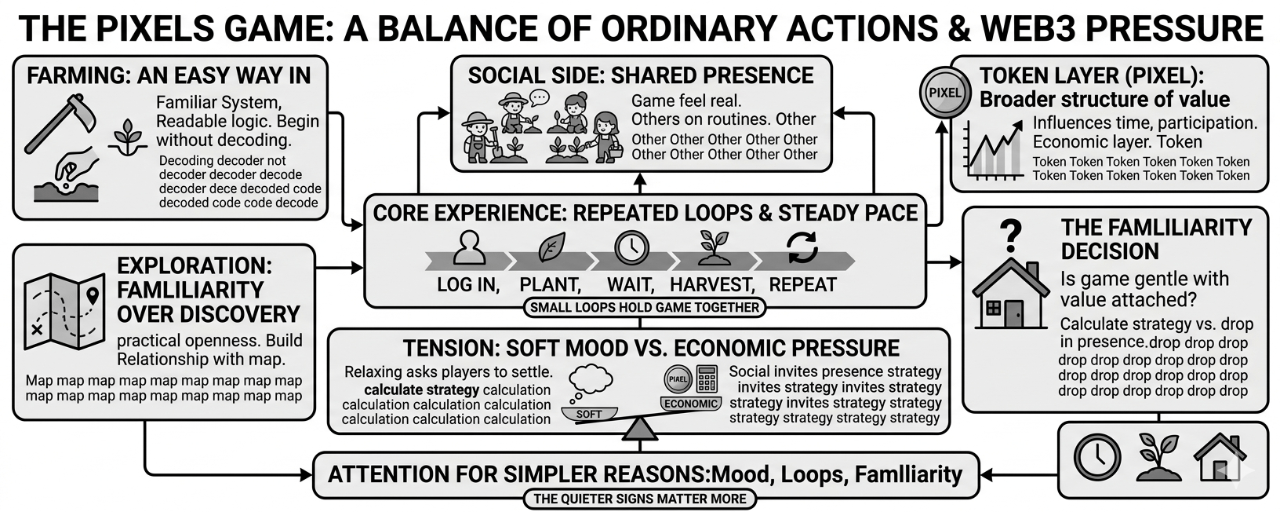
It’s built on the Ronin Network, and that obviously matters in the background. It gives the game its web3 structure, its token layer, its ownership logic, all of that. But if you only look at it through that frame, you miss something. The actual experience is much quieter. It’s about repeated actions, familiar spaces, and the kind of progress that doesn’t always look dramatic from the outside. You plant. You harvest. You move around. You gather. You adjust. Then you come back later and do some version of it again.
That loop sounds small when you describe it plainly. But small loops are often what hold games together.
You can usually tell when a game understands its own rhythm. Pixels seems to know that not every moment has to be exciting. Some moments can just be useful. Some can just feel settled. That’s a hard thing to get right, because “casual” is often misunderstood. People hear that word and assume shallow, or forgettable, or built only for short sessions. But casual can also mean readable. Comfortable. A game that knows how to leave a little space around the player instead of constantly pushing.
That’s one of the reasons the farming works.
Farming in Pixels isn’t interesting because it’s new. It isn’t. Most people already understand the logic of it before they even start. Put something in the ground, wait, return, harvest, repeat. But familiar systems have their own value. They give the player an easy way in. You don’t spend your first hour trying to decode everything. You just begin. And while you’re doing that, the rest of the world starts making sense around you.
That’s probably where the exploration side becomes more important than it first appears.
Pixels is described as an open-world game, but not in the usual oversized sense where the world exists mostly to sound impressive. Here, the openness feels more practical. You move through areas because movement is part of learning the game. You find resources. You notice routes. You start remembering where certain things tend to happen. At first the world feels scattered. Then, slowly, it begins to organize itself in your head. That place is useful for this. That path is faster than the other one. That area tends to be busy. This one feels quieter.
It becomes obvious after a while that exploration in this game is less about discovery in the dramatic sense and more about familiarity. You are not just finding new places. You are building a relationship with the map. And that’s a different kind of design choice. It makes the world feel lived in rather than presented.
The social side grows in the same way.
Pixels is not the kind of social game where every interaction needs to be a big event. Most of the social feeling comes from shared presence. Other people are around. They’re farming too, moving through the same systems, spending time in the same world for their own reasons. Sometimes that’s enough. A game starts feeling real when it seems like it continues even when you’re not doing anything especially important. Someone passes by. Someone is working nearby. Someone is clearly on their own routine. None of that is huge on its own, but together it creates texture.
That texture matters more than people sometimes admit.
A lot of web3 discussion ends up flattening games into economies. Who owns what, what the token does, how rewards work, whether the system is sustainable. Those questions are real, of course. PIXEL as a token is part of how this world functions. It connects in-game activity to a broader structure of value and participation. It influences how some people spend time in the game and what they expect from it. That layer is not separate from the experience. But it also isn’t the whole experience.
That’s where the project becomes more interesting to think about.
Because Pixels seems to sit in an in-between space. It is clearly a game, with routines and places and small personal habits. But it is also clearly an economic system, or at least partly one. Those two things can support each other, but they can also create pressure. A relaxing game asks players to settle in. A tokenized environment can push players to calculate. A social world invites presence. An economy invites strategy. Neither side cancels the other. They just keep rubbing against each other.
And maybe that friction is the real story.
The question changes from “is Pixels a good blockchain game?” to something more specific. Maybe it’s this: “Can a game stay gentle once value is attached to it?” That feels closer to what’s actually worth noticing here. Not whether farming exists, or whether the token exists, but what happens when both exist in the same space and both affect player behavior in quiet ways.
Some players will naturally lean toward efficiency. They’ll look for the smartest route, the best return, the most useful pattern. Others will treat the game more like a place to drop into for a while. A patch of digital routine. A place where not much happens, and that’s exactly why it works. Pixels seems open to both kinds of attention, which is probably part of its appeal.
The visual style plays a role in that too.
Pixel art has a way of lowering the emotional volume of a game. Things look simpler, but also softer. Less polished in the corporate sense, more readable in the human sense. The world doesn’t need to overwhelm you with detail to feel coherent. You just need enough to recognize its shape. Enough to know where you are. Enough to feel that the environment has its own character. Pixels uses that well. The art doesn’t beg for admiration. It mostly gets out of the way and lets the routines settle in.
Creation, in that context, feels less like a feature list item and more like a mindset. You’re not only following systems that already exist. You’re shaping your own version of participation inside them. What you focus on. What you build up over time. How your space starts reflecting your habits. That kind of authorship is subtle, but it matters. It gives the player a sense that their time is forming something, even if the changes are gradual and even if no single session feels important on its own.
That’s probably why the game feels more personal than its basic description suggests.
From a distance, “social casual web3 farming game” sounds almost too neat. Like a category more than a real place. But when you sit with it a bit, the categories matter less. What stays with you is the structure of ordinary actions. The repeated paths. The low-pressure feeling of checking in and finding the world still there. The sense that the game is not asking you to become someone else inside it. Just to keep showing up and notice what grows from that.
And maybe that’s enough for now.
Pixels doesn’t seem most interesting when it’s being treated as a big statement about the future of gaming. It feels more interesting when you look at it closely, at ground level, where players are just moving through a world, doing small tasks, and slowly giving those tasks meaning. The Ronin connection matters. The token matters. The systems matter. But they don’t fully explain why the game holds attention.
Sometimes attention stays for simpler reasons. A world has a certain mood. A loop feels steady. A place becomes familiar. You return because the return itself starts to feel natural. Pixels seems built around that kind of logic more than anything else.
And that leaves it in an unusual place. Not fully about farming. Not fully about ownership. Not fully about social play either. More like a quiet mix of all three, still finding its balance, still showing what kind of world it wants to be as people keep spending time inside it.
@Pixels #pixel $PIXEL

Artykuł
What stands out about Pixels isn’t really the farming at first. It’s the pace.
Zastrzeżenie: zawiera opinie stron trzecich. To nie jest porada finansowa. Może zawierać treści sponsorowane. Zobacz Regulamin