
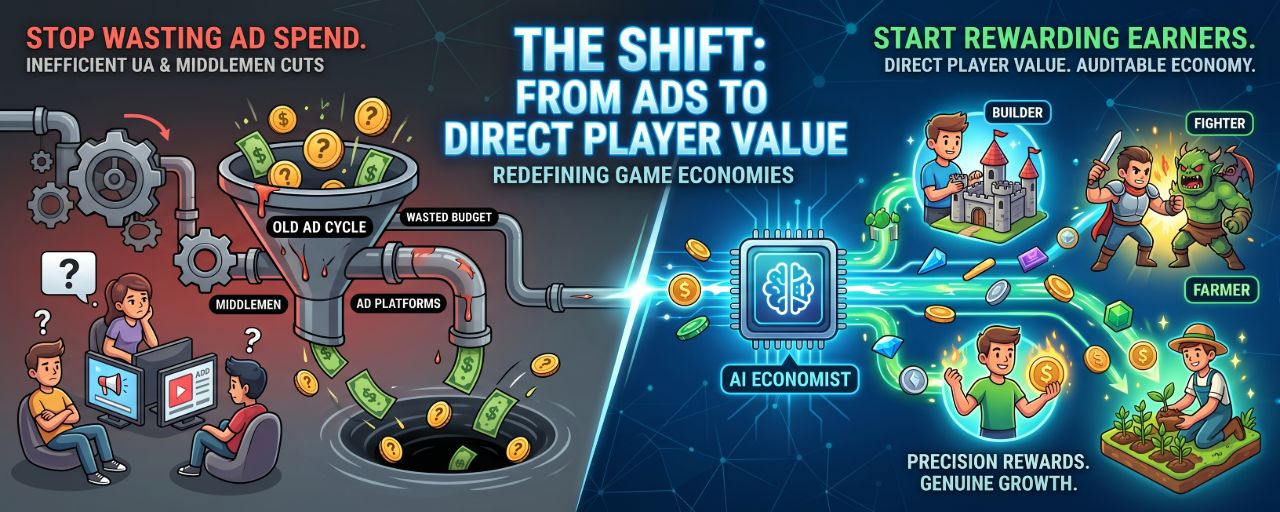
There's a number that doesn't get talked about enough in gaming. Studios spend billions every year on user acquisition. Google gets a cut. Meta gets a cut. Apple gets a cut. And somewhere at the end of that chain, a player shows up, maybe stays for a week, maybe doesn't. Nobody really knows if the money was well spent until it's already gone.
That system has been the default for so long that most people stopped questioning it.
Stacked is questioning it.
The idea behind it is almost uncomfortably simple. Instead of routing marketing budget through ad platforms that take their percentage and hand you a user you know nothing about, send that value directly to the players who are already showing up and doing things that actually matter. Not watching an ad. Not sitting idle. Farming, building, completing missions, contributing to the ecosystem in ways that move real KPIs.
The shift sounds obvious when you say it out loud. But the execution is where every previous attempt fell apart.
Most reward systems before this couldn't tell the difference between a genuine player and someone running five accounts to extract value. They couldn't measure whether a reward actually improved retention or just attracted a cohort that would leave anyway. They had no way to target the right user at the right moment with the right incentive. So the rewards either went to bots, got farmed into oblivion, or ended up being too blunt to change behavior in any meaningful way.
Stacked fixes this at the infrastructure level. The AI economist watches behavioral patterns across the entire network, builds a profile for each player, and decides what reward makes sense for that specific person at that specific moment in their journey. A player about to churn gets a different signal than a whale who needs a reason to go deeper. That's not a quest board. That's precision the ad platforms never had because they were never inside the game watching what was actually happening.
The results inside Pixels speak for themselves. $25M in revenue. 200M+ rewards processed. A system that survived bot attacks, farming exploits, and every form of adversarial behavior a live Web3 economy attracts at scale.
Now that infrastructure is opening to external studios. And for the first time, a game company can redirect what used to be ad spend into something auditable, measurable, and going directly to the players who earned it.
That's not a feature. That's a different philosophy about where value should flow.
