
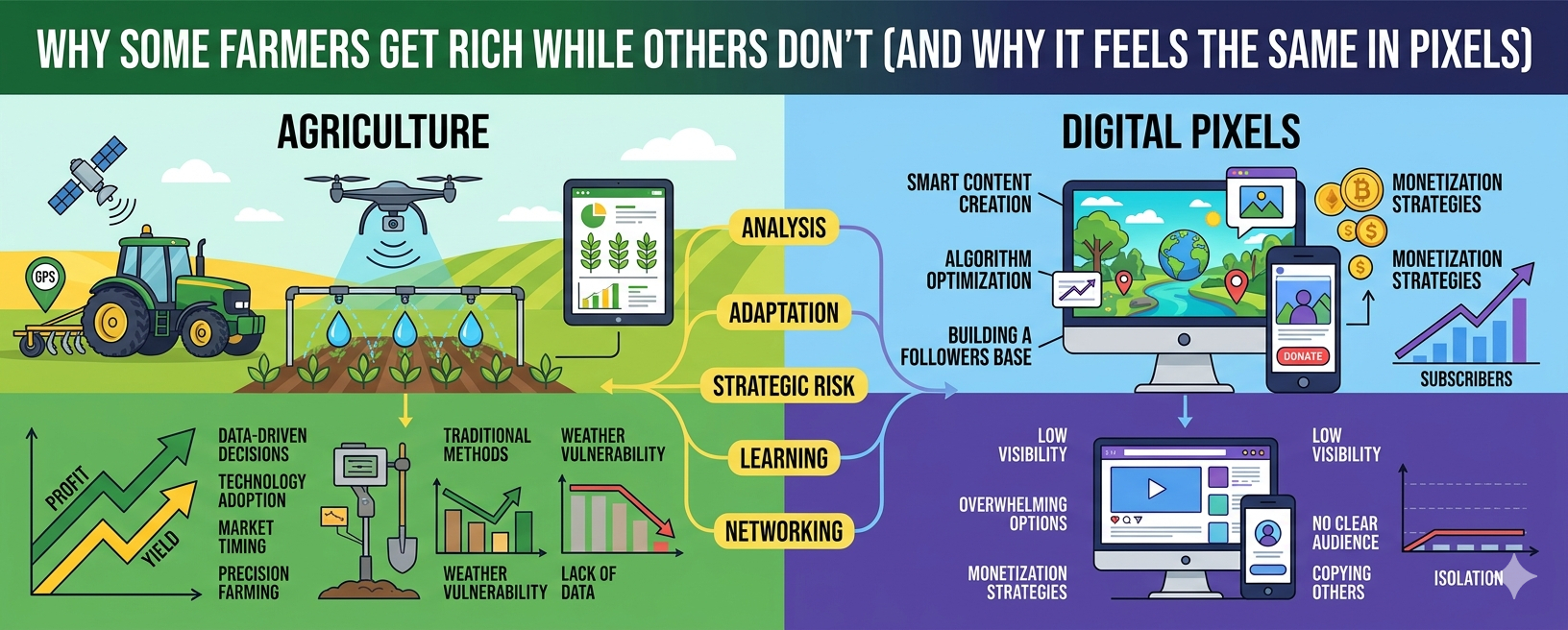

I used to think farming was simple.
You have land. You grow things. You sell them.
That’s it.
But the more you look at it, the more you realize it doesn’t really work like that.
Two people can work on almost the same land, put in similar hours, and still end up in completely different places. One builds something stable over time. The other is constantly busy but somehow always feels behind.
At first, it’s easy to assume it’s about effort. But it usually isn’t.
It’s more about how decisions are made.
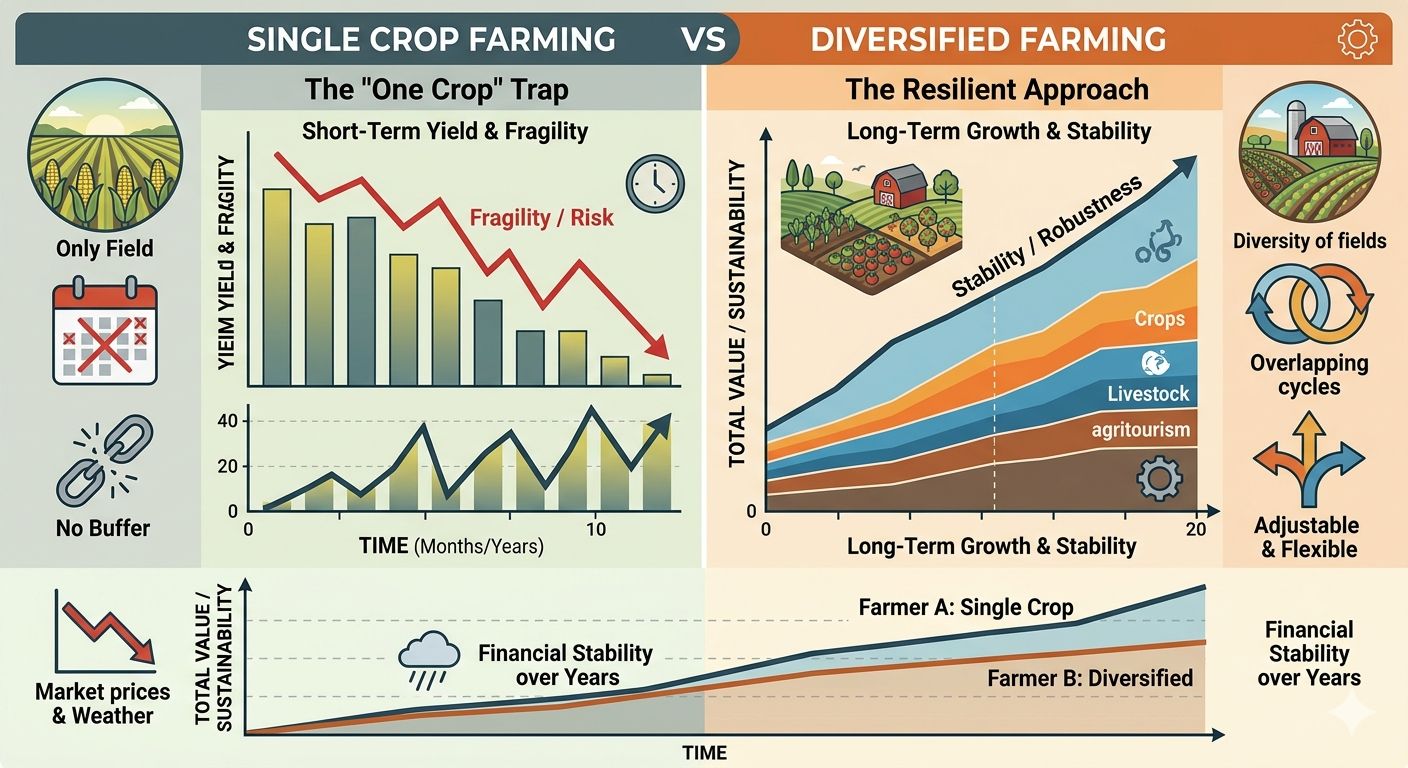
The “One Crop” Trap
A lot of people go all-in on one thing.
And to be fair, sometimes that works really well. If prices are good, if the weather holds up, if nothing goes wrong—you can make solid money.
But that “if” is doing a lot of work.
Because the moment something shifts—market prices drop, demand changes, or something unexpected happens—the whole setup starts to feel fragile.
There’s no buffer.
Why Some People Choose the Harder Path
Others do things differently.
They don’t rely on just one output. They spread things out. Different crops, different cycles, different ways of earning.
It’s definitely more complicated. More to manage. More things that can go wrong in small ways.
But overall, it tends to hold up better.
Instead of everything depending on one outcome, they’re building something that can adjust.
And that difference starts small, but over time it becomes obvious.
It’s Not About Working Harder
This is the part that’s easy to miss.
Most people are already working hard.
The real difference shows up in how they think about:
when to expand
where to put money
what to focus on now vs later
how much risk they’re taking without realizing it
And the tricky part is, these decisions don’t show results immediately.
You might only feel the impact months later.
This Is Exactly What Shows Up in Pixels
At first glance, Pixels feels like a normal farming game.
Plant, harvest, upgrade, repeat.
But after some time, it starts to feel different.
Because the game doesn’t really push you into one clear path.
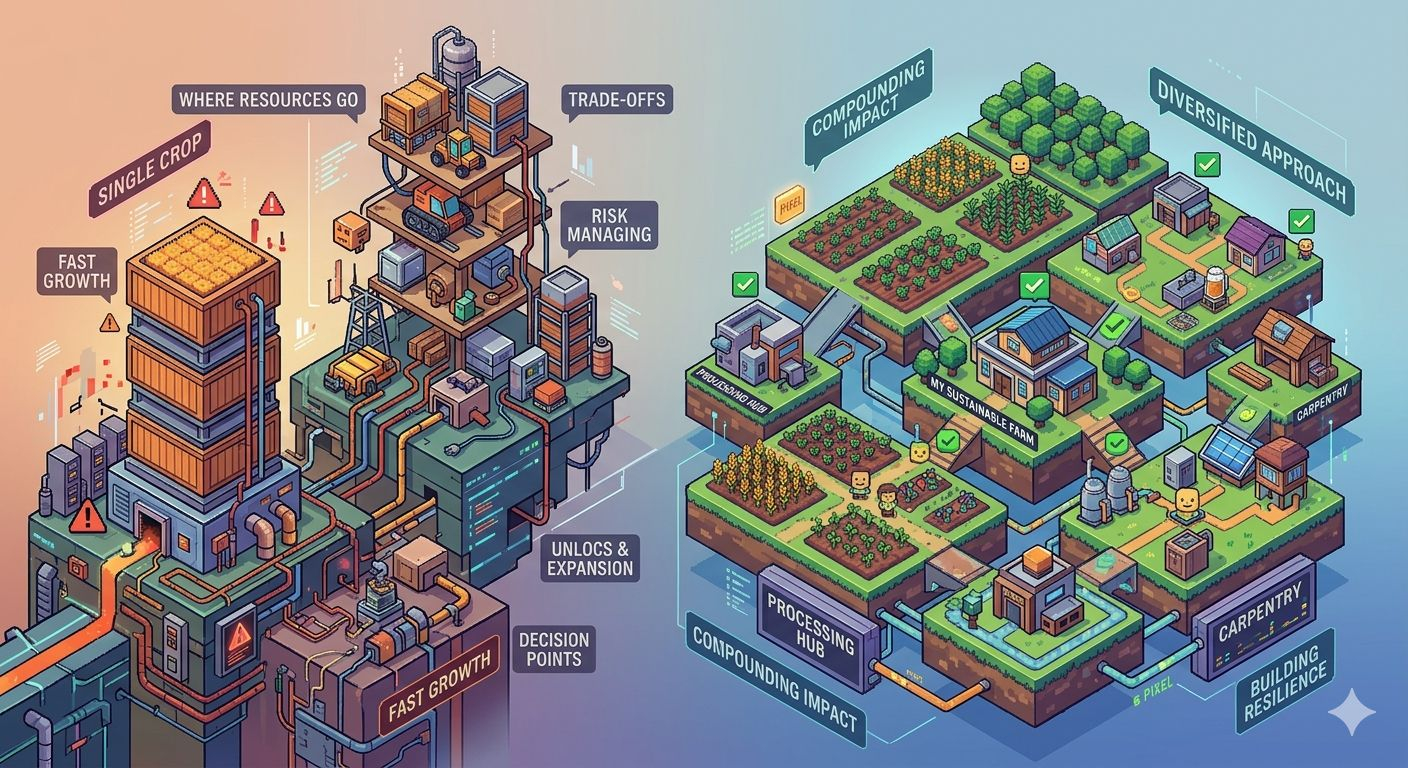
You can expand in different directions. And each direction comes with its own costs, pressure, and future impact.
So instead of just asking “what should I do next?”
You start asking:
“what kind of setup am I building?”
No Clear “Best Way”
In a lot of games, there’s always that one strategy everyone ends up following.
Once people figure it out, the game becomes routine.
You’re not thinking anymore—you’re just repeating.
Pixels doesn’t fully go in that direction.
There isn’t one obvious answer that works for everyone. And because of that, players end up making different choices.
Some move fast but hit pressure later.
Some move slower but feel more stable.
And you can actually feel that difference over time.
What You’re Really Managing
It looks like farming.
But it’s not just farming.
It’s decisions.
Where your time goes.
Where your resources go.
What you choose to build… and what you delay.
Every choice quietly limits something else.
And over time, those trade-offs start to define your experience.
Where $PIXEL Fits In
$PIXEL isn’t just something you earn and forget about.
You keep coming back to it.
Upgrades need it. Expansion needs it. Unlocks need it.
And because players go in different directions, it doesn’t get used in just one place.
It shows up again and again, depending on what you’re trying to do.
That actually makes it feel more connected to your decisions, not just your rewards.
Fast Growth vs Stable Growth
You can push hard in one direction and grow quickly.
A lot of people do that.
But later, things can get harder to manage. Costs stack up.
Returns slow down.
Small problems feel bigger.
Or you can spread things out.
It feels slower at the start.
Maybe even inefficient.
But over time, it becomes easier to handle.
More balanced.
Why the Gap Keeps Growing
What’s interesting is that everyone kind of starts from a similar place.
But slowly, things separate.
Some players (and farmers) keep reacting to what’s happening.
Others start thinking a bit ahead.
And that small difference compounds.
What Actually Makes It Interesting
A system feels deep when your choices matter.
Not just when there are a lot of features.
In Pixels you’re not just following steps.
You’re deciding where things go next.
And once that starts happening, the experience changes.
On the surface
it’s still farming.
But underneath
it’s something else.
It’s about how you manage things over time.
And once you see that, the difference between just playing and actually building something becomes really clear.