
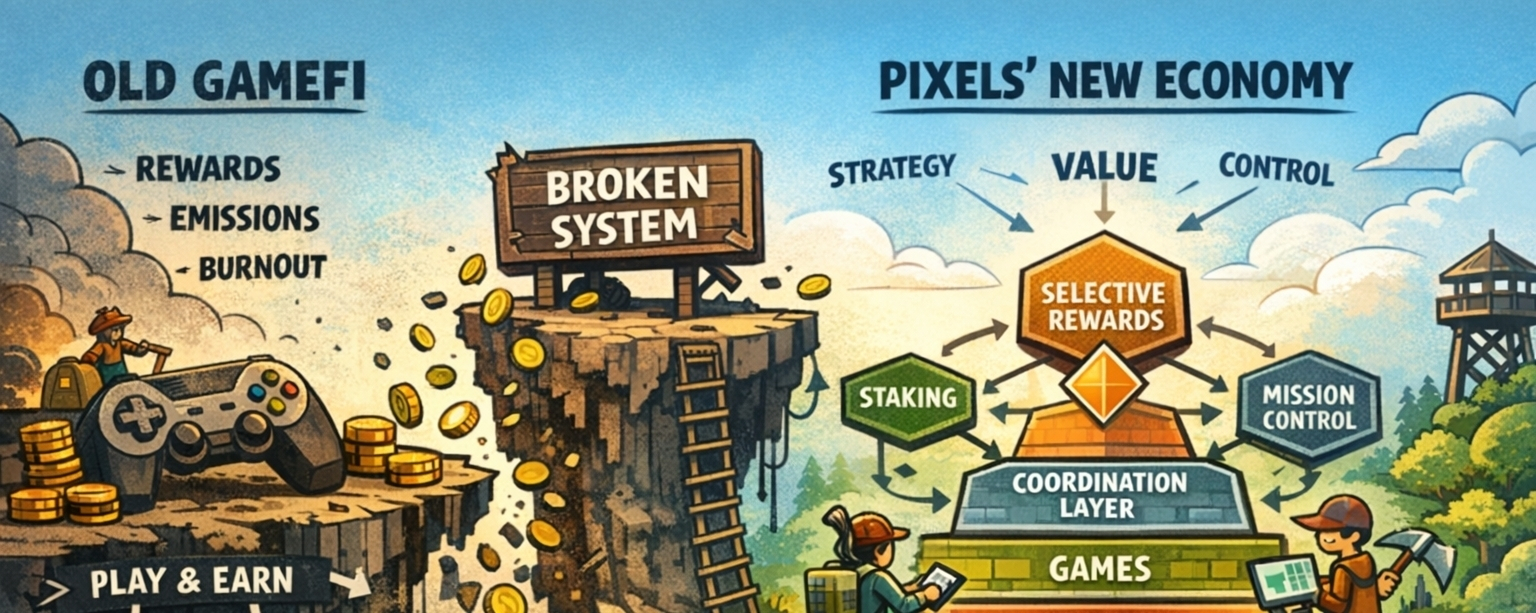

There’s a version of the Pixels economy that sounds clean when explained out loud. Value comes in through play, leaves through intentional costs, and circulates in a way that keeps everything alive without letting anything spiral. It feels composed, almost self-regulating. But that version mostly exists at the level of description. What actually happens is quieter and less settled. The system is constantly being tested by the people inside it, not in dramatic ways, but through repetition, habit, and small optimizations that slowly add up.
Most players don’t think in terms of sinks and faucets. They just notice whether their time feels respected. They notice if effort turns into something that holds its meaning for more than a moment. At the beginning, it usually does. The early loops feel generous enough to pull people in. There’s a sense that if you stay consistent, something accumulates not just resources, but momentum. That feeling is important. Without it, there is no reason to keep showing up.
But that same generosity creates a kind of quiet obligation for the system. Every reward that feels easy today becomes something that has to be managed tomorrow. Players don’t forget what the system once allowed them to do. They build expectations around it. And once expectations settle, even small changes start to feel larger than they are. A faucet doesn’t just produce value; it establishes a rhythm. If that rhythm shifts, people feel it immediately, even if the numbers still technically make sense.
Over time, the way people interact with the system begins to change. What started as play becomes something more deliberate. Players figure out what works, what repeats, what scales. They begin to lean into the parts of the system that give them the most return for the least uncertainty. This isn’t exploitation in a dramatic sense. It’s just what happens when people spend enough time inside a structure they start to see its edges more clearly than the designers can anticipate.
That’s where pressure starts to build. Not all at once, but gradually. Resources move faster in some places than others. Certain paths become more efficient, and once they do, they attract attention. The economy begins to concentrate around what is reliable. At that point, it isn’t just distributing value anymore. It’s shaping behavior in a narrower way than it might have intended.
This is usually when sinks step in more visibly. They are meant to take some of that pressure and redirect it, to keep things from piling up in ways that flatten the experience. But from the player’s side, a sink isn’t just a balancing tool. It’s a moment where the system asks for something back. Sometimes that feels fair, even necessary. Other times it feels like the system is trying to correct itself using the player’s accumulated effort.
The difference between those two feelings is small, but it matters. If a sink feels like part of moving forward, it’s accepted almost without question. If it feels like something standing in the way, it changes how people approach the entire loop. They become more cautious, more selective, sometimes less willing to engage at all. The system can still function, but the tone of participation shifts. It becomes less about exploring possibilities and more about avoiding loss.
What makes this difficult is that both sides—generation and removal depend on each other in ways that are hard to keep aligned. If too much value enters the system, it starts to lose weight. Progress becomes easier, but also less meaningful. If too much is taken out, progress slows to the point where it feels like work rather than movement. The balance isn’t just numerical. It’s emotional. It lives in how people interpret what’s happening to them over time.
And those interpretations don’t stay consistent. Someone who joined early experiences the system differently than someone arriving later. Someone who has already learned the most efficient loops sees opportunities where others see friction. Gradually, the economy stops feeling like a shared space and starts feeling like overlapping versions of the same space. Everyone is playing under the same rules, but not everyone is playing the same game.
At that point, the idea of control becomes less certain. The system still looks structured, but much of what happens inside it is driven by how players adapt to it rather than how it was intended to function. Adjustments can be made—tuning rewards, adjusting costs—but each adjustment carries its own consequences. It fixes one pressure point while quietly creating another. Nothing breaks immediately, but the system becomes more dependent on continuous correction.
That’s where the gap between design and reality becomes more visible. The design suggests a stable loop, something that can be maintained with careful calibration. The reality is a loop that is always slightly out of alignment, always being nudged back into place. The stability isn’t coming from a perfect balance. It’s coming from the system’s ability to keep adjusting without drawing too much attention to those adjustments.
Under calm conditions, that can hold together. The economy feels consistent enough, even if it’s doing more work behind the scenes than it appears. The real uncertainty shows up when the environment changes—when more players arrive, when behavior concentrates, when attention shifts. In those moments, the system is no longer just maintaining balance. It’s responding to stress.
If the underlying structure is strong, those responses feel natural. The economy bends without feeling like it’s being forced. If it isn’t, the responses start to feel visible. Players notice when things tighten or loosen too abruptly. They notice when effort starts to return less than it used to, or when accumulation no longer carries the same meaning. The system doesn’t need to fail outright for confidence to weaken. It just needs to feel slightly out of sync for long enough.
So the question isn’t really whether Pixels has the right mix of sinks and faucets in a static sense. It’s whether that mix can stay believable as people continue to learn, adapt, and push against it. Whether the system can keep translating time into something that feels stable, even as the conditions around it shift.
It may hold, especially if adjustments remain subtle and aligned with how players already want to move through the system. But if the balance starts to rely too heavily on visible correction if it begins to feel like something being maintained rather than something unfolding naturally then the structure may remain intact while the experience slowly changes underneath it. And that’s usually where the real test begins, not in whether the system works, but in whether it still feels like it does.