
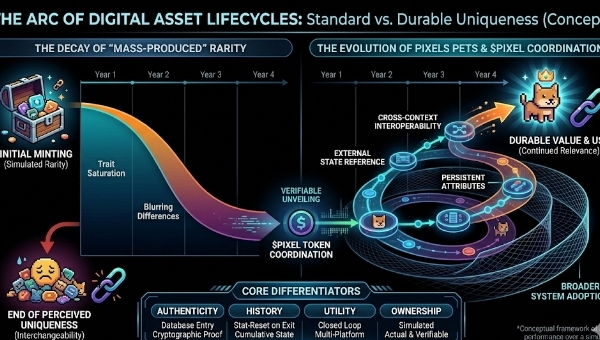
I remember trying to get a “rare” item in a game and realizing, after a while, that rare didn’t really mean anything.
Everyone seemed to have something similar. Maybe not identical, but close enough that it stopped feeling special. You grind, you mint, you open, and eventually the outcome starts to blur. Different labels, slightly different traits, but the experience feels mass-produced.And once that feeling sets in, it’s hard to shake.
At that moment, I realized the problem isn’t just about randomness or rarity. It’s about whether uniqueness actually holds up over time. Not just visually, but structurally. Can something remain distinct in a system that keeps producing more of it?
Most systems don’t really solve that. They simulate uniqueness, but they don’t anchor it anywhere reliable. So over time, everything starts to feel interchangeable, even if technically it isn’t.
That’s where something like @PIXEL started to feel a bit different, even if I didn’t fully understand it at first.
Initially, I thought minting unique pets was just another variation of the same model. Generate traits, assign rarity, let players trade or collect. It felt familiar, maybe slightly refined, but not fundamentally different.
But the more I looked at it, the less it seemed about the pet itself and more about how that pet exists within a system.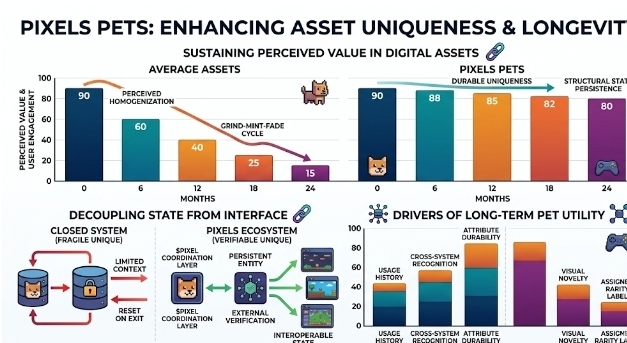
The role of $PIXEL here isn’t just tied to acquiring or minting. It acts more like a coordination layer for ownership and state. When a pet is created, it’s not just an entry in a game database—it’s something that can be referenced, verified, and persisted outside that immediate environment.So uniqueness isn’t just visual. It’s recorded.
Each pet carries a history, a set of attributes, and a state that isn’t easily altered or duplicated without being noticeable. Not because it’s technically impossible, but because the system makes those changes visible.That distinction matters more than I expected.
What I find interesting is that the technology behind it doesn’t need to feel complex to the user. You still go through familiar motions—minting, collecting, interacting. But underneath, there’s a structure ensuring that what you receive isn’t just another copy in a crowded pool.
It’s defined somewhere external. Something other systems could, at least in theory, recognize.Still, I had doubts.
If most players don’t check verification layers or care about how uniqueness is enforced, does it actually change anything? If the experience feels the same on the surface, is this just adding invisible complexity?Initially, it felt like overbuilding for a problem that players had already accepted.
But upon reflection, the difference shows up when systems start to overlap.
If a pet exists only within one game, its uniqueness is limited to that context. But if its state can be referenced outside—if another system can recognize it, interact with it, or build around it—then uniqueness becomes more durable.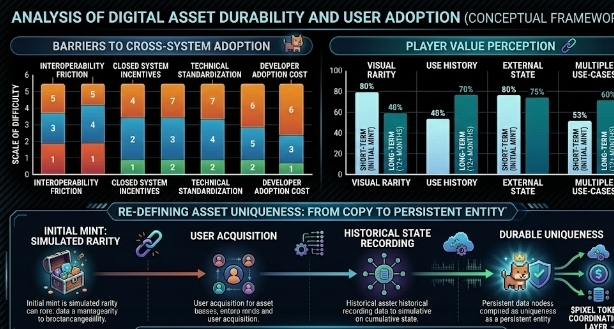
It doesn’t reset when you switch environments.That opens up possibilities that are easy to overlook at first.
You could have pets that evolve across different experiences, not just one. Traits that gain meaning based on how they’re used, not just how they were generated. Ownership that isn’t tied to a single interface, but carried with the user.
And suddenly, minting isn’t just about acquiring something new. It’s about introducing a persistent entity into a broader system.But I don’t think this plays out smoothly, at least not yet.
There’s friction in getting multiple environments to recognize the same assets. Most systems are still closed, optimized for their own internal logic. And even if the infrastructure exists, adoption depends on whether developers choose to build around it.
There’s also the question of demand. Do players actually want pets that persist across systems, or is that value still abstract?Right now, I’m somewhere in between.
I hold a small amount of $PIXEL, mostly to stay connected to how this evolves. I’m not fully convinced that verifiable uniqueness becomes essential, but I can see where it starts to matter if systems begin to rely on it.For me, the signal is simple.
If over time, these pets don’t just exist but get used—if players return to them, if other environments begin to recognize them, if their history actually influences how they’re treated—then the underlying system is doing something real.
Not because it promised uniqueness, but because that uniqueness holds up under repeated use.And that’s the part most systems never quite achieve.