
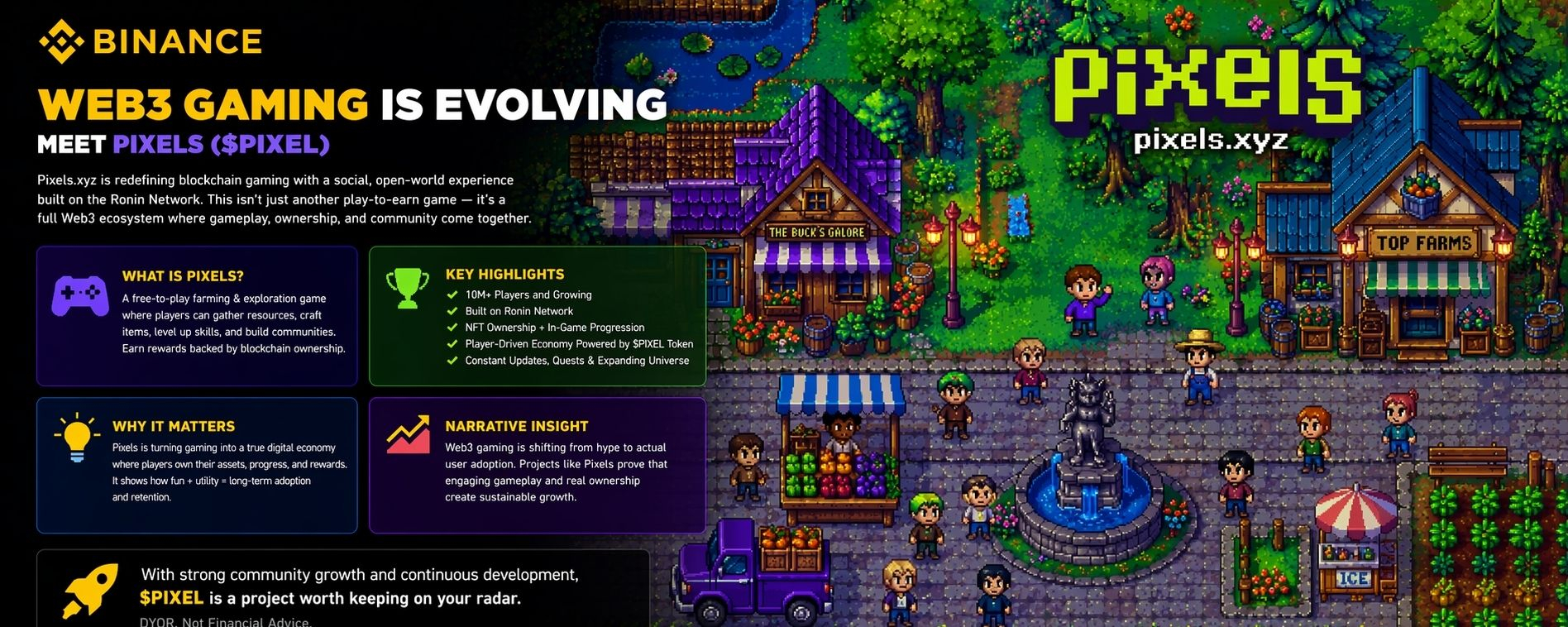
Web3 gaming has spent years trying to prove that it can be more than just hype.
Many early projects focused heavily on token rewards but failed to deliver engaging gameplay, leading to short-lived user interest. Pixels.xyz is part of a new wave attempting to fix that imbalance—by putting gameplay first while still leveraging the benefits of blockchain technology.
At its core, Pixels is a social, open-world farming and exploration game built on the Ronin Network. The game blends familiar mechanics—resource gathering, crafting, land management—with a persistent online world where players interact, collaborate, and compete. What makes it different is not just the mechanics, but how ownership and progression are structured.
Unlike traditional games where in-game items are locked within centralized servers, Pixels introduces true digital ownership. Players can earn, trade, and utilize assets that exist on-chain, giving them more control over their progress and time investment. This model shifts gaming from a closed system into something closer to a player-driven economy.
One of the biggest signals of Pixels’ success is its scale. The platform has attracted millions of users, a rare achievement in Web3 gaming, where most projects struggle to retain active players. This growth suggests that Pixels is tapping into something important: users are more likely to stay when the game is genuinely enjoyable, not just financially incentivized.
The integration with the Ronin Network is another strategic advantage. Ronin, known for powering Axie Infinity, is optimized for gaming with low transaction costs and fast processing. This allows Pixels to deliver a smoother experience compared to many blockchain-based games that suffer from lag and high fees. Infrastructure matters, and Pixels benefits from being built on a network designed specifically for this purpose.
The in-game economy revolves around the $PIXEL token, which acts as a utility and reward mechanism. Players can earn tokens through gameplay, use them within the ecosystem, or trade them externally. However, unlike earlier play-to-earn models that collapsed due to unsustainable token inflation, Pixels appears to be moving toward a more balanced system where engagement drives value, not just emissions.
Another key strength is its community-driven design. Pixels isn’t just a solo experience—it’s built around interaction. Players can own land, create spaces, and contribute to a shared world. This social layer increases retention because users are not just playing a game—they are participating in a digital society.
From a broader perspective, Pixels reflects a shift in the Web3 gaming narrative. The industry is moving away from pure speculation and toward usable, scalable products. The focus is no longer just on earning tokens, but on building ecosystems where players actually want to spend time.
That said, challenges remain. Web3 gaming still faces barriers such as onboarding complexity, regulatory uncertainty, and long-term economic sustainability. Pixels has made progress, but its future success will depend on how well it continues to balance fun, accessibility, and economic design.
In many ways, Pixels.xyz represents what Web3 gaming was originally supposed to be: a space where players have ownership, economies are open, and gameplay is engaging enough to stand on its own. Whether it becomes a long-term leader or just another phase in the evolution of blockchain gaming will depend on execution—but for now, it’s one of the clearest examples that the model can work when done right.
DYOR before investing. This is not financial advice.