
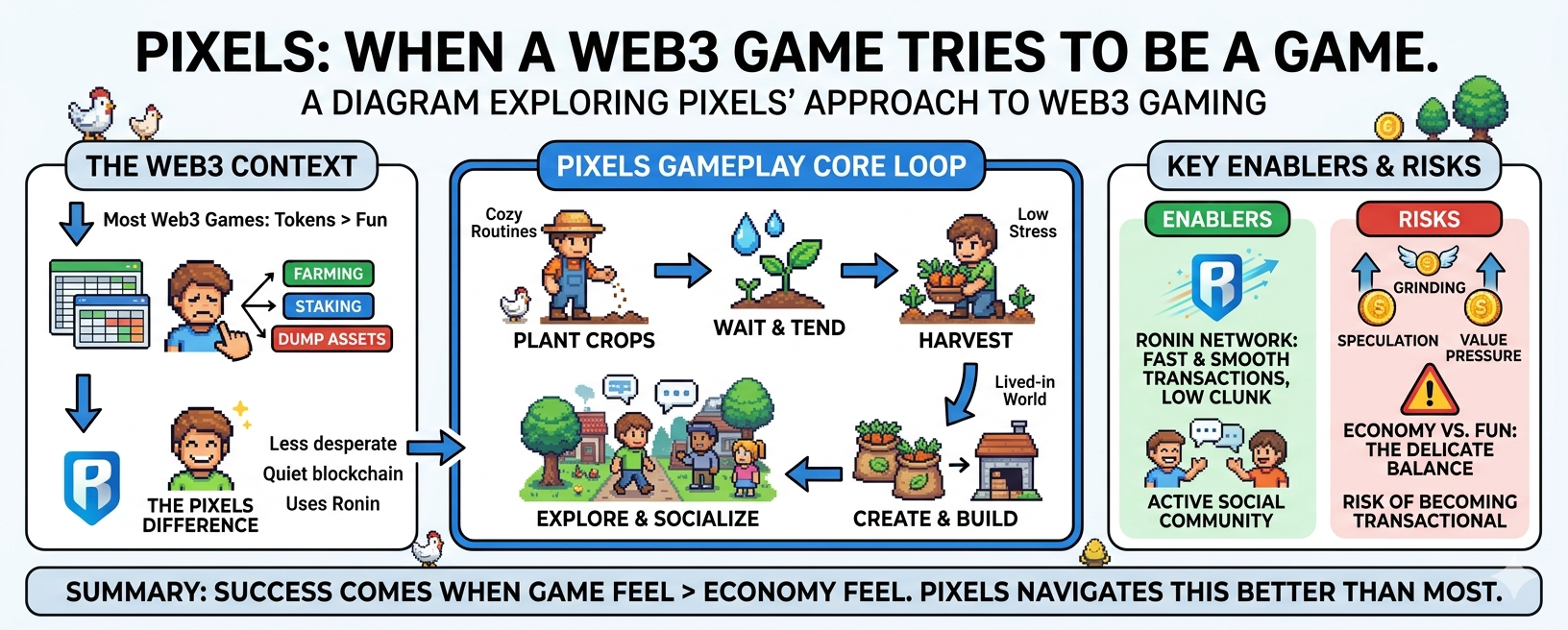

Most Web3 games have the same problem. They care more about tokens than fun. You load in and it feels like someone built a spreadsheet slapped a market on top and then called it a game. Everything is about earning staking flipping farming rewards and pretending that clicking buttons is somehow a revolution. It gets old fast. Real fast. A lot of these projects talk big promise big and then deliver a dead world with bad gameplay and a bunch of people trying to dump assets on each other.
That’s the mess Pixels walks into.
And to be fair it still has some of the same baggage. It’s a Web3 game. It runs on Ronin. There are digital assets in game value and all the usual stuff that makes normal people roll their eyes the second they hear the words blockchain gaming. I get it. I’m tired of it too. Most of the time the tech gets pushed so hard that the actual game disappears under it. You’re not playing. You’re managing wallet friction and pretending it’s entertainment.
Pixels does not fully escape that. But it handles it better than most.
The first thing that stands out is that it doesn’t feel desperate. That matters. It doesn’t hit you over the head with crypto talk every five seconds. It doesn’t seem obsessed with proving that it’s the future of gaming. It just lets you walk around plant stuff gather resources explore and mess with the world a bit. That sounds basic because it is. But basic is fine. Better than fine actually. Basic is good when the rest of the space is full of broken promises and fake excitement.
The game is built around farming exploration and creation. And yeah that sounds simple. Because it is simple. You plant crops. You wait. You harvest. You move around the map. You run into other players. You collect things. You build up your little routine. That’s the loop. No magic trick here. No need to fake depth where there isn’t any. The weird part is that this works better than a lot of bigger ideas because at least it knows what it is.
Farming is the center of it. Not in some deep simulation way. More in a steady low stress log in and do your thing kind of way. You plant harvest repeat. It gives the game structure. It gives people a reason to come back. It’s not thrilling. It’s not meant to be. It’s more like background comfort. That’s probably why it sticks. Not every game needs to feel like a boss fight or a job interview.
Exploration helps a lot too. The world has that open social MMO feel where half the point is just moving around and seeing what’s going on. Not because there’s some huge mystery around every corner but because a shared space always feels better when it has people in it. That’s one thing Pixels gets right. It feels lived in. Not perfect. Not super deep. Just active enough to feel like you’re not alone in some empty tech demo.
And then there’s the creation side of it. That part matters more than people think. A game like this needs players to shape the space not just consume it. Otherwise it turns into another shallow loop where you click collect and leave. Pixels works better when people treat it like a world instead of a reward machine. The problem is that Web3 games always struggle here because once money gets involved people stop acting like players and start acting like grinders. Or speculators. Or both.
That’s still a problem in Pixels.
You can feel it under the surface. Even when the game looks chill there’s always that other layer hanging around in the background. What is this item worth. What should I farm. What’s efficient. What’s the best route. How do I make this time count. That kind of thinking shows up fast when a game has any kind of economy attached to it. Suddenly people stop asking is this fun and start asking is this worth it. That’s when things usually go bad.
Because games built around value can end up feeling weird. Not broken exactly. Just off. Like every action has this extra weight on it that doesn’t need to be there. You’re not just planting crops. You’re thinking about yield. You’re not just exploring. You’re thinking about resources. You’re not just playing with other people. You’re sizing up market behavior whether you mean to or not. That can suck the life out of a game if it gets too strong.
Pixels avoids the worst version of that by keeping the blockchain side quieter than usual. That’s probably one of its smartest choices. Ronin does a lot of the heavy lifting here. The network is fast enough and smooth enough that the game doesn’t constantly trip over itself trying to process basic actions. That sounds like a low bar and honestly it is but in Web3 gaming a low bar still knocks out half the field. If the tech is annoying the whole thing falls apart. People do not want to fight wallets and transaction screens just to water imaginary crops.
Ronin helps Pixels feel less clunky. Less interrupted. Less like homework.
That doesn’t mean the tech disappears. It just stays out of the way more often which is exactly what it should do. Nobody should be praising the plumbing every five minutes. The pipes are supposed to work. That’s it. If the network does its job players can focus on the actual world instead of the system under it. Weirdly enough that alone makes Pixels feel more normal than most games in this space.
And that’s probably why some people who normally hate crypto games can tolerate this one. Maybe even like it a little. Not because it suddenly fixes every problem but because it remembers that games need texture routine and social life. They need something beyond price talk. Pixels has that. At least more than most.
The social side is a bigger deal than it looks. On paper it might sound minor. People walking around chatting trading hanging out. But that stuff is usually the difference between a game feeling alive and feeling dead. You can have all the token systems in the world but if the space feels empty nobody cares. Pixels works because people actually show up and do things together even if those things are small. A little trading. A little farming. A little nonsense. That matters. It makes the whole thing less sterile.
Still let’s not pretend this solves the bigger issue with Web3 games. The second real money touches a system it changes the mood. Every time. It attracts people who don’t care about the game. It pushes players toward efficiency. It creates pressure. Then come the balance problems the speculation the community drama the weird economy swings and the usual cycle where everyone acts like they are early until they are not. That risk never really goes away. Pixels is not above that. It’s just better at hiding the smell.
And maybe that sounds too harsh but come on. We’ve all seen how this goes. A project starts off talking about community and gameplay. Then numbers become the story. Then everything becomes about retention extraction token sinks and trying to stop the whole thing from collapsing under its own incentives. That’s the cloud hanging over every game like this. Pixels included.
So the real question is not whether Pixels is perfect. It’s not. The real question is whether it can stay fun while carrying all this extra economic weight. That’s harder than it sounds. Maybe impossible long term. I don’t know. A lot of games have tried to balance fun and financial systems and most of them end up leaning too far one way. Either they become boring because the money stuff takes over or the money side weakens and people lose interest because they were never there for the game in the first place.
Pixels is stuck in that same fight.
But it does have one thing going for it. It understands that people like routine. People like social spaces. People like simple loops they can settle into. There is value in that real value and not just the market kind. Logging in checking your farm moving around a familiar world seeing other people do their thing that can be enough. It does not need to pretend to be changing the world. It just needs to work. That’s the bar. Just work. Be stable. Be easy to get into. Don’t waste people’s time.
That sounds obvious but a lot of projects still fail at exactly that.
Pixels feels like a game that learned from watching other Web3 games embarrass themselves. It keeps things smaller. Softer. Less pushy. It doesn’t scream at you about ownership or decentralization like those words alone are supposed to carry the whole experience. Good. They shouldn’t. Most players do not care about the ideology. They care if the thing is boring. They care if it breaks. They care if it feels like a scam wrapped in pixel art.
Pixels mostly avoids that feeling. Mostly.
It still has the same core risk. If too much attention shifts toward extracting value the whole mood changes. The farming stops feeling cozy and starts feeling mechanical. The world stops feeling social and starts feeling transactional. The little routines that make the game pleasant start turning into labor. That line is thin. Really thin. Once a game crosses it getting back is hard.
So yeah Pixels is better than a lot of the junk in Web3 gaming. That’s true. But the bar is in hell so let’s not throw a parade. What it does well is pretty simple. It gives players a world that feels usable. It builds around farming exploration and creation without drowning the whole thing in hype. It uses Ronin in a way that supports the game instead of constantly interrupting it. It leaves enough room for players to just exist in the space without making every second feel monetized.
That alone makes it stand out.
Not because it’s some masterpiece. Not because it’s the future. Just because in a space full of loud broken nonsense Pixels at least seems to understand one basic thing. If you want people to stay the game has to feel good before the economy does. Not after. Before.
And honestly that should not be a radical idea. But here we are.
