
Look, we need to talk about Pixels. I’ve been watching this project simmer for a while now, initially on Ethereum before it made the inevitable leap to the Ronin Network, and I have to tell you, the chatter is getting loud. It is being pitched as the salvation of Web3 gaming, a "social casual" experience that supposedly bridges the gap between the crypto-obsessed and the average person who just wants to farm virtual turnips. The market is paying attention because, frankly, it has volume. In a sector starved for users who aren’t just bots clicking for crumbs, Pixels has managed to create a bustling, seemingly active economy. But let’s sit here with our coffee and be honest about what we are actually looking at. I have seen this movie before, usually with a different script but the same ending.
The core problem Pixels claims to solve is the sheer hostility of Web3. Most crypto games are dreadful. They are spreadsheets dressed up in low-resolution art, demanding you connect a wallet, sign seventeen transactions, and pay gas fees just to move a sword from one slot to another. Pixels promises a smoother onboarding ramp, an "open-world" farming and exploration game that hides the blockchain plumbing under the hood. It sounds tidy. On paper, at least. The industry is desperate for a "Blue Ocean" strategy, a way to bring the masses in without scaring them off with private keys and seed phrases the moment they land on the homepage. Pixels positions itself as that welcoming front porch.
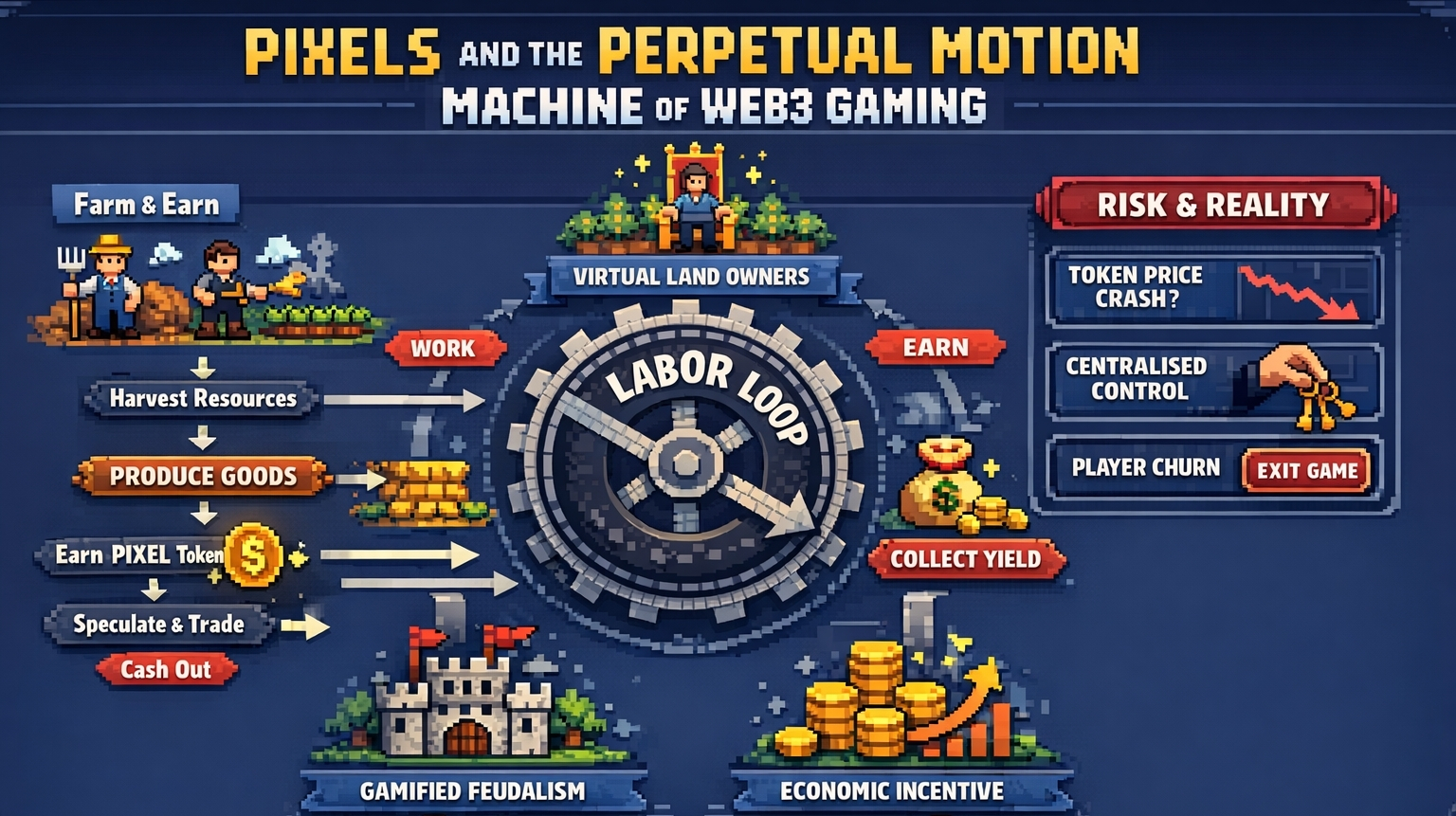
But what most people miss, or perhaps wilfully ignore, is that the "casual" label is doing a lot of heavy lifting here. When you peel back the marketing, the deeper idea isn't really about farming or social connection. It is about labour arbitrage. In traditional gaming, you pay for entertainment. In Web3 gaming, the game tries to make you work for it. The mesmerising open-world described in the whitepapers is essentially a digital factory floor dressed in pixel art. Players are not just engaging with a game loop; they are engaging with a series of repetitive tasks designed to extract value from their time in exchange for speculative tokens. The "social" aspect is merely the coordination layer for this labour. It is clever, certainly, but let’s not confuse it with the kind of emergent gameplay you find in a truly immersive RPG.
To understand how the system actually works, you have to look past the cute graphics. It operates on a resource management loop where time equals tokens. You farm, you harvest, you craft. The architecture relies heavily on the Ronin Network, an EVM-compatible chain built specifically for Axie Infinity and its ilk. By moving there, Pixels solved the immediate friction of Ethereum’s gas fees, which were strangling micro-transactions. The identity layer is your wallet, but the verification layer is the game client itself, tracking your actions and writing them to the blockchain only when necessary—or when a trade occurs. It functions, technically speaking. But the reliance on a specific chain like Ronin creates a walled garden. You are not really owning assets in a broad, interoperable sense; you own assets inside a specific arcade that happens to run on a blockchain.
The economic layer is where the skeptic in me really perks up. We need to talk about the PIXEL token. In a functioning economy, currency represents a claim on real resources or labour. Here, the token acts as the glue for a circular economy that relies heavily on new entrants to pay the bills of the old ones. You use tokens to speed up actions, buy decorations, or upgrade land. It is a consumption model. The problem is that the primary reason most people acquire these tokens is not to consume them for fun, but to speculate on their future value. When the token price dips, the "fun" of the game evaporates because the economic incentive collapses. The token is meant to be fuel, but in reality, it is the only reason 90% of the players are there. It is an elaborate mechanism for transferring value from late adopters to early adopters, disguised as a gameplay feature.
Where the model gets interesting, and admittedly where the designers showed some savvy, is the land ownership mechanic. By allowing players to own land and become the "employers" of other players who farm on their plots, Pixels creates a proto-feudal system. It gamifies the landlord-tenant relationship. This is the design decision that separates it from the mindless clickers of the last bull run. It creates a hierarchy where you don’t just play; you manage. However, this also exposes the centralisation risk. The game servers are centralised. The development team is centralised. If the team decides to change the drop rates of resources or the energy cost of actions, your "investment" in that land can be rendered worthless overnight. You are playing in someone else's kingdom, and they hold the admin keys.
The hard problem here isn't technical; it is psychological. The biggest challenge Pixels must solve is the retention of players when the yield goes to zero. In a traditional game, like the Stardew Valley that Pixels clearly draws inspiration from, players stick around because the gameplay itself is rewarding. In a Web3 game, history shows us that players leave in droves the moment the Return on Investment (ROI) dips below minimum wage. The team is trying to pivot towards a model where the game is actually fun, launching new features and mini-games to keep people engaged. But they are fighting against the very financialisation that brought them their initial success. It is a tightrope walk. If the economy is too generous, the token inflates to zero. If it is too strict, the players abandon ship.
Let’s do a reality check. The narrative suggests Pixels is the future of gaming. I would argue it is more like a highly efficient, gamified day-trading platform. The success of this project will not depend on how charming the pixel art is or how low the gas fees are on Ronin. It will depend on whether the token can sustain value without an endless stream of new money entering the system. That is the definition of a speculative mania. When the hype cycle turns, and it always does, the "mesmerising open-world" is going to feel very empty. The infrastructure works, the tokenomics are clear, but the foundation is built on the assumption that people will always be willing to pay for the privilege of doing digital chores. That is a bet I wouldn't take with your money.