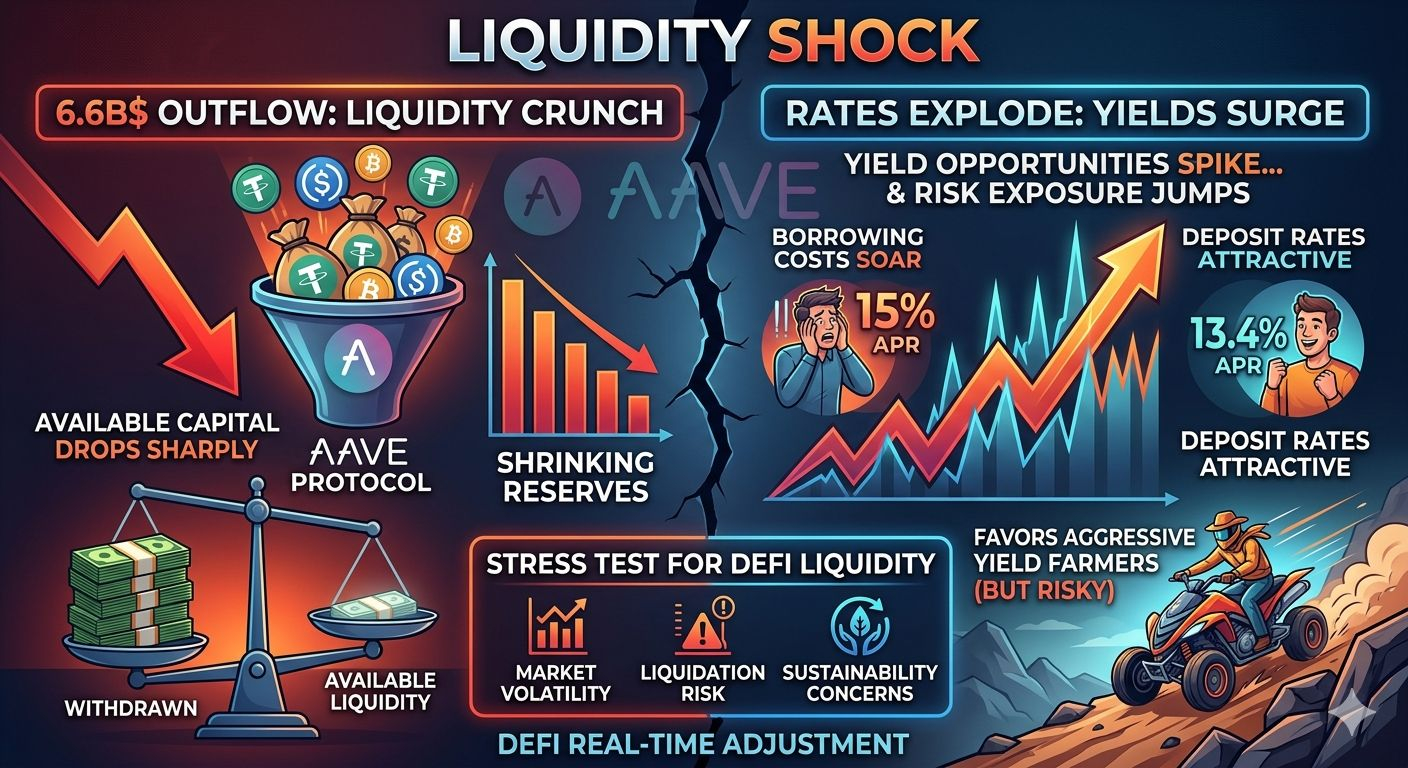
In a dramatic turn for decentralized finance, lending giant Aave has witnessed an enormous capital outflow, shaking liquidity conditions across its markets and sending interest rates soaring.
According to on-chain analyst EmberCN, approximately $6.6 billion has been withdrawn from the protocol within a single day — a move significant enough to ripple across the entire DeFi ecosystem. Notably, nearly $3.3 billion of that withdrawal consisted of stablecoins such as USDT and USDC, assets that typically provide stability and deep liquidity to lending platforms.
What Just Happened? 🔍
This isn’t just a routine withdrawal — it’s a liquidity shock event.
When large amounts of capital exit a lending protocol like Aave:
Available liquidity drops sharply
Borrowing demand remains or increases
Interest rates automatically adjust upward
As a result, Aave’s algorithmic rate model reacted instantly.
Rates Explode — Opportunity or Warning? ⚡
Following the withdrawals:
Stablecoin deposit rates surged to ~13.4%
Borrowing rates jumped to ~15%
This creates a rare scenario where yield opportunities spike rapidly, but so does the risk exposure.
For lenders, higher deposit rates may seem attractive — offering double-digit returns on stable assets. But for borrowers, the cost of capital has become significantly more expensive, potentially leading to forced position adjustments or deleveraging.
Who Benefits — and Who Should Be Careful? 🧠
This environment favors a very specific type of participant:
Aggressive DeFi yield farmers.
Those willing to:
Take on elevated borrowing costs
Rotate liquidity quickly
Exploit rate inefficiencies across protocols
…may find short-term opportunities in this volatility.
However, this is not a low-risk environment.
Hidden Risks Beneath High Yields ⚠️
While the headline numbers look appealing, there are deeper concerns:
✔️ Liquidity Fragility
Large withdrawals can reduce market depth, increasing volatility.
✔️ Rate Instability
Yields at these levels are often unsustainable and can normalize quickly.
✔️ Liquidation Cascades
Higher borrowing costs may pressure leveraged users, increasing liquidation risks.
✔️ Market Sentiment Shift
Such large outflows can signal caution or repositioning by major players (“smart money”).
Bigger Picture 🌐
Events like this highlight the core nature of DeFi — fully transparent, but highly reactive.
Unlike traditional finance, where changes unfold slowly, DeFi markets adjust in real-time. Capital flows dictate conditions instantly, and opportunities often come paired with equal or greater risk.
Final Take 💡
This isn’t just a spike in yields — it’s a stress test for DeFi liquidity dynamics.
For experienced participants, this could be a window to capitalize on inefficiencies. For others, it’s a reminder that high returns in DeFi rarely come without elevated risk.
As always in crypto:
Follow the liquidity, respect the volatility, and never ignore the risk behind the reward.
#BitcoinPriceTrends #BTC #ETH #AAVE #crypto