
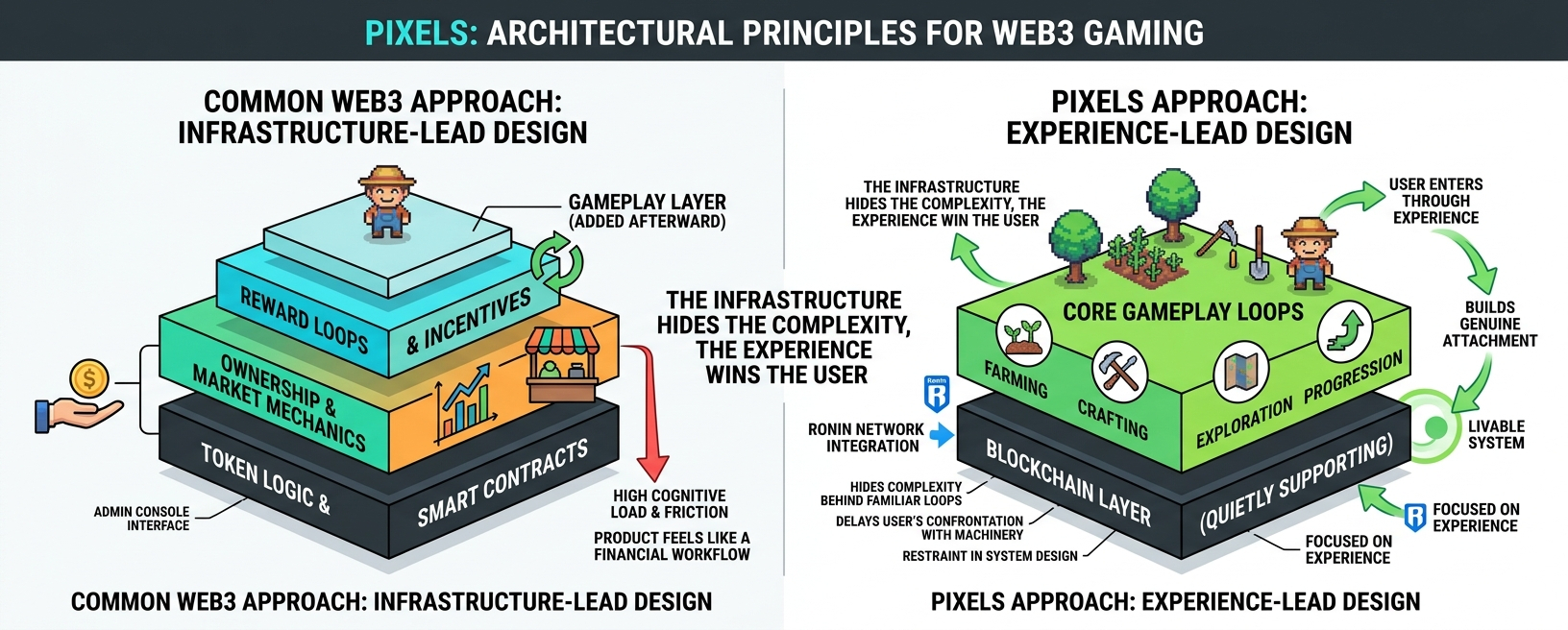

Pixels is one of those projects I keep coming back to, not because I buy the usual Web3 game narrative, but because it exposes a real infrastructure problem: how do you build a system with blockchain in the stack without making the user suffer for it
That sounds obvious. It usually is not
Most Web3 games I’ve looked at over the past few years make the same architectural mistake. They start with token logic, ownership models, marketplace mechanics, and reward loops, then try to wrap a game around the whole thing afterward. I’ve seen this fail. Repeatedly. The result is usually a product that behaves more like a financial workflow than an actual game. The interfaces are noisy, the onboarding path is brittle, and the gameplay loop feels like a thin translation layer for an economy nobody has properly stress-tested
Pixels takes a different route, and that alone makes it worth examining
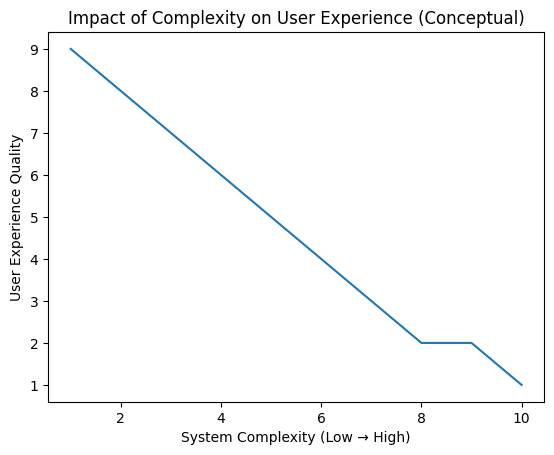
On the surface, it is a casual social game built around farming, exploration, crafting, progression, and a persistent world. That description is almost too clean, but the design choice behind it is the important part. The game starts from familiar interaction patterns. Plant something. Gather something. Build something. Come back later. Repeat. Those loops are well understood because they work. They reduce cognitive load, create habit, and give players a reason to return that is not purely financial
That matters more than most teams in this space seem willing to admit
If a player’s first experience is wallet friction, token confusion, or marketplace dependency, the system is already losing. Nobody cares how elegant the backend is if the front-end experience feels like an admin console with trees and crops painted on top. Games are ruthless that way. They expose bad infrastructure decisions very quickly. A player does not need to understand distributed systems to know when a product is asking too much from them
Pixels seems to understand that the blockchain layer should not lead the interaction. It should support it. Quietly
That is a better architectural instinct than a lot of “next-generation” platforms have shown. The industry keeps producing grand solutions to problems users never asked to have. More token layers. More asset abstractions. More governance logic. More complexity presented as empowerment. It is a mess. Most of it increases the operational burden on the user while pretending to increase flexibility. In practice, it often just widens the gap between what the system can theoretically do and what a normal person will actually tolerate
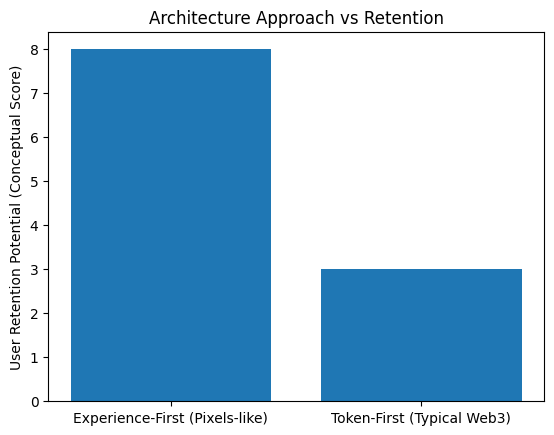
Pixels avoids some of that by leaning into restraint. It presents as a world first. A system second. That ordering is not cosmetic. It changes the entire adoption curve
The move to Ronin made that even more interesting. Ronin is one of the few networks where gaming is not an afterthought bolted onto a general-purpose chain. That does not make it magically clean. Nothing in this space is clean. But it does mean the infrastructure has at least been shaped by the right category of pain. Networks mature when they are forced to handle real usage, uneven demand, asset movement, and the awkward edges of consumer behavior. Ronin has been through enough of that to be useful, even if the ecosystem still carries the usual baggage that comes with crypto platforms
Pixels stepping into that environment made sense. The game needed a chain that understood gaming workloads and gaming users. Ronin needed something that felt less like recycled speculation and more like a product people might actually spend time inside. That combination gave both sides a lift. But it also introduced the same question that always shows up once the early excitement fades: are users here because the system is genuinely good, or because the incentives are temporarily attractive
That is where things usually get interesting, and not in a good way
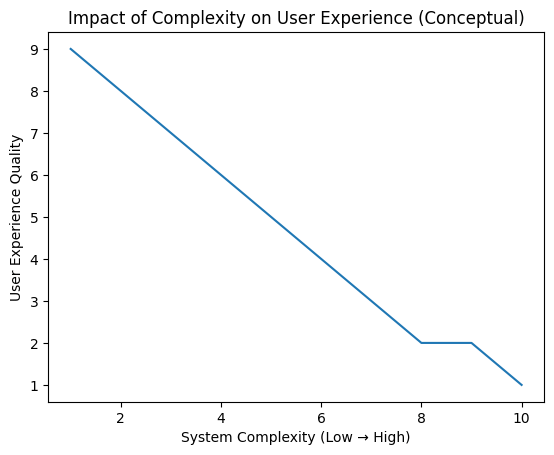
A lot of blockchain games can generate activity. That has never been the hard part. Reward a behavior strongly enough and users will show up. Wallet counts go up. Transactions spike. Dashboards look impressive. Then the system begins to reveal what it was really optimized for. If most of the activity is tied to extraction rather than engagement, the numbers stop telling a useful story. They are not fake, exactly. Just shallow. The reality is messier than the metrics deck suggests
Pixels has had to deal with that same tension in public. Good. More teams should
I am less interested in whether a project can generate growth than in whether it can survive normalization. That is the real systems question. What happens when the novelty drops, reward sensitivity increases, and users start making quieter, more rational decisions about whether the product deserves their time? That is when architecture shows up. Not just technical architecture, but behavioral architecture. What does the system reward? What does it tolerate? What kind of user does it keep
Those questions matter because every extra layer in a Web3 product adds a failure mode. Wallets interrupt flow. Tokens distort incentives. Ownership systems complicate progression. Marketplaces leak speculation into core design. Governance mechanics arrive too early and solve nothing. I have watched teams stack these elements together and call it ecosystem design. Most of the time it is just unresolved product architecture with better branding
Pixels is still exposed to those risks. It is not exempt. But it does something smarter than most of its peers: it hides the complexity behind familiar loops and delays the user’s confrontation with the machinery. That buys time. Sometimes that is enough to build real attachment. Sometimes it just postpones the reckoning. Either way, it is better than shoving every system into the player’s face on day one and calling the friction “education
I also think there is a broader lesson here for anyone building consumer infrastructure. The systems that win are usually not the ones that advertise their depth most aggressively. They are the ones that make complexity feel distant. Stable systems do not constantly remind users how much is happening underneath. They let people do the obvious thing without needing a diagram
That is where Pixels feels more mature than a lot of the category
Not because it solved Web3 gaming. It did not. Not because its model is perfect. It is not. But because it appears to understand a basic rule that a surprising number of teams still ignore: users do not adopt infrastructure. They adopt experiences. Infrastructure only matters if it improves the experience without demanding constant attention in return
That sounds simple. It is not simple to execute
I’ve seen technically capable teams fail here because they fell in love with architecture and forgot to build a product. I’ve seen game teams fail because they accepted a broken economic model in exchange for fast growth. I’ve seen platforms try to solve retention with more mechanics, more rewards, more token layers, when the actual problem was that the core interaction loop was thin and nobody really wanted to come back
Pixels, for all its imperfections, seems closer to the right stack order. Experience first. Infrastructure underneath. Economics carefully constrained, or at least kept from swallowing the product whole. That is not flashy. It is just disciplined. And in this space, discipline is rare enough to stand out
So yes, I pay attention to Pixels. Not because I think it represents the future in any final sense. That kind of language usually ages badly. I pay attention because it shows what happens when a team stops trying to impress users with the system and starts trying to make the system livable. That is a much harder problem. It is also the only one that matters
