

I didn’t think much about Pixels at first.
It just felt like another Web3 game doing its thing—farm a bit, explore, collect resources, earn some PIXEL. The usual loop. Nothing surprising there.
But after sitting with it for a while, something about it started to feel… slightly off. Not in a bad way—just different in a way that’s hard to explain directly.
It doesn’t feel like the game is only rewarding effort.
And I don’t mean that in the obvious sense like “some players are better than others.” It’s more subtle than that. It’s almost like the game pays attention to how you behave over time, not just what you do in a single session.
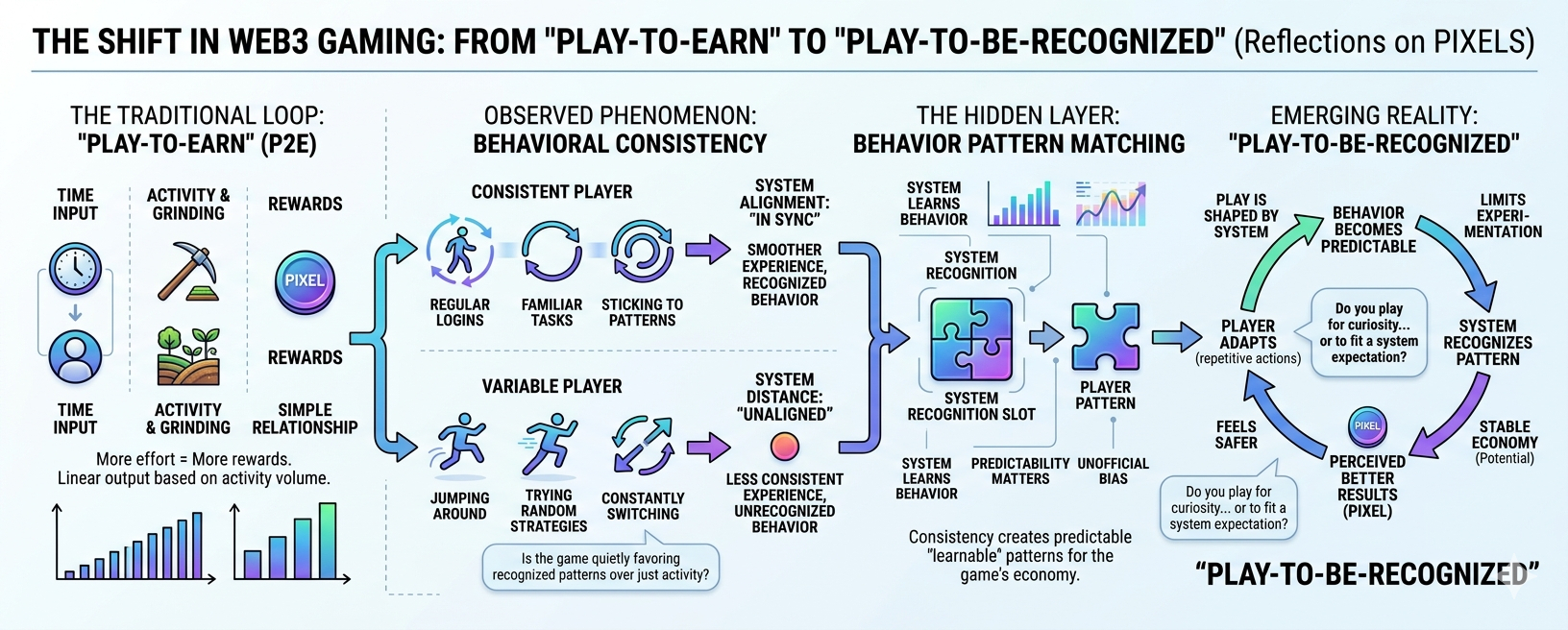
Like… if you tend to play in a certain rhythm—logging in at similar times, doing familiar tasks, sticking to patterns—you start to feel more “in sync” with the system. Not because the game tells you that, but because things just seem to… work out more smoothly.
At first I thought I was imagining it.
But then I started noticing how different styles of play feel. If you jump around a lot, try random strategies, or constantly switch what you’re doing, it doesn’t always feel like the game responds the same way. Not worse, exactly—just less… aligned.
That’s when it started to click for me.
Maybe the game isn’t treating all activity equally. Maybe it’s quietly favoring behavior it can recognize.
And that’s a strange idea, because most GameFi systems I’ve seen are pretty blunt. They don’t really care how you play, as long as you’re active. More time, more grinding, more rewards. Simple.
But this feels different.
It feels like there’s an invisible layer where consistency matters. Where being predictable—having a pattern the system can “learn”—might actually matter more than just doing more.
If that’s even partly true, then PIXEL starts to feel less like a basic reward token and more like something else. Almost like it’s tied to how well your behavior fits into the game’s expectations.
Not officially. Not in a way anyone explains.
Just… in the way things seem to play out.
And I don’t know how to feel about that.
On one hand, it could make the whole system more stable. If the game leans toward players who behave consistently, then maybe it avoids some of the chaos that usually comes with Web3 economies. It might even feel better for people who naturally fall into routines.
But on the other hand, it makes me wonder what happens to experimentation.
If you slowly realize that certain patterns “work,” do you stop trying new things? Do you start playing in a way that feels less like curiosity and more like… fitting into something?
And the tricky part is, you’re never fully told what that “something” is.
So you adjust. You repeat what seems to go well. You drop what doesn’t. And over time, your playstyle becomes a little more predictable—not necessarily because you want it to, but because it feels safer.
That’s the part I can’t quite shake.
Because it suggests the game isn’t just rewarding play—it’s shaping it.
Maybe not intentionally. Maybe it’s just what happens when behavior meets an economy.
But either way, it feels like a shift.
We used to talk about play-to-earn like it was straightforward: put in time, get rewarded.
Now it feels a bit different.
Like the real question isn’t how much you play… but whether the way you play is something the system has learned to recognize.
And if that’s where things are heading, then maybe we’re moving toward something quieter, and a little harder to define.
Not just play-to-earn.
More like… play-to-be-recognized.