
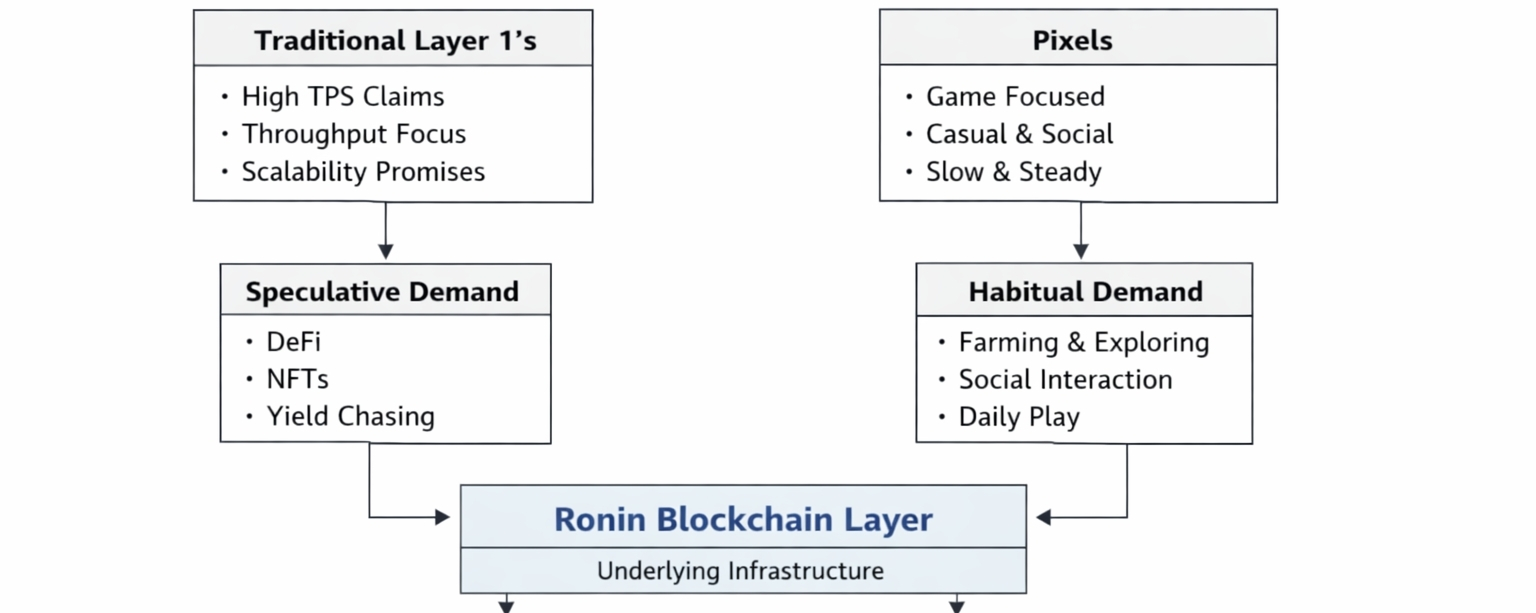
Pixels, if you just stumble into it without context, doesn’t really feel like a Layer 1 at all. It feels like a game first. A quiet one. Farming, wandering around, figuring things out at your own pace. There’s no immediate pressure to understand what chain you’re on or why it matters. And that’s kind of the strange part. Most projects in this space lead with infrastructure, with big claims about throughput and modularity and whatever the current narrative happens to be. Pixels doesn’t. It sort of pulls you in sideways. You’re already interacting with it before you even think about the underlying system.
After a while, though, you realize that this is sitting on top of something bigger. It’s tied into Ronin, which has its own history, its own cycles of hype and stress and recovery. And then the usual question creeps in: is this actually trying to behave like a Layer 1, or is that just a label we’re forcing onto it because we don’t know where else to place it?
There’s a kind of fatigue that comes with that question. Every year there’s a new batch of “next generation” chains. Faster, cheaper, more scalable, more aligned with whatever narrative is trending at the time. AI gets stapled onto it now, whether it makes sense or not. You start to notice the pattern after a while. The language changes slightly, the pitch decks get cleaner, but the underlying promise is always the same. This time it works. This time it scales. This time people actually show up.
And the thing is, scaling isn’t really a theoretical problem anymore. We’ve seen what happens when usage hits. Systems don’t fail in whitepapers. They fail when real people start doing messy, unpredictable things at the same time. Transactions pile up, fees spike, interfaces lag, assumptions break. That’s the part you can’t simulate properly. It’s not about whether a chain can process X transactions per second in a controlled environment. It’s whether it can survive actual behavior.
Even something like Solana, which in good conditions feels incredibly smooth, has had moments where that smoothness cracks under pressure. Not constantly, not disastrously every time, but enough to remind you that performance claims are always conditional. They depend on the exact shape of demand, not just the volume of it.
Pixels seems to quietly sidestep that conversation. It doesn’t position itself as the ultimate infrastructure layer. It doesn’t try to win on raw technical comparisons. Instead, it leans into something simpler, almost obvious in hindsight: give people a reason to be there that has nothing to do with the chain itself. The farming, the exploration, the social layer — those aren’t just features, they’re a kind of buffer. They slow things down. They shape how users interact with the system.
That might be the real insight here, if there is one. Not that you need a better blockchain, but that you need a different kind of demand. Something less spiky, less speculative, more habitual. Most chains are built assuming chaotic bursts of activity. Pixels seems to assume the opposite — that people will log in, do small things, come back later. It’s a different load pattern entirely.
Of course, that comes with trade-offs. By focusing on a game-like environment, it narrows its scope. It’s not trying to be everything. It’s not optimizing for every possible use case. That’s probably intentional. But it also means it might never attract the kind of liquidity or developer ecosystem that broader Layer 1s chase. It simplifies the experience, but in doing so, it ignores a lot of the complexity that other projects treat as essential.
Then there’s the adoption question, which is always where things get uncomfortable. It’s easy to say users will come because the experience is better. It’s harder to explain why they would leave where they already are. Liquidity has inertia. Communities have inertia. Even habits have inertia. People don’t migrate just because something is slightly more elegant or slightly more fun. There has to be a stronger pull, or a clear break from what they’re used to.
Pixels might have that pull for a certain type of user. Not the typical DeFi crowd, not the people chasing yields or flipping tokens, but a different segment entirely. The question is whether that segment is large enough to matter at the infrastructure level. Can a game-driven ecosystem support something that behaves like a Layer 1, or does it remain contained within its own loop?
There’s also the broader idea floating around that maybe we don’t end up with one dominant chain anyway. Maybe it fragments. Multiple ecosystems, each handling their own type of activity, loosely connected but not fully unified. It sounds reasonable on paper. In practice, coordination between these systems is messy. Bridges introduce risk. Standards don’t always align. And users don’t like thinking about any of that.
Still, Pixels feels like it’s at least acknowledging that reality in a subtle way. It’s not trying to absorb everything. It’s building a contained environment and seeing if it can sustain itself. That’s a more modest ambition, even if people still frame it in bigger terms.
There’s something slightly refreshing about that, even if it’s not entirely convincing. It doesn’t solve the fundamental problems of blockchain scalability or adoption. It just approaches them from an angle that most projects ignore. Whether that’s enough is unclear.
It might work. Or nobody shows up.
