

What keeps pulling me toward Pixels is that it does not feel like a blockchain project trying too hard to look like a game. It feels like a world first. That difference matters to me more than the marketing language, more than the token talk, and more than the usual Web3 noise that tends to surround projects like this.
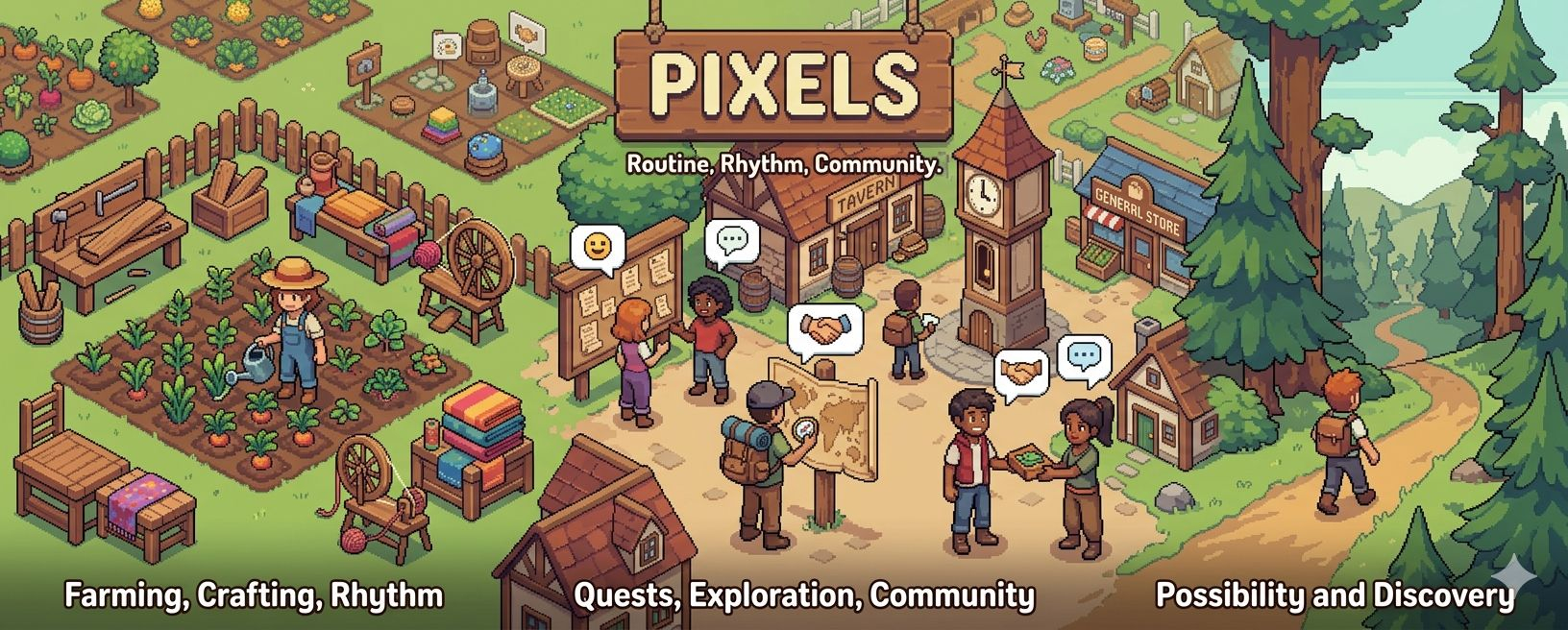
When I look at Pixels, I do not see a game built around one dramatic mechanic. I see a world built around everyday actions that slowly start to matter. Farming, quests, crafting, exploration, community. On paper, those things sound familiar. Almost too familiar. But that is exactly why I find it interesting. The simplicity is not a weakness. It is the foundation.
I am watching this closely because open-ended games usually reveal themselves through small details. A lot of them look exciting at first and then fall apart once the novelty fades. Some feel busy but empty. Some feel polished but lifeless. Pixels stands out to me because it seems to understand that players do not always stay because of spectacle. Sometimes they stay because a game gives them a routine, a rhythm, and a feeling that their time inside the world actually means something.
That is where farming becomes more important than it looks.
Most people see farming as a passive mechanic. Plant something. Wait. Harvest it. Repeat. But I think that interpretation misses the point. In a world like Pixels, farming is not just an activity. It is a relationship with time. You return. You check on things. You manage progress. You begin to care about efficiency, timing, and growth in a way that feels strangely personal. That is how attachment starts. Not through some huge cinematic moment, but through repetition that slowly becomes investment.
And once that happens, the world begins to feel different.
You are not just clicking through a system anymore. You are building a presence. A crop is no longer just a crop. It becomes part of your rhythm. Part of your planning. Part of the way you move through the world. I pay attention to this because the strongest games are often the ones that make ordinary things feel meaningful. Pixels seems built around that idea. It does not rush to overwhelm the player. It lets value build gradually, which in my view is a much smarter design choice than trying to force intensity every minute.
The quest system adds another layer to this, and this is where things get more interesting for me. Open-ended games always have a risk. Too much freedom can feel like emptiness if there is nothing guiding the player forward. Quests solve that problem when they are done properly. They give shape to the experience without making it feel trapped. They nudge the player. They create movement. They teach the world without lecturing.
That balance matters.
I think a lot of people misunderstand quests in games like this. They treat them like a checklist. Something to clear as quickly as possible so they can get to the “real” game. But from my view, quests are part of how the world introduces itself. They are not only tasks. They are signals. They quietly show the player what this world rewards, what it values, and how it wants to be understood. In Pixels, that matters because the world is not built around one single objective. It is built around participation.
Crafting also deserves more respect than people usually give it. I always look at crafting systems as a test of whether a game understands depth or just likes the appearance of depth. Gathering resources is easy to design. Transformation is harder. Crafting only becomes meaningful when it feels connected to everything else. The materials need to feel earned. The outputs need to feel useful. The process needs to feel like part of the world, not a detached menu mechanic that exists just to tick a feature box.
This is the part most people ignore.
A good crafting system tells you that effort can become form. That raw material can become something with purpose. That the time you spend moving through the world is not isolated from the things you eventually create inside it. In Pixels, crafting works best as part of a chain. You farm, gather, complete, explore, and then convert those actions into something tangible. That creates continuity. And continuity is what gives an open-ended world weight.
Then there is exploration, which I think is often badly defined in games. A lot of projects say they offer exploration when what they really offer is movement. That is not the same thing. Exploration should mean uncertainty. Discovery. Pattern recognition. A reason to care about what lies beyond the obvious path. Otherwise it is just walking.
What stands out to me in Pixels is that exploration does not have to rely only on the map. It can also come from the systems and from the people. You explore opportunities. You explore how different mechanics connect. You explore social spaces, community behavior, trading patterns, and the small hidden dynamics that make a world feel alive. That is why I think the game has more depth than someone might assume at first glance. The world is not only something you move through. It is something you slowly learn to read.
And honestly, that is where the community side becomes impossible to ignore.
For me, community is not some optional extra in a game like this. It is the multiplier. Without it, farming becomes routine without memory. Quests become isolated tasks. Crafting becomes private utility. Exploration becomes lonely movement. But once people start interacting, sharing, building, comparing, and returning together, everything changes. The same mechanics suddenly carry more emotional weight. Progress feels visible. Identity starts to form. A player stops feeling like an individual account and starts feeling like part of a living world.
I pay attention to this because communities are what decide whether an open-ended game expands or slowly fades. Mechanics can bring people in. Community is what gives them a reason to stay. In Pixels, that social energy feels central, not secondary. And I think that is one of the smartest things about it. The game does not seem built around the fantasy of a lone hero conquering a closed system. It feels built around people inhabiting a shared space in different ways, at different speeds, with different priorities.
That creates a very different kind of experience.
Some players will care about optimization. Others will care about land, identity, collectibles, progression, or social interaction. Some will focus on efficiency. Others will enjoy the slower atmosphere of building something over time. In my view, that flexibility is one of the strongest parts of the Pixels universe. It allows the world to feel wide without becoming directionless. There is room for different motivations, and that is exactly what a persistent digital world needs if it wants to feel real.
Still, I do not think any of this should be romanticized.
Web3 worlds come with real tension. That tension never disappears just because the art looks friendly or the gameplay loop feels cozy. The moment ownership, economy, and digital assets enter the picture, the player experience changes. Sometimes that creates meaningful incentive. Sometimes it distorts behavior. This is where I become more cautious. A world like Pixels works only if the economy supports the experience instead of replacing it.
That distinction is everything.
If players are only thinking about extraction, the world loses its soul. Farming turns into labor. Quests turn into transactions. Crafting turns into output. Community turns into strategy. And once that happens, the emotional layer starts collapsing under the weight of optimization. I am watching this closely because this is usually where Web3 games either mature or expose their weakness. The ones that survive are the ones that understand economy is not the center of meaning. It is only one layer of it.
What matters more is whether the world gives players a reason to care before they start calculating.
This is why I keep coming back to the quieter parts of Pixels. The routines. The land. The feeling of building something gradually. The social presence. The sense that not everything has to be urgent to be valuable. I think that is a deeper strength than people give it credit for. In a digital environment where so many experiences are built around speed, intensity, and constant stimulation, a world that lets attachment grow more slowly can actually feel more durable.
And durability is the real test.
Not hype. Not launch excitement. Not token momentum. Not short-term attention.
Durability.
Can the world still feel meaningful after the first wave passes? Can the mechanics still hold attention when novelty fades? Can the social layer keep generating life without forcing it? Can players feel that their time is adding up to something more than a temporary loop? These are the questions I care about most, and they are the questions that make Pixels worth paying attention to.
From my view, the project becomes most compelling when I stop thinking about it as a Web3 product and start thinking about it as a place shaped by repeated actions. That is when it makes sense. Farming gives it rhythm. Quests give it movement. Crafting gives it transformation. Exploration gives it possibility. Community gives it memory.
Without that last part, none of the rest would matter for very long.
What I take from Pixels is not just that it offers an open-ended world, but that it understands something many projects miss. People do not build attachment through abstraction. They build it through presence. Through routine. Through effort. Through returning. Through small acts that slowly turn a digital space into somewhere that feels familiar.
That, to me, is where the real promise of Pixels lives.
Not in the idea that everything can be owned. Not in the surface-level excitement of Web3. Not in the language of innovation for its own sake. The real promise is much quieter than that. It is the possibility that a player can enter this world, start with something simple, and over time feel that the world is beginning to hold a piece of them.
And when a game reaches that point, it stops being something you just play.
It becomes somewhere you live, even if only for a while.
