
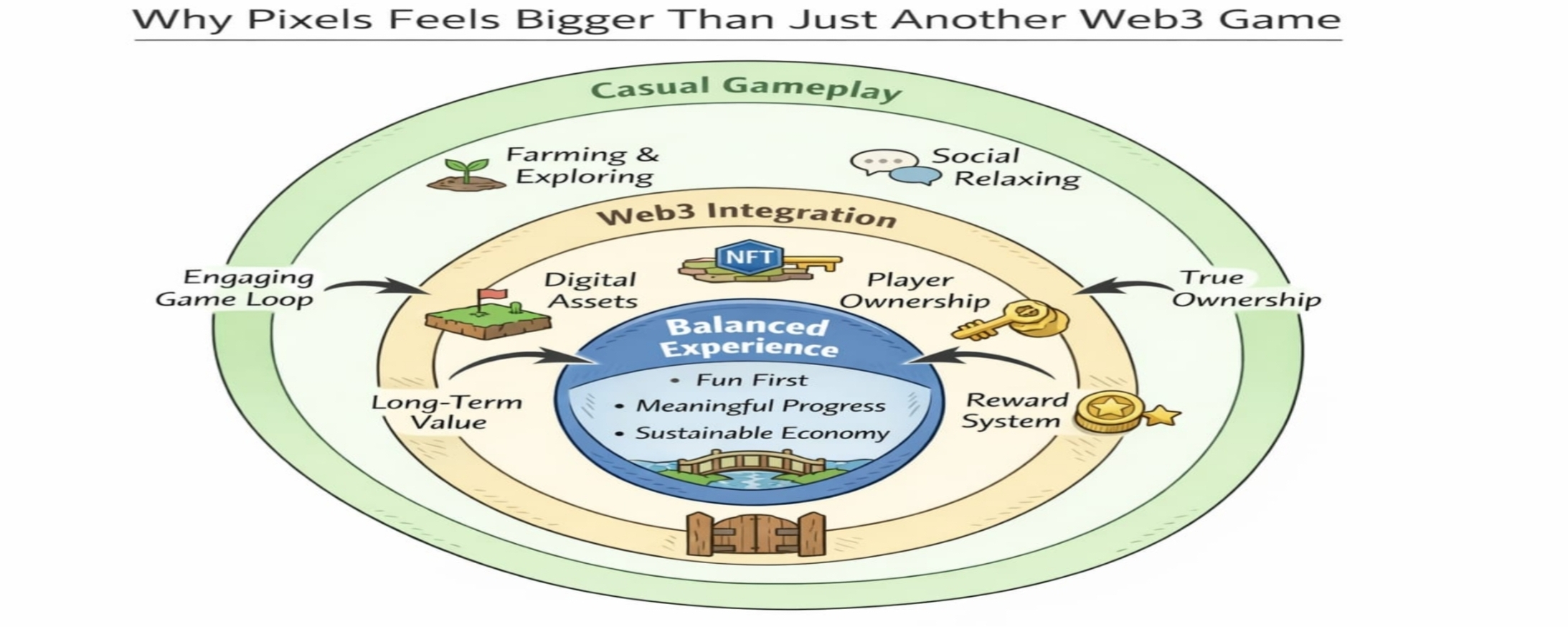
What I am watching right now is not just another Web3 gaming story. I am looking at something more specific than that. I am looking at how Pixels is trying to do something this market talks about all the time but rarely gets right. A lot of projects in crypto say they want to combine fun, ownership, rewards, and digital assets into one smooth experience. Very few actually make it feel natural. Most of the time, you can feel the tension immediately. The game starts to feel like a reward machine. The economy becomes louder than the gameplay. And once that happens, I lose interest fast.
That is why Pixels catches my attention.
The first thing I notice is that it does not try to punch me in the face with the Web3 part. I pay attention to that. In crypto gaming, that is usually where things go wrong. Too many projects want the player to care about tokens, assets, wallets, and ownership before they even care about the game itself. I have always thought that is backwards. If the game is not enjoyable, then the ownership layer does not save it. It only adds more weight to something that was already weak.
Pixels feels different because the casual side of it comes first.
When I look at it, I do not see a product trying too hard to prove it is “the future.” I see a game built around familiar behavior. Farming. Exploring. Building. Collecting. Social interaction. Progress that feels simple enough to understand but still rewarding enough to come back to. That matters more than people think. Casual design is often dismissed in crypto because this market loves complexity. It loves overexplaining things. It loves pretending that more systems automatically mean more value. I do not buy that. Sometimes the smartest design is the one that feels easy to enter and hard to leave.
That is what stands out to me here.
The way I see it, Pixels understands that if you want people to stay, you need to give them a reason beyond speculation. You need routine. You need comfort. You need a world that feels alive enough for people to check in even when they are not thinking about profit. I am watching this closely because that is where the real test begins. It is easy to attract attention in crypto with rewards. It is much harder to build a place people genuinely want to return to.
And that is where I become careful.
Because once rewards enter the picture, everything changes.
I have watched enough projects in this space to know how quickly a good idea can become distorted by incentives. At first, rewards look like a growth engine. They bring in users. They create noise. They create momentum. But they also change behavior. People stop asking whether the game is enjoyable and start asking how much they can extract from it. That shift is subtle at first, then obvious later. The experience starts bending around the economy instead of the other way around. Once that happens, the soul of the game starts to weaken.
This is the part I do not ignore.
With Pixels, I think the balancing act is the real story. Not just the rewards. Not just the digital assets. Not just the ownership narrative. The real story is whether all of those pieces can exist without crushing the casual experience that makes the game appealing in the first place. That is the challenge. And honestly, I think that challenge is bigger than most people admit.
Ownership sounds powerful. In theory, it is.
The idea that a player can actually hold something, trade something, build something that has meaning beyond a closed platform, that is a strong idea. I understand why that pulls people in. It gives time a different kind of value. It makes effort feel less disposable. In a normal game, progress often lives and dies inside the walls of that game. In Web3, the promise is that your work, your assets, and your participation can carry more permanence. That can be exciting. It can also be dangerous if the design gets lazy.
Because ownership alone is not enough.
I keep coming back to that point because this market keeps forgetting it. A player does not fall in love with a system just because it is tokenized. A player stays because the experience means something. Because the loop feels good. Because the world keeps pulling them back in. If ownership enhances that, great. If it replaces that, the whole structure becomes fragile.
And that is why I keep looking at Pixels from both angles.
On one side, I see a casual game that lowers the barrier. That is smart. On the other side, I see a Web3 economy layered underneath it, offering rewards and asset integration that make the player’s time feel more valuable. That combination can be powerful when it is controlled properly. But it can also get messy very fast. I think that is what separates retail excitement from deeper market observation.
Retail usually sees the obvious part. They see rewards, digital ownership, token connection, community excitement. They see a narrative they can easily repeat. But what I pay attention to is something else. I watch the behavior underneath. I ask whether users are showing up because they enjoy the game or because they are chasing the output. I watch whether the economy is supporting the experience or slowly hijacking it. I look for signs that stronger hands might already understand where the stress points are.
That is how I read it.
Because smart money does not just ask whether a project looks good today. It asks whether the structure can survive its own popularity. It asks what happens when growth accelerates. It asks what breaks first. That is the kind of thinking I bring here. And with Pixels, the question is not whether the concept sounds attractive. It obviously does. The real question is whether the game can keep the human side intact while the ownership and reward layers get more attention.
That matters more than most people realize.
The moment players start treating every action like a transaction, something changes in the atmosphere. A farming mechanic no longer feels relaxing. It starts feeling optimized. Exploration no longer feels curious. It starts feeling strategic. The world becomes less playful and more calculated. That does not happen overnight, but I have seen it happen enough times to know how quickly a casual environment can become overly financial if the balance is not protected.
This is where I become skeptical, but not dismissive.
Because I do think Pixels has an advantage in the way it approaches the player. It does not seem to demand that users become crypto natives first. That is important. A lot of Web3 products still make the mistake of designing for insiders only. Pixels looks more aware of the fact that broader adoption comes from simplicity, not from forcing every user to think like a trader. That is one reason I think it deserves attention. It is not just throwing ownership into a game and calling that innovation. It is trying to make that ownership fit inside an environment people can actually enjoy.
That is a much harder thing to do than it sounds.
And it is also why I think this matters beyond one project.
Pixels, to me, is part of a bigger market test. I keep asking myself the same question when I look at blockchain gaming: can this space build economies that support experience instead of consuming it? That is the real question. Not whether digital assets are possible. They are. Not whether rewards attract users. They do. The real question is whether these systems can create lasting engagement without training the player to care only about extraction.
That is where the answer starts to separate serious projects from temporary ones.
Right now, what stands out to me is that Pixels appears to understand the importance of softness. That may sound like a strange word in crypto, but I mean it. Not everything should feel aggressive, financial, optimized, or hyper-competitive. Sometimes what keeps people engaged is rhythm. Familiarity. A sense of low-pressure progress. A world that feels calm enough to live in, but structured enough to keep moving forward. If Pixels can preserve that while still giving users meaningful ownership and reward exposure, then it is doing something far more valuable than just following a trend.
It is building a bridge.
And I think the market needs to pay closer attention to that.
Because the way I see it, the future winners in Web3 gaming will not be the loudest projects. They will be the ones that make the technology feel almost secondary to the experience. The ownership should feel like an enhancement, not a burden. The rewards should feel like support, not the entire reason for being there. The digital assets should deepen attachment, not replace it. That is the balance I am focused on.
So when I look at Pixels, I am not just asking whether it can grow. I am asking how it grows. I am asking whether the casual charm can survive the pressure of incentives. I am asking whether the players remain players, or whether they slowly become extractors. I am asking whether the game keeps its identity when the economic layer becomes more visible.
That is what I am watching now.
Because this is not just about one game to me. It is about whether Web3 can finally learn how to support fun instead of suffocating it. And with Pixels, I see enough intention, enough design awareness, and enough restraint to take that question seriously. I am still careful. I am still observant. But I do not ignore what is forming here. What matters most to me now is whether this balance holds as more attention comes in. That is the next thing I will keep watching, because that is where the truth usually shows itself.
