
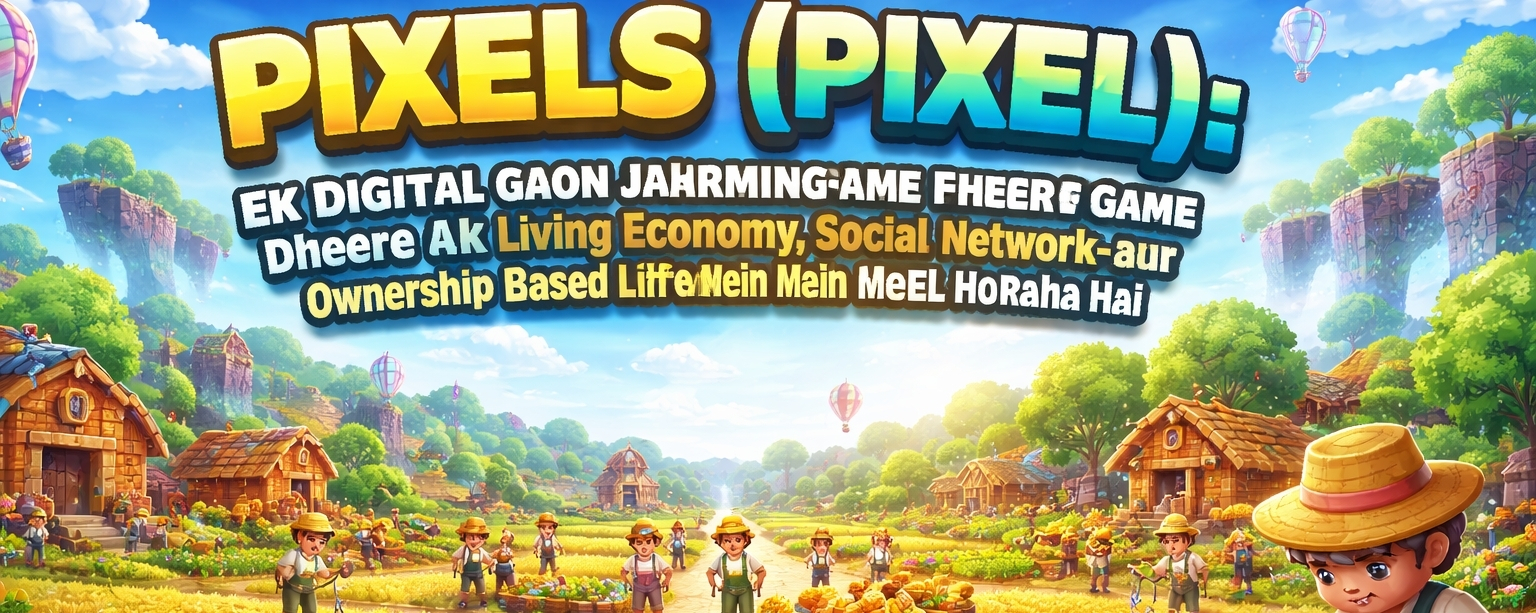
Pixels doesn t feel like something you playIt feels more like something you slowly grow intolike a place that starts as a game and, without asking permission. turns into a habit. then a routine. and eventually something closer to a small digital life.
You arrive thinking you’ll just plant a few crops, maybe explore a little. The world is simple on the surfacefarming, crafting, wandering. Familiar motions. Comfortable. But after a while, you begin to notice something subtle: nothing you do really disappears. It lingers. Your effort accumulates, your land changes, your resources stack, your presence becomes visible. Unlike most games where time dissolves the moment you log out, here it stays behind, quietly holding your place.
That persistence is the real design. Pixels isn’t built around actionit’s built around continuity.
Underneath that calm surface runs a system that behaves less like a game economy and more like a living organism. The token, PIXEL, moves through the world like circulationused for crafting, unlocking features, participating in governance, and shaping how players interact with the environment. It isn’t just a reward it s a signal. It tells the system who is contributing, who is building. who is adding weight to the world.
And what’s interesting is that the game doesn’t try to overwhelm you with this complexity. It hides it in plain sight. You don’t feel like you’re engaging with tokenomicsyou feel like you’re just playing. But behind that simplicity sits a carefully structured balance between soft in-game currencies and the harder, more scarce PIXEL layer, a system that mirrors how real economies separate everyday transactions from deeper stores of value.
The shift away from older “play-to-earn” thinking is noticeable if you pay attention. Pixels doesn’t aggressively promise income. Instead, it builds an environment where value can emerge if the system itself remains healthy. That’s a very different philosophy. It’s less about extracting rewards and more about sustaining participation. In a way, it asks a quiet question: what if people stayed not because they were paid tobut because leaving meant stepping out of something they had already started to belong to?
The move to Ronin Network amplified that feeling. It didn’t just improve performance; it changed the atmosphere. Suddenly the world felt populated, active, alive. Millions of players began moving through the same space, creating a kind of density that most Web3 games struggle to achieve.
And density matters more than graphics or mechanics ever will. Because once enough people are present, a game stops feeling like software and starts feeling like a place.
That’s where Pixels quietly transforms into something else entirely.
It becomes social without announcing itself as social. You start recognizing names. You trade with familiar players. You join groups not because the system tells you to, but because it feels natural. Guilds aren’t just featuresthey’re clusters of trust. Land isn’t just decorationit’s influence. Even something as simple as farming begins to carry a different weight when other people depend on, compete with, or benefit from what you produce.
Over time, the boundaries blur. Are you playing? Are you working? Are you participating in a kind of shared economy? The answer shifts depending on how deeply you’re involved.
From a technical perspective, the structure is surprisingly deliberate. Resources act as the base layer, feeding crafting systems and trade loops. Land NFTs introduce ownership and scarcity. The token adds liquidity and governance. The entire system is modular, almost like it was designed to expand beyond itself. And it probably will. There are already signs pointing toward a broader platform direction—tools for user-generated content, integrations with external NFT collections, and the possibility of other experiences being built inside the same ecosystem.
If that happens, Pixels won’t just be a game anymore. It will be a foundation.
Still, there’s a quiet tension running through everything. Systems like this depend on balance, and balance is fragile. If too much value flows out, the world empties. If too much accumulates at the top, new players feel locked out. If the experience starts to feel like labor instead of play, people disengage. These are not theoretical risksthey’re patterns already seen across Web3.
And yet, Pixels seems aware of this. You can feel it in the pacing. In the way progress is gradual. In how the game leans into simplicity instead of constant escalation. It resists becoming overwhelming, which might be its most underrated strength.
Culturally, it represents something that Web3 has been trying to figure out for years: how to make ownership feel natural instead of forced. Pixels doesn’t start with finance and try to add fun later. It starts with something humanroutine, growth, interactionand lets the economic layer form around it.
That’s why it works, at least for now.
Because at its core, it taps into something older than blockchain, older than gaming itself—the satisfaction of building something slowly, watching it change, and knowing that your effort has weight.
Not dramatic weight Not life changing overnight
Just enough to matter
And maybe that s the real shift happening here Not a revolution not a disruptionjust a quiet redefinition of what it means to spend time inside a digital world