

In the context of the Binance Pixel campaign, a “@Pixels ” represents more than a visual element—it represents a fragment of digital information. A small, precise unit that appears incomplete on its own, yet contributes to a larger system of meaning when combined with other signals.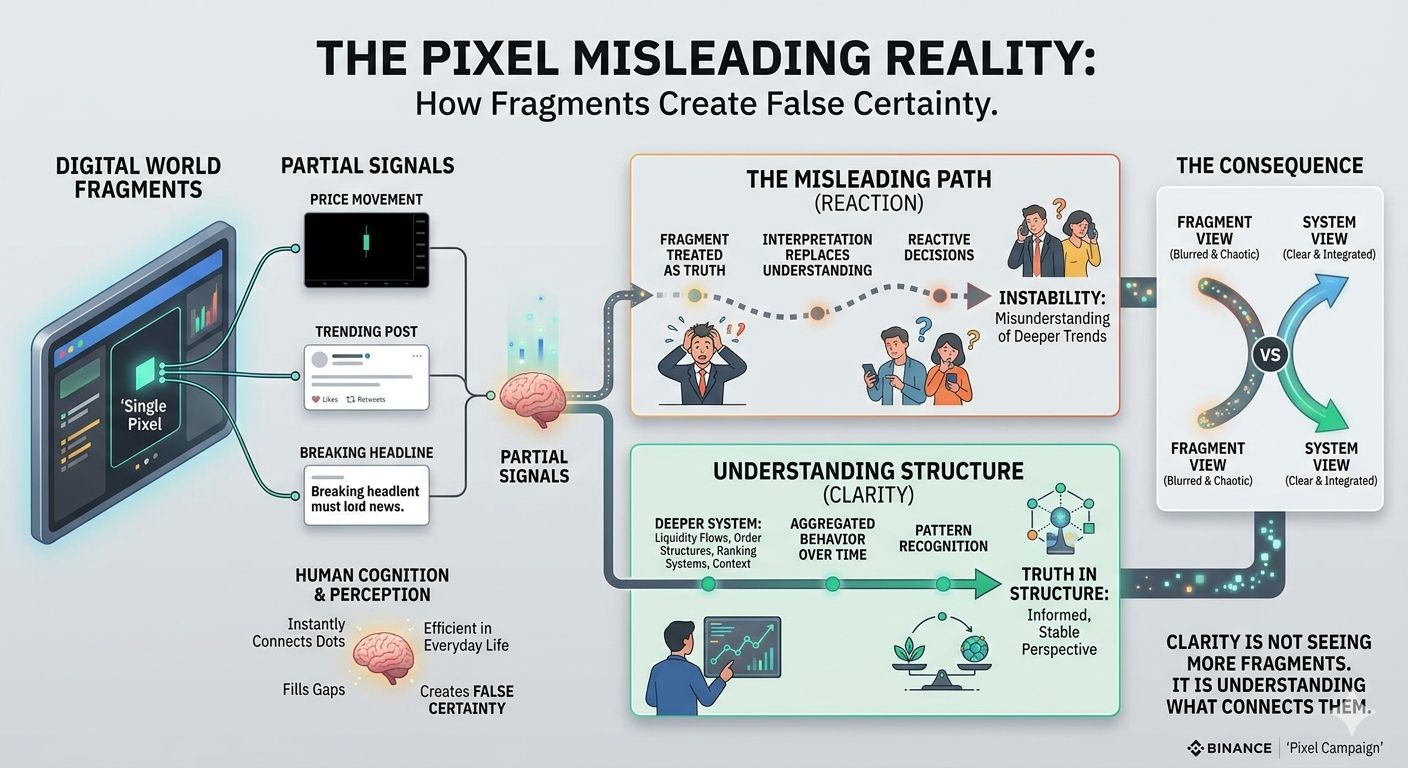
Modern digital environments are built entirely on this principle. What we perceive as reality online is not a complete picture—it is a structured collection of pixels. Each data point, each movement on a chart, each viral post, each headline is only a fragment of a much larger system operating beneath the surface.
The challenge is that these fragments feel complete in isolation.
A price movement appears to show direction. A trending post appears to show consensus. A breaking headline appears to show final truth. But in reality, each of these is only a partial signal—an output of a deeper structure that is not immediately visible.
Digital systems are designed to compress complexity into readable fragments. This is necessary for speed and accessibility, but it also creates a risk: humans begin interpreting fragments as full reality.
A trader reacting to a single candle may believe a trend has formed, when in fact the movement is only temporary imbalance. A social media user seeing viral content may assume widespread agreement, when in fact it may be algorithmic amplification. A reader seeing a headline may form conclusions without seeing the underlying context.
This is where misinterpretation begins—not because the data is false, but because it is incomplete when isolated.
Behind every visible pixel lies a system that defines its meaning. In financial environments, that system includes liquidity flows, order structures, and aggregated behavior over time. In digital platforms, it includes ranking systems, distribution logic, and engagement mechanisms. In information systems, it includes selection, filtering, and framing processes.
What we see is never the full system—it is only the output of it.
Human cognition naturally tries to complete incomplete information. We connect dots instantly, even when the picture is not finished. This is efficient in everyday life, but in digital environments, it creates false certainty. The mind fills gaps that the system intentionally leaves open for simplification.
Over time, this creates a pattern: fragments are treated as truth, and interpretation replaces understanding.
The consequence is not just misunderstanding—it is instability. Decisions become reactive. Confidence becomes dependent on short-term signals. Perception shifts rapidly as new fragments appear, even though the underlying structure may not have changed at all.
The deeper shift required is from reaction to structure. From seeing isolated pixels to understanding how those pixels are connected. A single signal becomes meaningful only when it is placed within its system—when its origin, relation, and behavior over time are understood.
Clarity, therefore, is not about seeing more fragments. It is about understanding what connects them.
In a fragmented digital world, truth does not exist in isolation. It exists in structure.
A pixel can capture attention—but only structure defines reality.


#pixel #BitcoinPriceTrends #TrendingTopic #meme板块关注热点 #MegadropLista