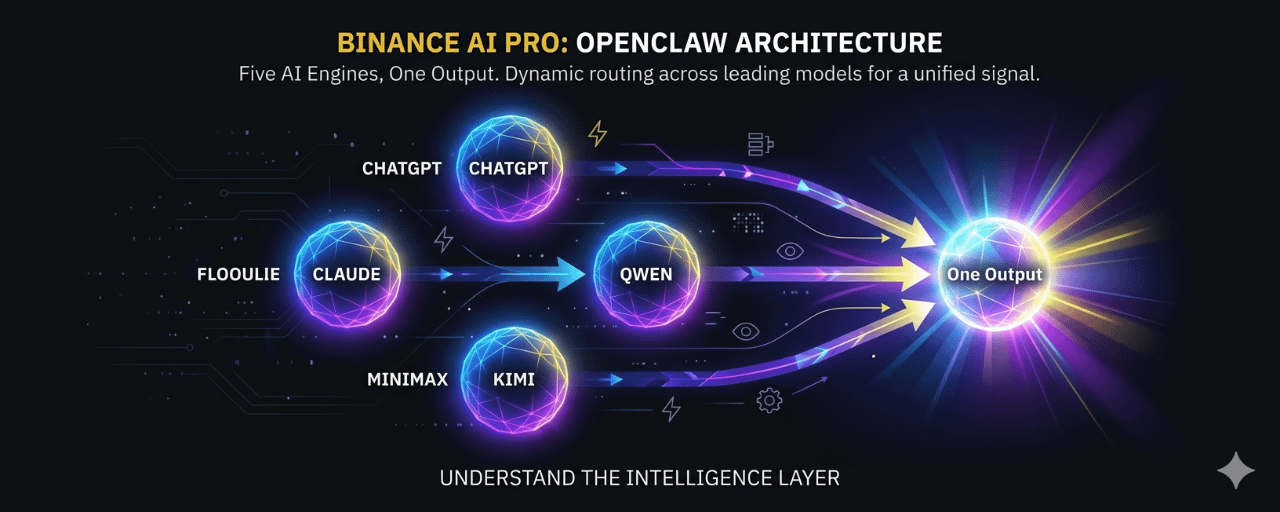
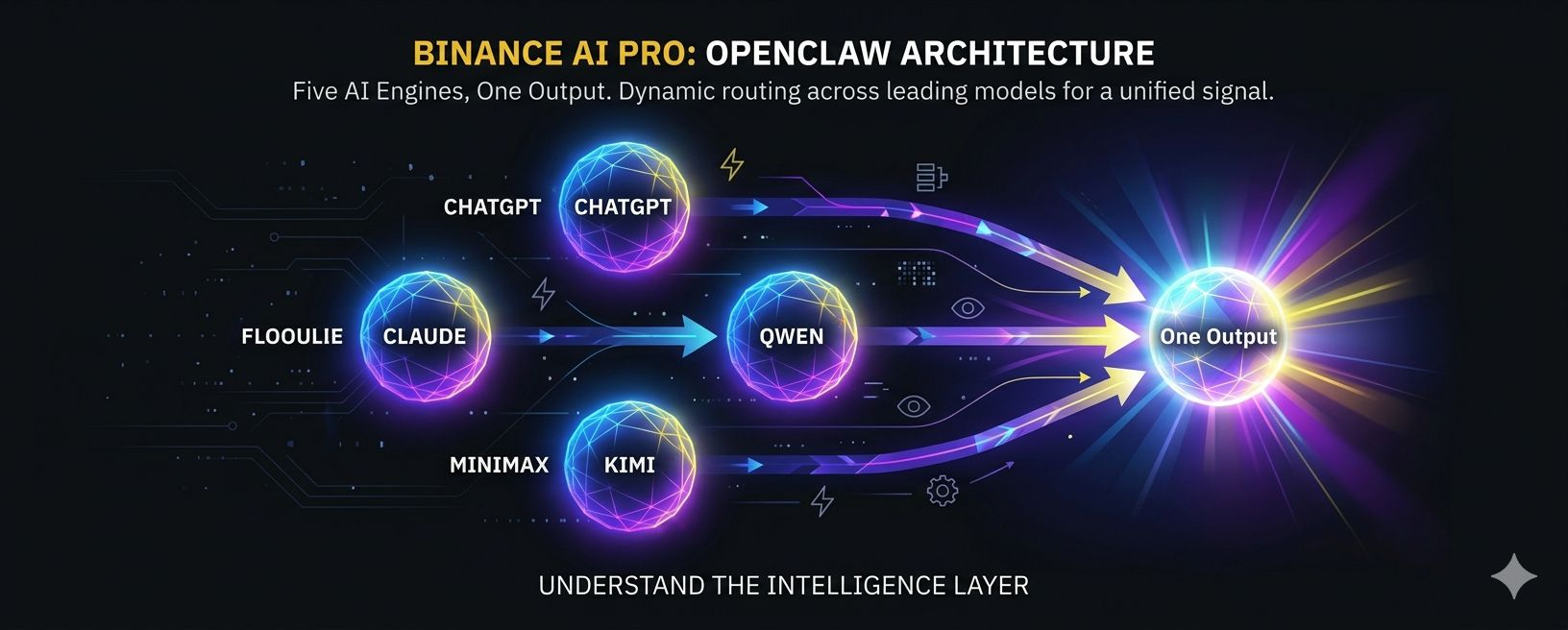
Binance AI Pro is built on the OpenClaw open-source ecosystem. That's how Binance describes the infrastructure, and it appears in virtually every official announcement. What the descriptions don't include is how the routing works.
The five AI engines integrated into Binance AI Pro are ChatGPT, Claude, Qwen, MiniMax, and Kimi. ChatGPT and Claude are the two most recognizable: both are leading general-purpose language models with documented strengths in analysis and reasoning. Qwen is Alibaba's flagship model, strong in Chinese-language contexts and increasingly competitive in English. MiniMax is a Chinese AI company building multimodal models. Kimi, developed by Moonshot AI, has built a reputation for long-context document processing.
These are not similar tools. They have different architectures, training regimes, geographic optimization, and known capability profiles. The question of how Binance AI Pro routes a given query across five distinct AI engines matters a great deal to what output you receive.
The three most plausible architectures are: a primary model with fallback routing when the primary fails or hits limits; a task-type router that assigns query categories to the most capable engine; or an ensemble system that queries multiple models and synthesizes their responses. Each architecture has a different trust implication.
If Binance is running a primary model with fallback routing, then most of your market analysis is coming from one model and the others are standby infrastructure. The output you receive has a single author that changes only when the primary is unavailable. You don't know which model is primary, which means you don't know whose reasoning patterns are shaping your signals.
If Binance is running task-type routing, then different kinds of queries go to different models. A market price analysis might go to one engine; an on-chain wallet query to another; a strategy adjustment request to a third. This architecture makes sense if the models have meaningfully different strengths, but it requires Binance to maintain a classification layer that decides which task fits which model. That classification layer is invisible to users.
If Binance is running an ensemble with synthesis, then multiple models respond to each query and something, either a weighting function or a meta-model, produces the final answer. Ensemble systems can reduce individual model errors, but they can also obscure the reasoning chain. You receive a consensus output with no visibility into whether the underlying models agreed or were three-to-two split on a direction.
As of April 2026, the official documentation does not specify which architecture is in use. The announcement says AI Pro "helps connect these models and AI Skills into AI-assisted workflows." That phrase is deliberately agnostic about the routing mechanism.
Why does this matter more than it sounds? Because the trust relationship a user builds with an AI system depends partly on consistency. If you observe the AI making analysis calls and you notice patterns, you're inferring the reasoning style of whatever model is running. If the model routing is dynamic, you may be inferring the style of several different models and treating them as one. Your calibration of the AI's reliability accumulates on top of an unstable foundation.
The OpenClaw ecosystem being open-source is potentially significant here. Open-source infrastructure means the routing architecture is theoretically inspectable. Whether the specific configuration Binance runs on OpenClaw is published is a different question. Open-source infrastructure does not automatically mean transparent deployment. The code that routes queries between models could be public in principle and obscure in practice.
There's also a competitive consideration. The five models are not static. ChatGPT releases new versions. Claude's capabilities change across model versions. Qwen has been iterating rapidly. If Binance updates the underlying models without user notification, the "same" Binance AI Pro you've been calibrating your trust against may have changed its core reasoning architecture. The surface product stays consistent. What's underneath it doesn't.
Compared to competing AI trading tools, the multi-model approach is genuinely unusual. Most single-model AI trading platforms offer more transparency about what you're getting because there's one thing to be transparent about. Binance's approach potentially offers superior breadth if the routing is well-designed, but it trades that breadth for opacity in the intelligence layer.
One argument in favor of the multi-model approach: each of the five engines has different training data emphases and different failure modes. A crypto market scenario that confuses one model might be handled accurately by another. Diversity in the intelligence layer could reduce correlated failures. This is a real benefit.
The counterargument: users can't verify whether this benefit is materializing. The output is unified. The failure mode distribution across models isn't reported. You can't tell if the system routed your query to the wrong engine or if two models disagreed and the synthesis got it wrong. The unified output looks the same whether the underlying agreement was strong or fragile.
I find the architecture compelling as an idea. I can't evaluate it as a product because the architecture isn't visible at the level where I operate. That gap between the compelling idea and the unverifiable execution is where my trust currently sits, unsettled.
Whether the OpenClaw multi-model routing turns out to be Binance AI Pro's strongest differentiator or just its most interesting design decision will depend on something I can't currently measure: how often the synthesis layer produces better results than any single model would alone, and under what market conditions that advantage disappears.
Trading always involves risk. AI-generated topics are not financial advice. Past performance does not reflect future performance. Please check product availability in your region.
@Binance Vietnam $XAU $BTC $ETH #BinanceAIPro