
Pixels kept feeling different to me in a way that took a little time to name.
At first, it looks almost too easy to explain. A farming game. A social world. A Web3 layer underneath. You walk around, gather things, plant things, craft things, meet people, slowly build a rhythm. On paper, that can sound small. Maybe even predictable. But the longer I sat with Pixels, the less it felt like one of those projects you can sum up in a neat sentence and move on from.
What stayed with me wasn’t just the farming. It was the strange mix of comfort and tension inside it.
Pixels has that soft, welcoming surface that makes people lower their guard. The world feels casual. The routines feel familiar. You don’t enter it feeling like you need to decode some grand system before you can enjoy yourself. That already sets it apart from a lot of Web3 games, which still seem weirdly committed to making players feel like part-time analysts before they ever feel like players. Pixels doesn’t begin there. It begins with ordinary actions. Small loops. Repetition that makes sense immediately.
And that matters more than people think.
There’s a big difference between a game that gives you tasks and a game that gives you a rhythm. Pixels understands rhythm. Planting, harvesting, gathering, wandering, crafting, returning. None of this is new, obviously. That’s part of why it works. It borrows from habits players already know how to settle into. It doesn’t force meaning onto every action. It lets repetition do the work slowly. That’s a much more human way to build attachment than throwing “ownership” and tokens at people in the first five minutes and expecting them to care.
I think that’s what makes Pixels more interesting than its own description.
If you describe Pixels in the usual way, it starts sounding flatter than it actually is. Social casual Web3 game. Open world. Farming. Exploration. Creation. All true. None of it wrong. But it misses the texture. It misses the feeling of a project trying very hard to become a place, not just a product. And there’s a difference between those two things, even if a lot of crypto projects like to pretend there isn’t.
A product can survive on hype for a while. A place can’t. A place has to feel inhabited. It has to feel repeatable. It has to make room for boredom without collapsing under it. That’s a harder thing to build. Pixels, for all its rough edges, at least seems to understand that.
I don’t mean that as blind praise. The rough edges matter too.
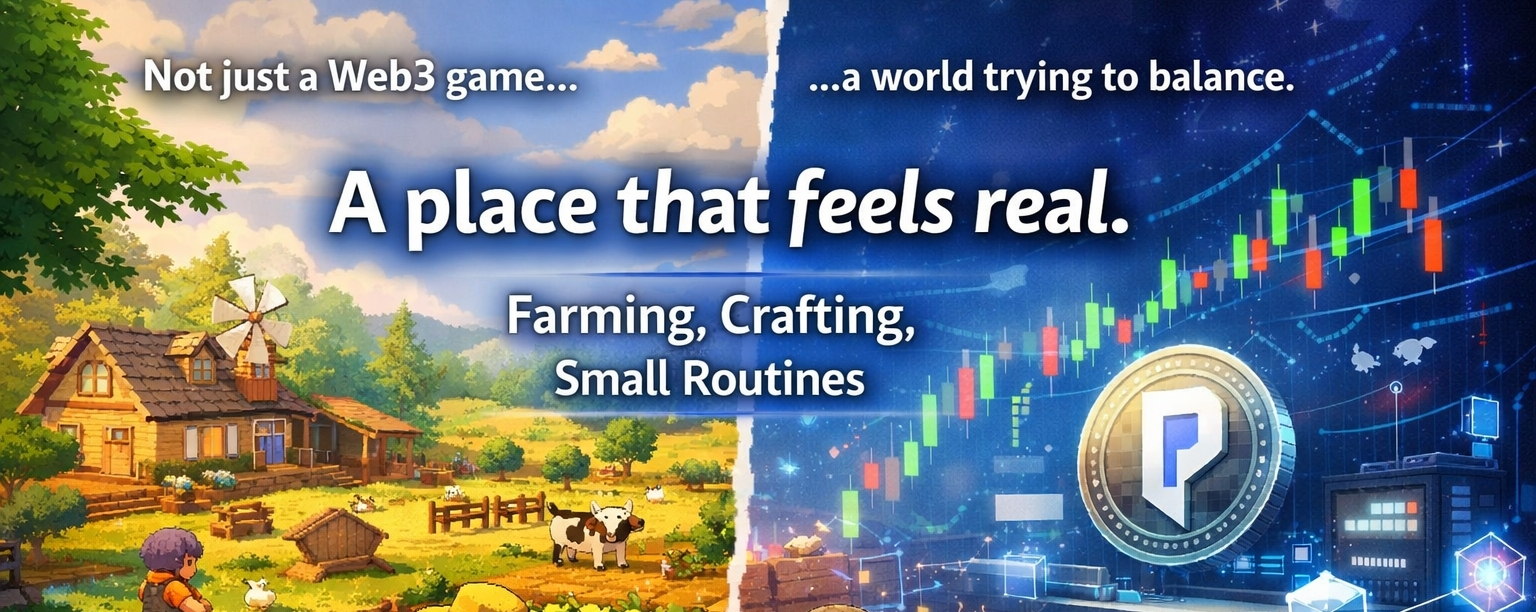
The more time I spent thinking about Pixels, the more I felt that it is quietly negotiating with itself. On one side, it wants to be this relaxed, social world where players return because the loop feels natural and the atmosphere feels light. On the other side, it still belongs to a Web3 structure, and that means there is always an economic layer sitting behind the curtain, shaping how people behave whether they want to think about it or not.
That tension never fully disappears.
It’s actually one of the most honest things about Pixels. The game wants to feel soft. The system under it is not always soft. The game wants to feel like routine. The surrounding economy keeps reminding you that routine can be measured, priced, incentivized, pushed around. And once you notice that, the mood changes a little. Not enough to ruin it. Just enough to complicate it.
That complication is where Pixels becomes worth thinking about.
Because a lot of projects in this space are easy to dismiss. They feel empty almost immediately. You can sense that the “game” part is mostly decoration and the real point is elsewhere. Pixels doesn’t feel that shallow to me. It feels like a project that genuinely wants to make the world matter. It wants people to stay for reasons that are social, habitual, even emotional. Not just financial. Whether it fully succeeds at that is another question, but the intention is there, and in this space that already counts for something.
What I kept noticing is how much Pixels depends on familiarity. That’s not a criticism. Familiarity is probably one of its smartest choices. Farming is familiar. Wandering is familiar. Gradual progression is familiar. Even the social energy around the game has that recognizable feeling of people sharing a routine more than chasing a spectacle. Pixels doesn’t feel like it’s trying to overwhelm you. It feels like it’s trying to settle into your day.
That’s a very different ambition from the one most Web3 games used to advertise.
And honestly, I trust that ambition more.
There is something quietly sensible about a project that doesn’t act like it needs to reinvent human behavior from scratch. Pixels seems to know that people already understand the appeal of tending to something, building something over time, checking back in, seeing who is around, making small progress and calling that enough for the day. Those are not huge dramatic feelings. They are ordinary ones. But ordinary is powerful. Most online worlds that actually last are built on ordinary habits, not constant excitement.
That’s why Pixels sticks in the mind more than I expected it to.
Not because it feels flawless. It doesn’t. In fact, part of what makes it memorable is that it still feels unresolved. Still mid-conversation with itself. You can feel Pixels trying to balance the warmth of a social game with the pressures of a tokenized ecosystem. You can feel it trying to protect the mood of the world from becoming swallowed by the logic underneath it. Some days that balance probably holds better than others. Some days it probably feels seamless. Other days, I imagine, the economic machinery becomes impossible to ignore.
That doesn’t make Pixels fake. It makes it fragile in a very particular way.
And maybe fragility is the right word here. Not weakness exactly. Just sensitivity. Pixels feels like one of those projects where the atmosphere matters so much that any disruption underneath can travel upward quickly. If the economy shifts too sharply, the world feels it. If player incentives drift too far from the social experience, the world feels it. If the routine starts feeling less like life inside a game and more like work around a system, the world feels it.
That’s a difficult line to walk.
Still, I think Pixels deserves credit for even trying to walk it. A lot of projects would have given up and leaned fully into the financial side by now. Others would have buried the economic reality under cozy aesthetics and hoped nobody looked too closely. Pixels seems to sit in the uncomfortable middle. It wants the softness to be real, but it can’t fully escape the structure it was built inside. That’s not a clean story. It’s probably a more truthful one.
And maybe that’s why my reaction to Pixels never settles into pure admiration or pure doubt.
I can see why people are drawn to it. The loop is approachable. The world has charm. The social side gives the repetition some warmth. It doesn’t feel desperate to impress in the usual loud crypto way, which already makes it easier to spend time with. But I can also feel the uncertainty humming underneath it. The sense that Pixels is still proving what it really is. Not pitching it. Proving it.
That distinction matters.
A lot of projects are good at naming themselves. Far fewer are good at becoming themselves over time.
Pixels, to me, still feels like it’s in that process. Still becoming. Still trying to turn a soft-looking game into a durable place people return to without having to force the reason. And I think that’s the part I find most compelling. Not the promise. Not the category. Not even the Web3 layer, really.
Just the effort inside Pixels to make routine feel alive.
That’s harder than it sounds. Maybe harder than the project itself expected.
And I guess that’s where I’m left with it. Pixels doesn’t strike me as something neat or finished or fully resolved. It feels more human than that. A little uneven. A little restless underneath its calm surface. Trying to be gentle while carrying systems that are not always gentle. Trying to become ordinary in a space that still treats ordinary as if it isn’t enough.
There’s something quietly admirable in that.
And something a little uneasy too.