I did not take Pixels seriously at first.
That probably says more about me than the game. After a few cycles of Web3 promises, play to earn booms, token collapses, and whitepapers disguised as roadmaps, I developed a reflex. Open world. Player owned economy. Sustainable tokenomics. Community driven. I have read that sentence too many times. So when I heard about a farming game on Ronin, built around social play and $PIXEL rewards, I assumed I already knew the arc. Early growth. Speculation. Optimization spreadsheets. Gradual decay.
And yet, I keep coming back to it.
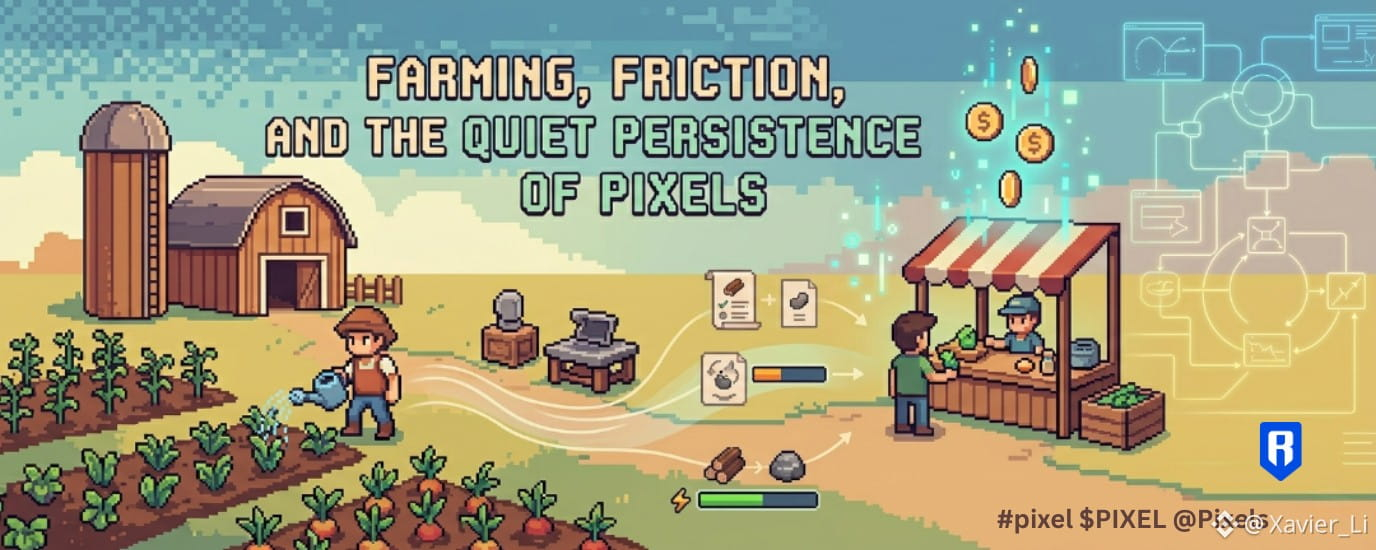
Not because it is loud or revolutionary. It is not. It is farming. You plant crops. You gather resources. You walk around pixelated land that feels deliberately simple. Almost understated. If you look at it too quickly, you might miss what is happening underneath.
What surprised me later was not the token. It was the pacing.
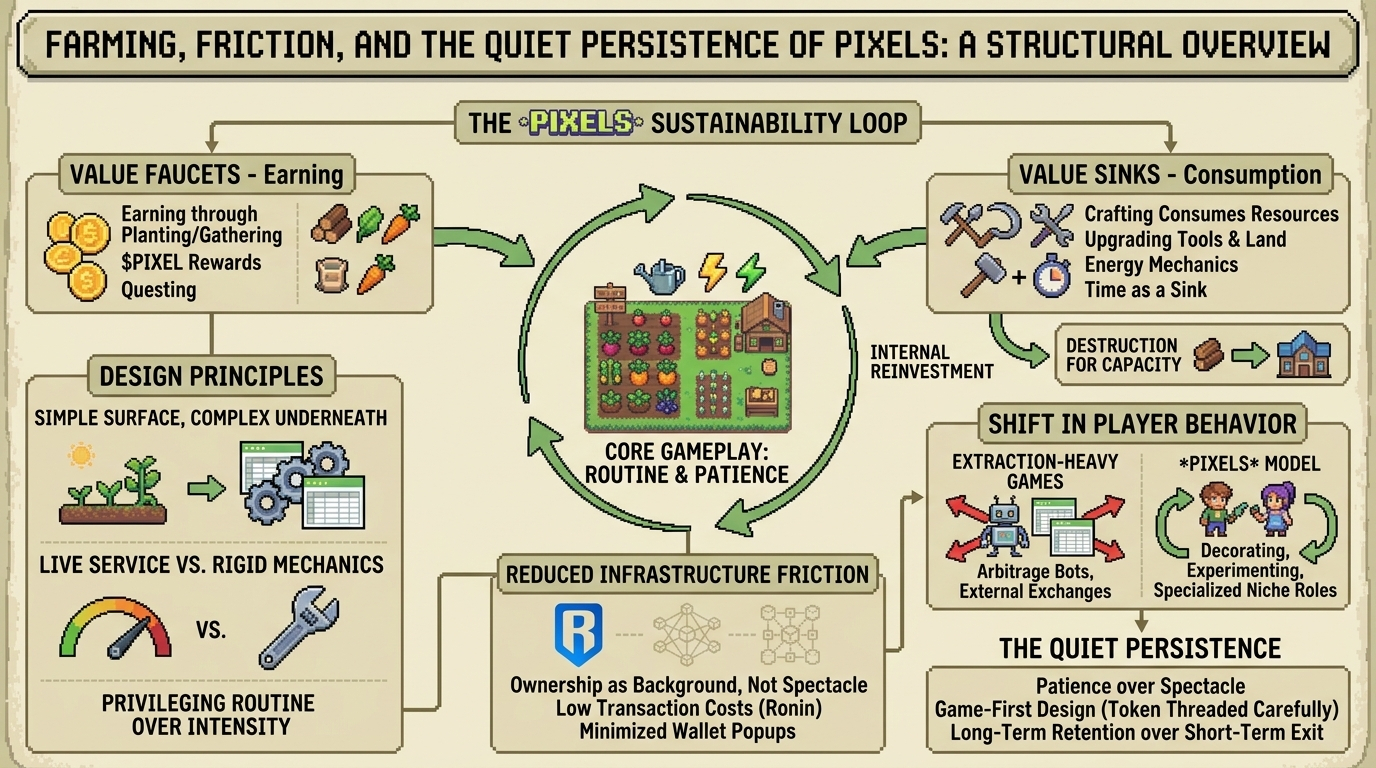
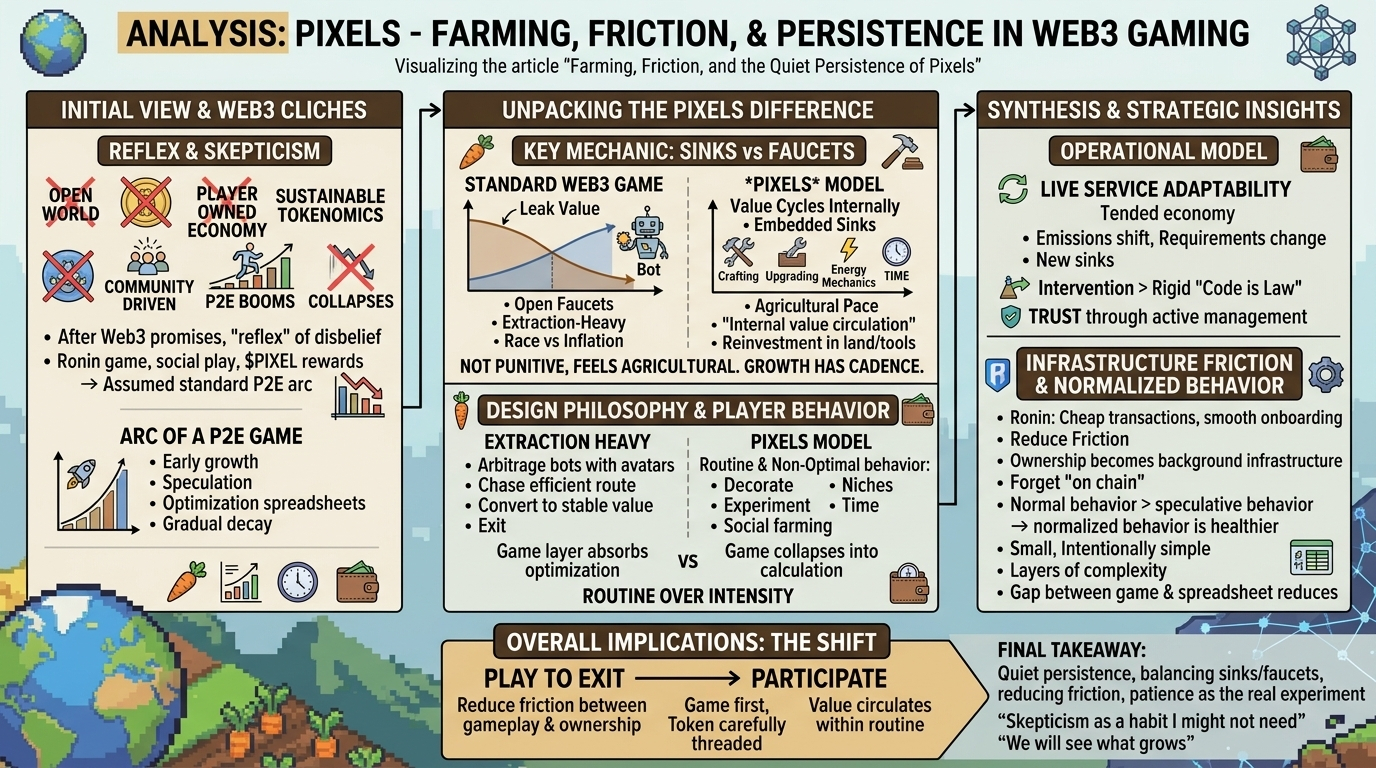
Most Web3 games leak value. Faucets are wide open. Rewards feel urgent. Players rush in, extract what they can, and then leave when emissions slow. The system becomes a race between inflation and attention span. Pixels feels different. The faucets exist, yes. You can earn. But there are sinks everywhere, quietly embedded in the loop.
Crafting consumes. Upgrading consumes. Energy mechanics slow you down. Even time itself is a sink. You cannot optimize away the need to wait, to return, to check back in. It does not feel punitive. It feels agricultural. Growth has cadence.
That changes player behavior more than people realize.
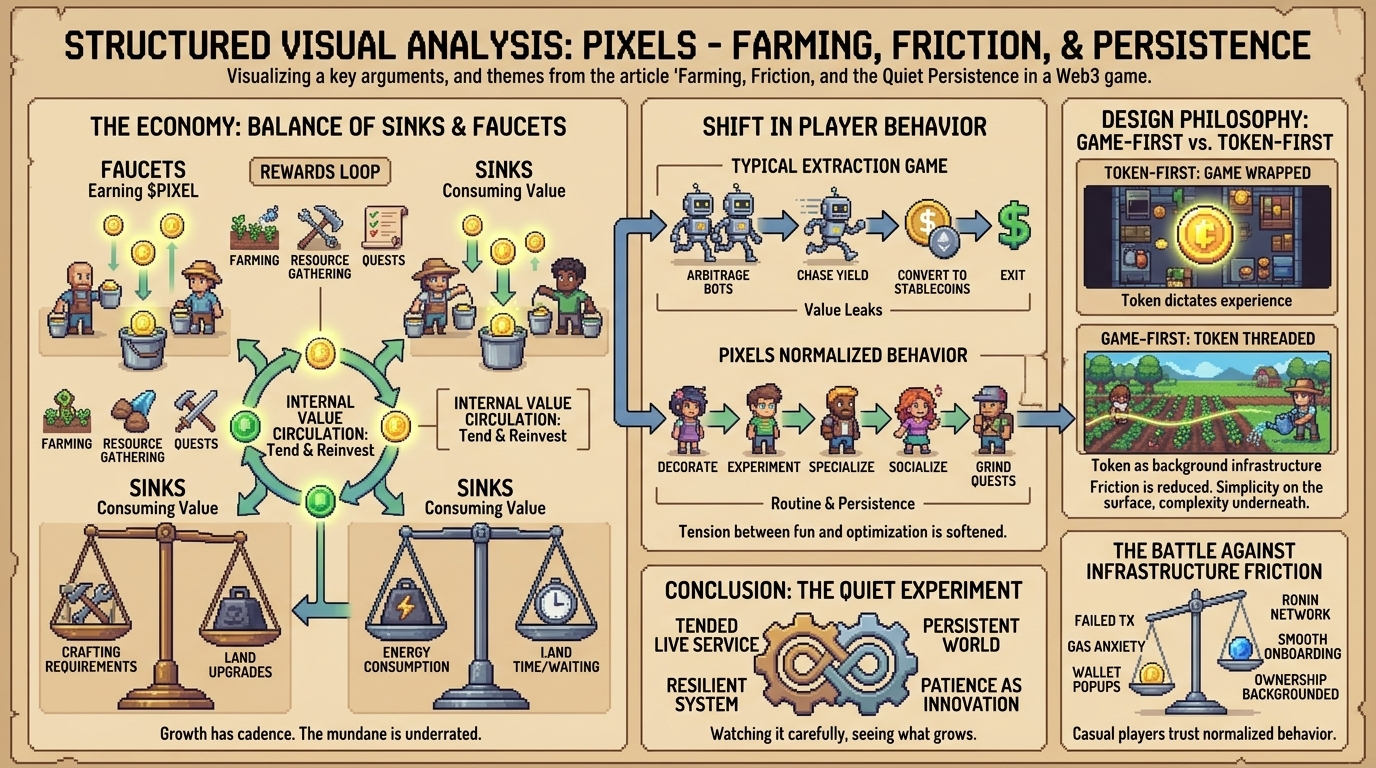
In extraction heavy games, players behave like arbitrage bots with avatars. They chase the most efficient route, convert to stable value, and exit. In Pixels, I notice something else. Players decorate. They experiment. They specialize in odd little niches. Some farm purely for social reasons. Some flip resources. Some grind quests that are not even optimal, just familiar.
Maybe that sounds too generous. There are spreadsheets, of course. There are optimized crop rotations and Discord threads about yield per energy. But the game layer absorbs that optimization instead of collapsing into it. It remains playable even if you are not maximizing every minute.
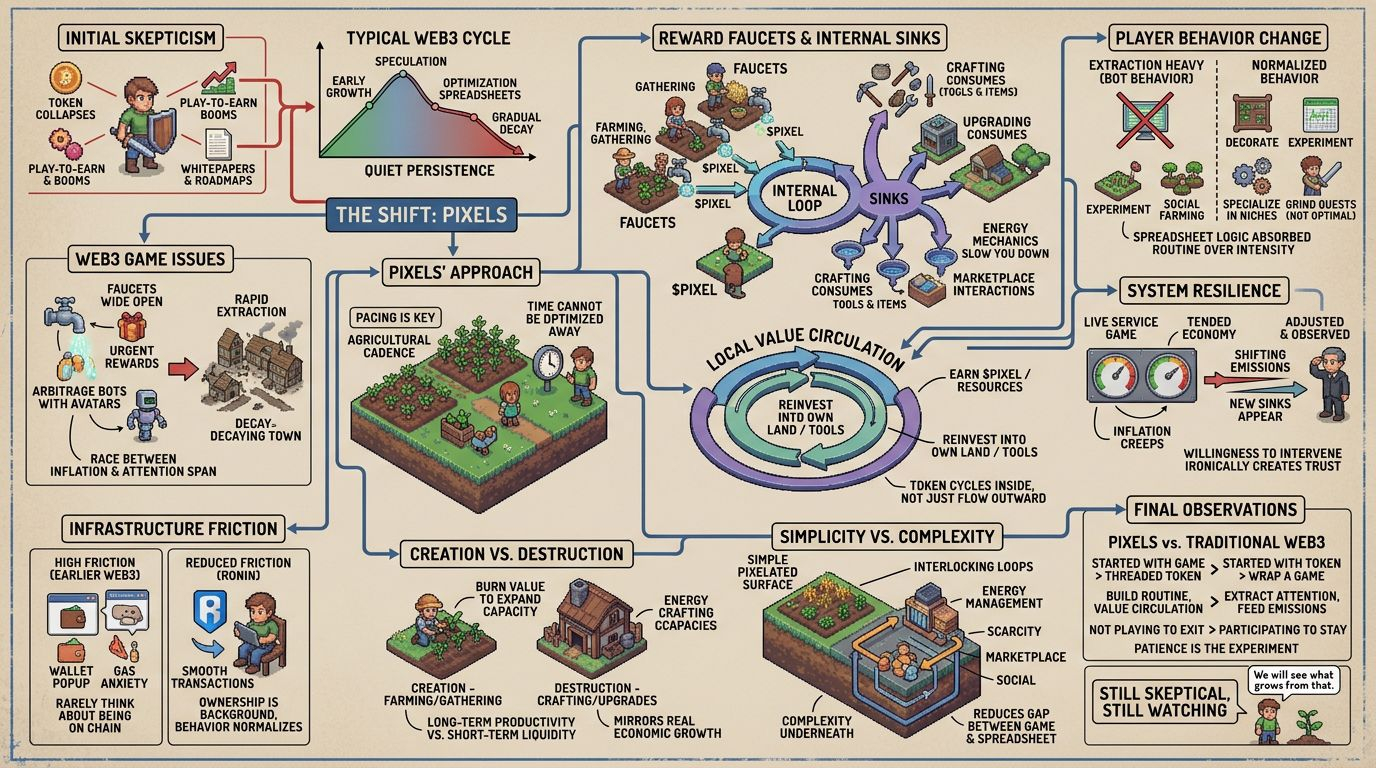
That tension between fun and optimization is where most Web3 games break. The token turns everything into a calculation. Pixels seems aware of that risk. The reward loops are present, but they are softened by design choices that privilege routine over intensity.
I keep thinking about sinks versus faucets because that is usually where sustainability lives or dies. In Pixels, value circulation feels more local. You earn, you spend, you reinvest into your own land or tools. The token does not just flow outward to exchanges. It cycles inside the system through upgrades, crafting requirements, marketplace interactions.
Is it perfectly balanced? I doubt it. No live economy ever is. But it feels tended. Adjusted. Observed.
That is another subtle difference. Many Web3 games launch with rigid mechanics, as if immutability were a virtue. Pixels behaves more like a live service game that happens to use tokens. Emissions shift. Requirements change. New sinks appear when inflation creeps. It suggests a willingness to intervene, which ironically creates more trust than rigid “code is law” posturing.
Infrastructure friction is another quiet battleground. Wallet popups. Failed transactions. Gas anxiety. These small breaks accumulate and push casual players away. Ronin helps, obviously. Cheap transactions, smoother onboarding. But what matters more is how rarely I think about being on chain while playing. Ownership exists, but it does not constantly announce itself.
That reduction of friction might be the most thoughtful part.
In earlier Web3 games, every action felt financial. You were always aware that something economic was happening. It created tension, but also exhaustion. In Pixels, I sometimes forget that my crops are part of a tokenized economy. They just feel like crops. That sounds trivial, but it is not. When ownership becomes background infrastructure instead of foreground spectacle, behavior normalizes.
And normalized behavior is healthier than speculative behavior.
There is also an interesting balance between creation and destruction. Resources enter the world through farming and gathering. They leave through crafting and upgrades. But the destruction is purposeful. You burn value to expand capacity. You sacrifice short term liquidity for long term productivity. It mirrors real economic growth more than zero sum reward pools.
I did not expect to think about macroeconomics while watering digital carrots.
Retention versus extraction is where my skepticism usually returns. Are players staying because they enjoy it, or because they hope the token appreciates? It is probably both. Incentives always shape behavior. But when I log in, I do not feel the urgency of a ticking emission schedule. I feel routine. There is something almost mundane about tending land each day.
Mundane is underrated.
Web3 often chases spectacle. Big mints. Big rewards. Big partnerships. Pixels feels small by comparison. Intentionally small. Its simplicity hides a layered system. Farming looks basic, but underneath are interlocking loops of energy management, resource scarcity, marketplace pricing, and social coordination.
Simplicity on the surface. Complexity underneath.
That layering reduces the gap between game and spreadsheet. The numbers matter, but they are embedded in actions that make intuitive sense. Planting more of a profitable crop feels natural. Crafting higher tier items feels like progression, not financial engineering.
Design intent and player behavior still diverge sometimes. Players will always find the most efficient path. Some will treat it purely as yield generation. But the system seems resilient to that pressure. When a meta emerges, it adjusts. When a faucet flows too strongly, a sink deepens elsewhere.
I do not want to romanticize it. Pixels is still exposed to market cycles. Token prices fluctuate. Speculation ebbs and flows. Sustainability is not guaranteed just because the loops feel thoughtful. The broader Web3 environment is volatile, and no farming mechanic can fully insulate against that.
And yet, I keep coming back to the feeling that something quieter is happening here.
Maybe what makes Pixels interesting is not innovation in the loud sense. It is not redefining graphics or inventing new financial primitives. It is reducing friction between gameplay and ownership. It is letting the token exist without forcing it to dominate the experience.
That is harder than it sounds.
Most Web3 games start with the token and wrap a game around it. Pixels feels, at times, like it started with a game and carefully threaded a token through it. The difference is subtle but profound. One extracts attention to feed emissions. The other builds routine and lets value circulate inside that routine.
I am still skeptical. I probably always will be. Web3 has trained me that way. But when I find myself planning crop rotations absentmindedly, or checking market prices without feeling stressed, I notice the shift.
It does not feel like I am playing to exit. It feels like I am participating in something that wants me to stay.
Whether that is enough for long term sustainability, I do not know. Economies are fragile. Player sentiment changes. Incentives can drift. But there is a patience in Pixels that I did not expect to see in this space.
And maybe that patience is the real experiment.
Not a loud reinvention of gaming. Not a speculative frenzy disguised as fun. Just a persistent world, quietly balancing its sinks and faucets, letting players farm, trade, and build without constantly reminding them that they are inside a token economy.
I am still watching it carefully. Still questioning. But for the first time in a while, my skepticism feels less like a shield and more like a habit I might not need as much.
We will see what grows from that.