
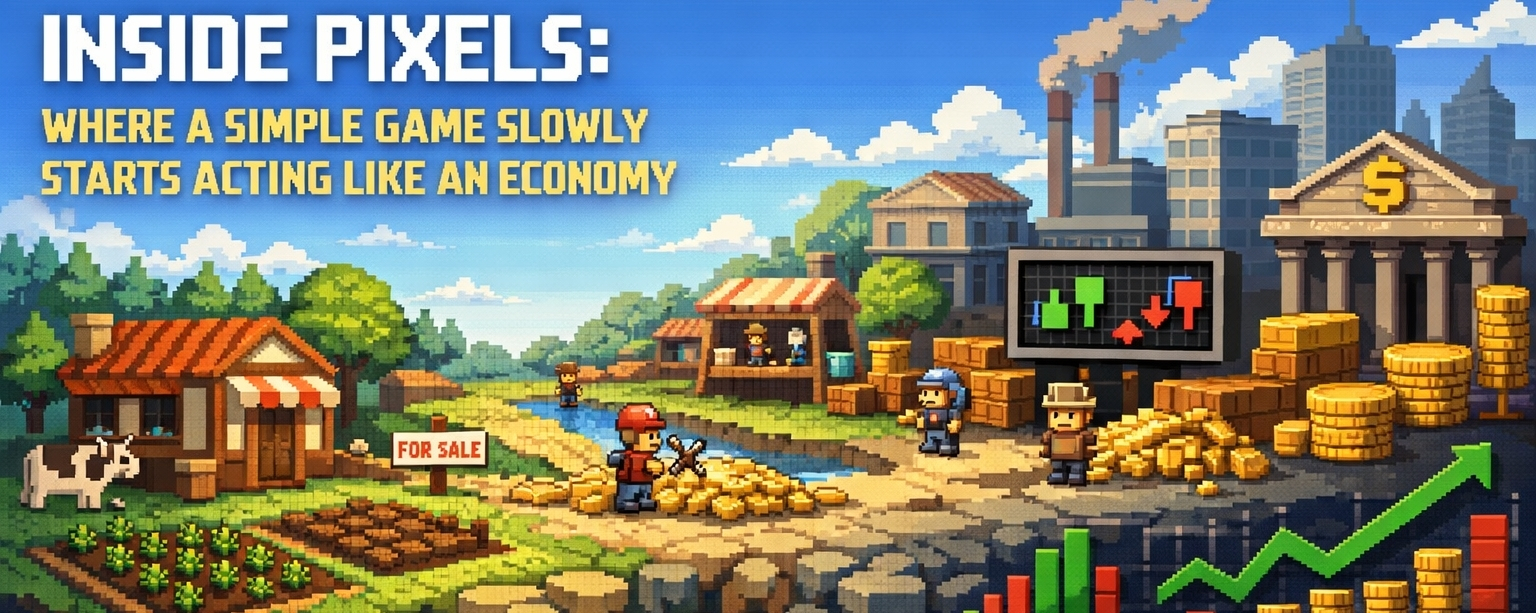

Honestly… the first time you open @Pixels , nothing about it screams “economy.”
It just feels like a simple game.
You plant crops. You walk around. You collect things. Maybe trade a little without thinking too much about it. It’s calm. Almost too calm. Like nothing serious is really happening underneath.
But if you stay with it a bit longer… something starts to shift.
Not suddenly. Slowly.
You begin to notice that players aren’t just playing — they’re repeating. Coming back at certain times. Focusing on specific tasks. Some optimize farms. Some move between areas collecting resources. Some start trading more than they explore.
No one tells them to do this.
But it starts happening anyway.
And that’s usually the first signal that you’re not just inside a game loop anymore — you’re inside something that’s beginning to organize itself.
At that point, the farming isn’t just farming.
It’s production.
Resources aren’t just items.
They’re supply.
And trading… stops feeling like a feature and starts feeling like circulation.
That’s where Pixels quietly changes its identity.
It doesn’t announce itself as an economy. It doesn’t push you into roles. It just creates enough structure for behavior to form on its own. And once players begin settling into patterns, the system starts doing something games don’t usually do very well — it begins to sustain activity through player coordination, not just design.
That’s a different kind of energy.
Because in most games, value is injected. Rewards are given. Systems are tightly controlled to keep progression moving. But here, value starts to feel like it’s moving between players instead of just coming from the game itself.
And when movement becomes consistent…
it starts to look like an economy.
But the more I sit with this, the more I realize it’s not as stable as it feels.
Because once a system begins acting like an economy, behavior changes in ways that aren’t always aligned with “fun.” Some players will keep playing casually. Others will start optimizing everything. Time, resources, trades — all of it.
And that’s where tension builds.
If too many players optimize for efficiency, the system can start feeling mechanical. If too few engage deeply, the economy doesn’t really form. It just stays as surface-level interaction.
So PIXEL is constantly balancing something invisible.
Between play… and production.
Between experience… and extraction.
And it’s not clear yet where that balance settles.
Because what makes it feel alive right now is how natural everything seems. Nothing is forced. Nothing feels overly engineered. But as more players enter, more value flows through the system, and more attention shifts toward optimization… that natural feeling becomes harder to maintain.
The system has to evolve.
Or it starts to feel predictable.
The more I think about it, Pixels isn’t trying to build an economy directly.
It’s creating the conditions where one can emerge.
And that’s a much slower, more fragile process than just designing rewards or adding tokens.
Because once an economy starts forming, you can’t fully control it anymore.
You can guide it.
You can shape incentives.
But the behavior… belongs to the players.
And maybe that’s the real shift happening here.
This isn’t a game turning into an economy overnight.
It’s a game slowly stepping back…
and letting players turn it into one.
The only question is when that transition becomes fully visible…
will it still feel like a game people want to stay in, or something they start treating like work?
