
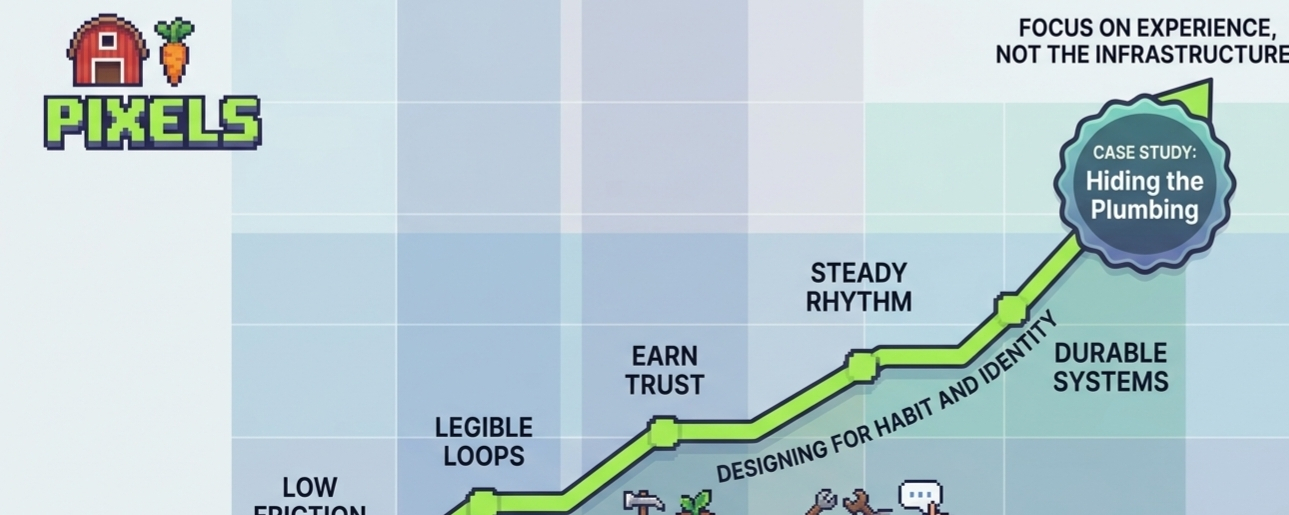
Pixels keeps showing up in conversations about Web3 gaming, and I understand why. It is one of the few projects in this space that at least tries to hide the plumbing until the player has a reason to care. That sounds minor. It is not. I’ve watched too many teams build the stack in reverse, then act surprised when users bounce before the product has done anything useful.
Most blockchain games still make the same mistake. They obsess over asset ownership, token sinks, marketplace flow, and reward distribution, then treat gameplay as the final integration layer. It’s a mess. You end up with products that are technically ambitious and practically exhausting. The user is expected to absorb wallet setup, economy rules, network behavior, and progression systems all at once. That is not onboarding. That is abandonment with extra steps.
Pixels works better than most because it starts somewhere more grounded. The surface area is familiar. Farming loops. Resource gathering. Crafting. Small tasks. A persistent world that asks for repeat visits instead of a huge one-time commitment. None of that is new, which is exactly why it works. Familiarity lowers cognitive load. It gives the system room to earn trust before it introduces complexity.
That is a real design decision, not just an art direction choice.
I tend to look at games like this less as games and more as distributed consumer systems with a game-shaped interface. Maybe that sounds cold. Fine. But once blockchain gets involved, the architecture matters whether the team likes it or not. State, ownership, latency tolerance, transaction design, identity, portability, reward emission, anti-abuse controls — all of that starts shaping the product long before the player has language for it. If those layers are exposed too early, the experience breaks. If they are buried too deeply, the economy becomes incoherent. There is no clean answer. The reality is messier.
Pixels at least seems aware of that tension.
What I find notable is not that it is built on Ronin. Not really. It is that Ronin gives it an environment where game-specific tradeoffs are more acceptable than they would be on a chain that treats gaming as an edge case. That matters. General-purpose infrastructure usually talks a big game about composability and scale, but once you start modeling actual consumer behavior, the cracks show fast. Players are impatient. They do not care about ideological purity. They care whether the product responds, whether progress is understandable, and whether the overhead stays out of the way.
I’ve seen this fail in products far better funded than Pixels.
A lot of teams think the answer is to make the user care more about the system. More tutorials. More token education. More dashboards. More “ownership narratives.” That usually means the product has already lost the argument. Good infrastructure does not require constant explanation. It supports the primary interaction and stays quiet unless something goes wrong. Anything else is engineering vanity dressed up as user empowerment.
Pixels gets closer to the right model by making the loop legible first. Plant. Wait. Harvest. Upgrade. Explore. Repeat. That rhythm is not glamorous, but stable systems rarely are. Stability often looks dull from the outside. I would take dull and durable over exciting and fragile every time.
The harder question is what happens after the first wave of attention. That is where projects like this usually get exposed. Early growth in Web3 is easy to misread. Activity spikes can come from incentives, curiosity, or temporary market conditions, and all three can vanish without much warning. A busy system is not necessarily a healthy one. A growing network is not necessarily retaining the right users. If people show up because the rewards are attractive but leave once the arithmetic changes, then what you built is not a game economy. It is a traffic pattern.
Pixels has had enough visibility that it cannot avoid that test.
That is why I find it more useful as a systems case study than as a hype object. It sits right on the fault line between product design and incentive design. If the economy becomes too dominant, the play layer starts feeling fake. If the play layer is too thin, no amount of economic engineering will save retention. If both layers are competing instead of reinforcing each other, users feel it immediately, even if they cannot describe it.
And users are usually right.
One thing the broader Web3 space still struggles to accept is that friction compounds. Every extra dependency, every extra token, every extra system that leaks into the interface increases the chance that the user stops. Not pauses. Stops. Teams love to talk about onboarding funnels as if drop-off were mainly a messaging problem. Often it is structural. The system is asking too much too soon. Pixels avoids some of that by narrowing the first experience to something people already know how to do. That is not revolutionary. It is disciplined.
Discipline is rare in this category.
I also think the project says something about infrastructure maturity. Not in the overused “this changes everything” sense. I mean something simpler. We are finally seeing a few teams accept that consumer-facing blockchain products need to feel less like protocol demonstrations and more like ordinary software. Reliable loops. Clear progression. Hidden complexity. Limited exposure to economic abstraction until the user has context. That should have been obvious years ago, but this industry burns an amazing amount of time rediscovering basic product principles.
Pixels is not clean. I would not pretend otherwise. No system carrying game logic, token logic, social logic, and on-chain ownership is clean. There are too many competing incentives and too many ways for one subsystem to distort the others. It only takes a poorly tuned reward model or a badly balanced extraction path for the whole thing to start optimizing for the wrong behavior. Then the community gets warped, the metrics get noisy, and the team spends months trying to patch a design problem with parameter changes.
I’ve watched that cycle enough times to be suspicious whenever a project gets described as “self-sustaining.” Usually it isn’t. Usually it is just temporarily aligned.
What Pixels appears to do better than most is acknowledge, implicitly at least, that the user should not have to solve the architecture. That is the architect’s job. The player should be allowed to inhabit the system without constantly negotiating with it. Once a game starts feeling like a spreadsheet with animation, it is already over. It may still have volume. It may still have speculation. But it has stopped being a durable consumer product.
That is why I keep coming back to Pixels. Not because I think it is the final answer. I don’t. But because it is trying to solve the right problem. How do you use infrastructure to support habit, identity, and return behavior without turning the entire experience into a lesson on how the backend works? That is the right question. Most teams ask louder ones because louder questions are easier to market.
Pixels asks the quieter one. That makes it more credible.
If this category is going to produce anything lasting, it will probably come from projects that treat blockchain as supporting infrastructure rather than the main character. That means fewer ceremonial mechanics, fewer exposed abstractions, and less demand on the user’s patience. It means designing for repeat behavior instead of event-driven spikes. It means understanding that ownership is not the product. Experience is the product. Ownership only matters if it strengthens experience without derailing it.
That is a hard balance. I have not seen many teams hold it for long.
Pixels has not fully solved it either. But at least it seems to know where the problem is, and in this space that already puts it ahead of the crowd. #pixel $PIXEL @Pixels
