
When people talk about systems like Pixels, they usually expect clear outcomes: growth, decline, success, or failure. But real digital economies rarely behave that way. They don’t collapse in a visible moment. They drift.
And that drift is what makes them interesting to study.
At the beginning, everything feels aligned. Users understand what to do, incentives are clear, and participation feels natural. The system and its users are temporarily pointing in the same direction.
But alignment is not a permanent state. It’s something that has to be continuously maintained.
The First Shift Is Almost Invisible
Most systems don’t break when something stops working. They start shifting when things still technically work, but no longer feel equally meaningful to everyone involved.
Users begin optimizing behavior differently. Some focus on rewards, others on shortcuts, others on minimal effort participation. The system still functions, but the shared interpretation of value starts to weaken.
Nothing crashes. Nothing fails. It just stops feeling unified.
When Participation Becomes Uneven
Over time, participation patterns become uneven. A small group stays deeply engaged, while a larger group interacts more selectively.
This doesn’t immediately damage the system. In fact, it often looks like normal scaling.
But underneath, something important changes: the average meaning of participation starts to vary across users. What “doing well” means is no longer consistent.
That’s where systems begin to lose alignment without losing activity.
Why This Matters More Than Volume
A common mistake is measuring systems only by how much activity they generate.
But volume alone doesn’t explain stability.
Two systems can have the same level of activity while having completely different levels of coherence. One behaves like a coordinated structure. The other behaves like disconnected participation happening in parallel.
The difference is alignment, not scale.
Where Tokens and Incentives Interact With This
In systems with tokens like $PIXEL , incentives help establish early alignment. They define what matters and guide behavior.
But over time, incentives alone are not enough to preserve that alignment. As users adapt, the system has to rely more on consistency of experience than on initial reward logic.
If that balance doesn’t hold, participation continues but meaning becomes fragmented.
Final Thought
The most important shift in digital economies is not visible growth or visible decline.
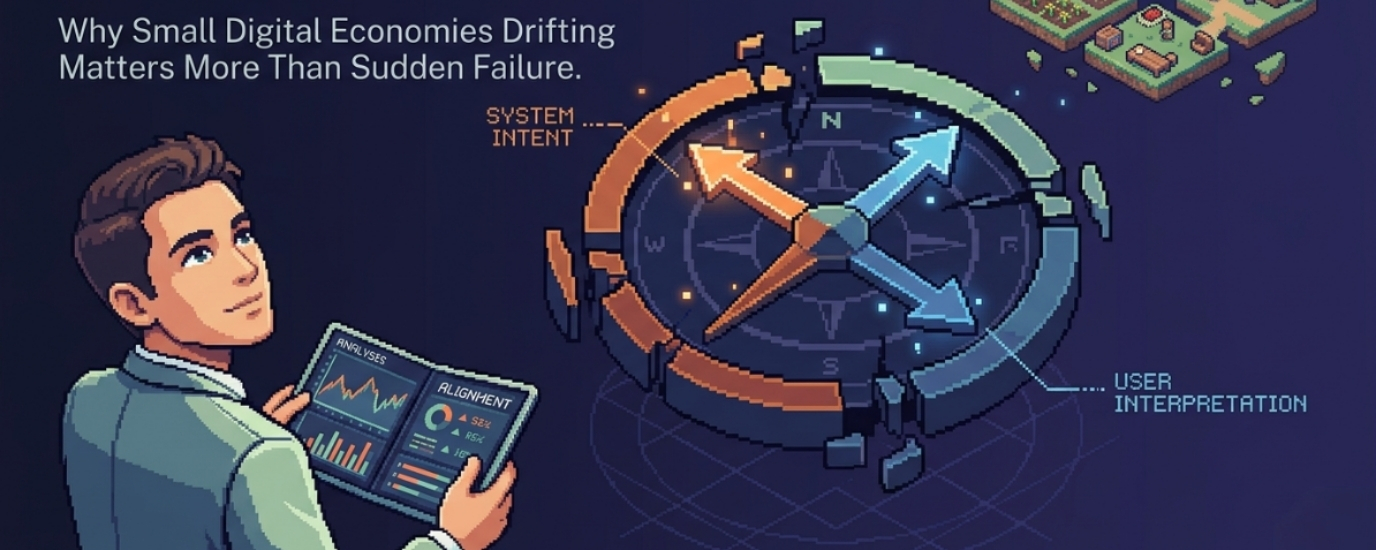
It’s the slow separation between system intent and user interpretation.
When those two remain aligned, systems feel coherent even at scale. When they drift apart, everything still works — but it stops working together.
And that difference is usually only noticed when it’s already well underway.