
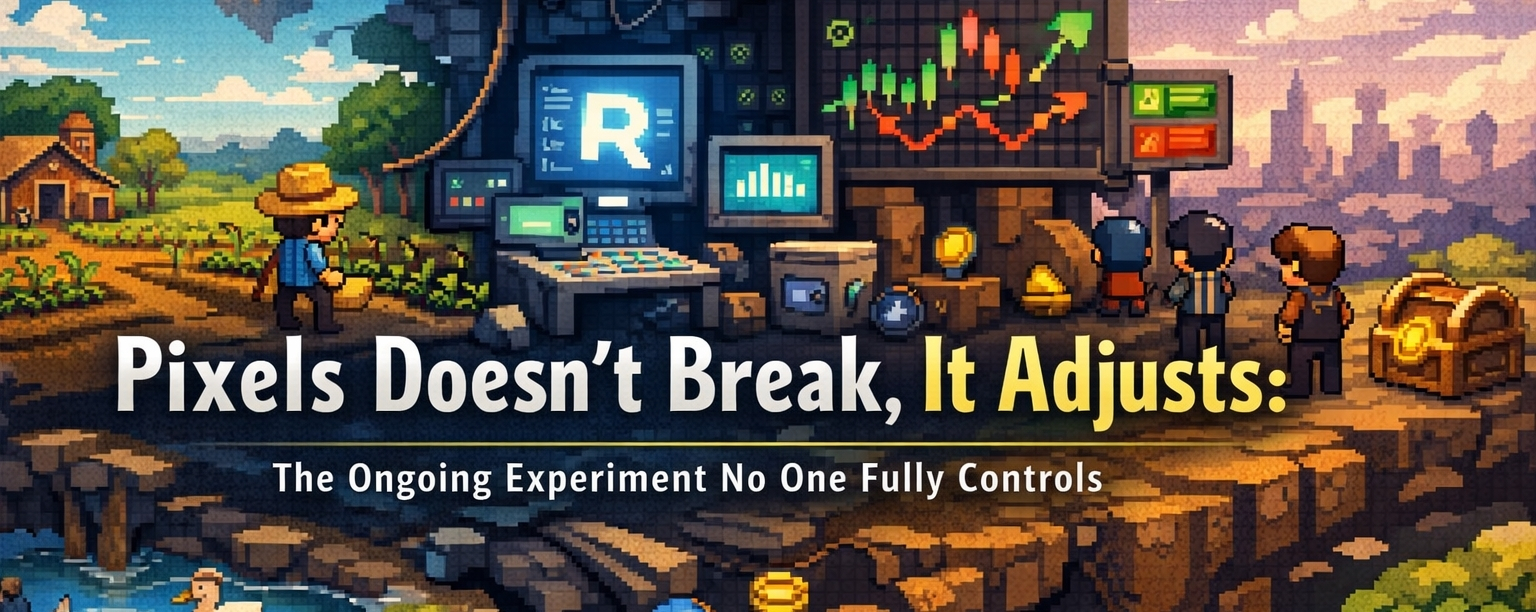

I’m watching the loop play out again—tiles changing, characters drifting between patches of land, small repetitive actions stacking into something that feels bigger than it looks—and I keep coming back to the sense that I’m looking at two different systems trying to occupy the same space; I’m not convinced they move at the same pace, or even aim for the same outcome, because one is clearly designed to feel light and effortless while the other quietly records, assigns value, and accumulates consequences, and that difference doesn’t break anything right away, it just lingers underneath everything.
On the surface, Pixels is easy to understand. You farm, you move around, you gather, you interact. It’s intentionally simple, almost disarmingly so. That simplicity works. You don’t need instructions, you don’t need prior context, you just start doing things and the system responds. In a space where most Web3 experiences overwhelm people early, this restraint matters. But the simplicity isn’t just for comfort—it increases activity. More actions, more participation, more engagement per minute. And because those actions are connected, even loosely, to ownership and tokens, they carry more weight than they seem to.
That’s where things start to shift. Once actions are tied to something persistent, they stop being just part of a game loop. They become part of a system that remembers. A crop isn’t just harvested—it’s produced. Time spent isn’t just time—it’s input. The design doesn’t force you to think this way, but over time, players begin to. They notice patterns, they test outcomes, they adjust behavior. The system invites that, even if it doesn’t say it outright.
The infrastructure underneath—like the Ronin Network—makes this possible in a practical sense. Transactions are cheap, fast, and frequent, which means small actions can be tracked without friction. That’s important, because without it, the entire model would slow down or become too expensive to sustain. But infrastructure only removes barriers; it doesn’t decide how people behave inside the system. It enables scale, but it doesn’t create balance.
And over time, behavior tends to settle into patterns. What starts as exploration slowly becomes optimization. Players figure out what works better, even if the differences are small. Certain actions become preferred, certain paths become efficient. The farming loop, which feels open at first, begins to narrow. Not because the design forces it, but because the system allows it. And once enough people follow similar strategies, the experience subtly changes for everyone else.
The developers can adjust things—rebalance outputs, introduce limits, add variability—but every change sends a signal. It tells players that the system is flexible, that outcomes can shift. That’s necessary, but it also creates a kind of second layer where players try to anticipate changes instead of just responding to what’s there. The game becomes partly about reading the system itself.
The social aspect adds another layer that isn’t immediately obvious. At first, it feels like a shared space—people moving around, doing similar things, existing together. But ownership introduces differences that build up quietly. Some players have more resources, better positioning, earlier access. These differences don’t explode into the open, but they shape interactions over time. New players enter a world that already has a structure, even if it’s not clearly visible.
There’s also a tension between different ways of engaging with the game. Some people play casually, enjoying the rhythm and repetition. Others look for efficiency, trying to get the most out of every action. The system doesn’t fully separate these approaches, so they overlap. Over time, the more optimized approach tends to influence the overall environment, even if the game still looks casual on the surface.
Friction shows up in places that aren’t obvious at first. A simple loop is easy to repeat, which also makes it easy to automate or partially optimize with minimal effort. Trying to prevent that adds complexity, but adding complexity risks breaking the accessibility that made the system appealing in the first place. So there’s a constant balancing act between keeping things open and keeping them controlled.
Another pressure comes from outside the game. If anything inside has real value beyond the game itself, then external changes start to matter. Prices shift, sentiment changes, and suddenly behavior inside the game adjusts even though nothing internally has changed. The system becomes connected to something it doesn’t fully control.
The bigger question isn’t whether people join, but what keeps them there. Early engagement can come from curiosity or incentives, but long-term engagement depends on whether the experience holds up on its own. If the value layer weakens, does the core loop still feel worth returning to? It’s not entirely clear yet. The answer probably isn’t fixed—it changes depending on how the system evolves.
Over time, players start to see more of what’s underneath. What begins as a simple environment becomes something more mechanical. People understand where value flows, where it builds up, where it can be redirected. The relationship with the game shifts. It’s less about just participating and more about understanding how to move within it effectively.
What’s interesting is that nothing here collapses outright. The system keeps going. It adjusts, it absorbs changes, it keeps functioning. From a distance, it can look stable. But that stability feels active, not natural—something maintained rather than something that just exists on its own.
I keep coming back to the idea that Pixels works because these layers haven’t fully pulled apart yet. The simplicity still holds, the incentives still align just enough, the infrastructure still supports the volume. But it feels like something that’s still in motion, still being shaped by how people use it, and I’m not fully convinced where it settles, or if it really settles at all, but it’s difficult to ignore how these pieces are starting to fit together, even if the fit isn’t completely clean.