
Most Web3 games didn’t collapse because they lacked players. They collapsed because they misunderstood why anyone would stay.
The industry spent years chasing attention as if attention were loyalty. Tokens were designed to spike, not to hold. Worlds were built to be entered, not inhabited. What looked like growth was often just movement—capital rotating through systems that never asked a harder question: what makes a player return when there’s nothing left to extract?
That mistake is now harder to ignore. The market has matured just enough to punish shallow design, but not enough to consistently reward depth. Builders are caught in a narrow corridor. If they lean too far into speculation, they lose credibility. If they lean too far into traditional gameplay, they lose the financial engine that brought Web3 into the room in the first place. Most projects try to balance both and end up convincing neither side.
The deeper problem is not technical. It is behavioral. People do not form attachment to systems that feel temporary. And most Web3 games, despite their scale and funding, still feel like events rather than places. They are experienced in bursts, not lived in. That distinction is where things break.
As the market evolves, this tension only tightens. Liquidity becomes more selective. Users become less forgiving. Time becomes the scarcest resource, not capital. The question shifts from “can you attract users?” to “can you hold them without bribing them?” That is a far more difficult problem, and it does not yield to marketing.
Pixels sits inside that pressure point.
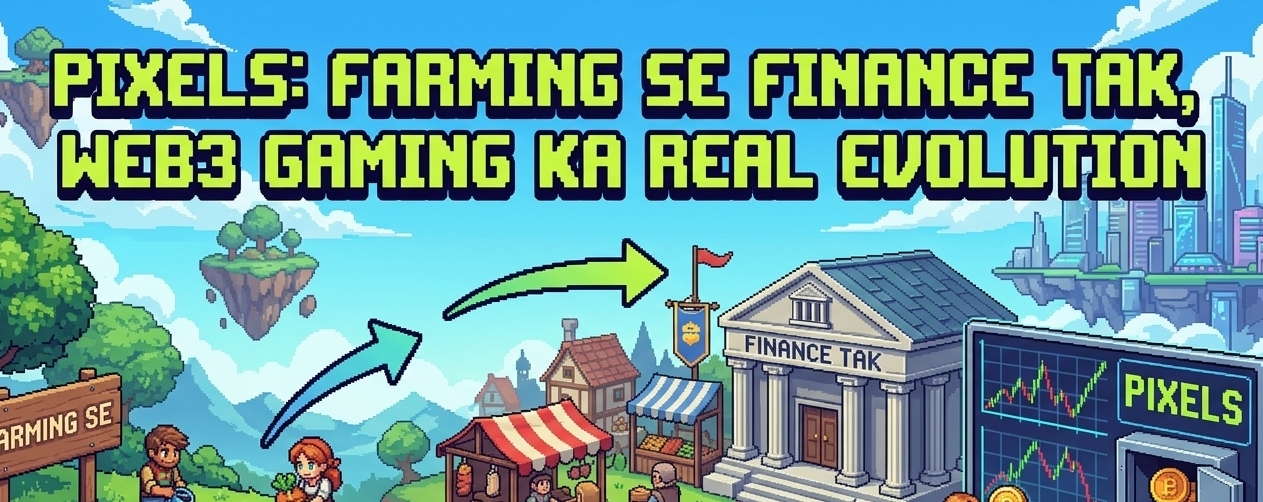
Not as a dramatic reinvention, but as a refusal to play the same game. A social, open-world environment built around farming, exploration, and creation sounds almost unfashionable in a market trained to chase intensity. There is no urgency in farming. No artificial scarcity in wandering. No obvious leverage in creating something that does not immediately convert into yield. That is precisely why it matters.
The decision to anchor the experience in slower, repeatable actions is not aesthetic. It is structural. Systems built on routine behave differently from systems built on spikes. They produce different user habits, different economic rhythms, different expectations. A player who logs in to maintain something is not the same as a player who logs in to exit something. One builds continuity. The other builds churn.
Running on the Ronin Network is not just a technical choice either. It signals alignment with an ecosystem that has already endured cycles of hype and correction. That matters because distribution in Web3 is rarely about visibility—it is about gravity. Where users already are, where they are willing to return, where they trust that time spent will not evaporate overnight. Pixels is not trying to invent gravity from scratch. It is stepping into an existing field and testing whether it can hold weight.
There are quieter decisions here that suggest restraint. The world does not overwhelm the user with urgency. Progression is not framed as a race. Interaction feels optional rather than forced. These are small choices, but they run against the dominant logic of Web3 design, which often relies on pressure to manufacture engagement. Removing pressure is risky. It exposes whether the environment itself is enough.
And that is where the real test begins.
Because a calm system can just as easily become an empty one.
Adoption will not hinge on whether the idea is sound. It will hinge on whether enough people find meaning in the loop without needing constant external incentives. Execution will not fail loudly; it will fail quietly if daily activity thins out, if social interactions never deepen, if creation becomes repetitive instead of expressive. The hardest part is not launching a world like this. It is sustaining it when novelty fades and the market looks elsewhere.
There is also the uncomfortable question of incentives. Web3 has trained users to expect upside, even when they claim to want experience. If Pixels leans too far into financialization, it risks becoming what it quietly resists. If it avoids it entirely, it risks being ignored by the very audience that made the space viable. That balance is not theoretical. It plays out in user behavior, in retention curves, in how quickly a community shifts from curiosity to indifference.
Timing complicates everything. The market is in a phase where patience is thin but expectations are rising. Projects that require time to reveal their strength often struggle to survive long enough to prove it. Pixels is, by design, a slower burn in an environment that still rewards speed.
None of this makes it fragile. But it does make it exposed.
What Pixels is really testing is whether Web3 can support environments that are not driven by extraction. Whether a digital world can feel persistent without relying on financial urgency. Whether players are willing to invest time into something that does not promise immediate return, but offers continuity instead.
That is not a small experiment. It cuts against years of learned behavior.
And the market has not yet decided whether that behavior can be unlearned, or whether it is the only thing holding attention together.
