
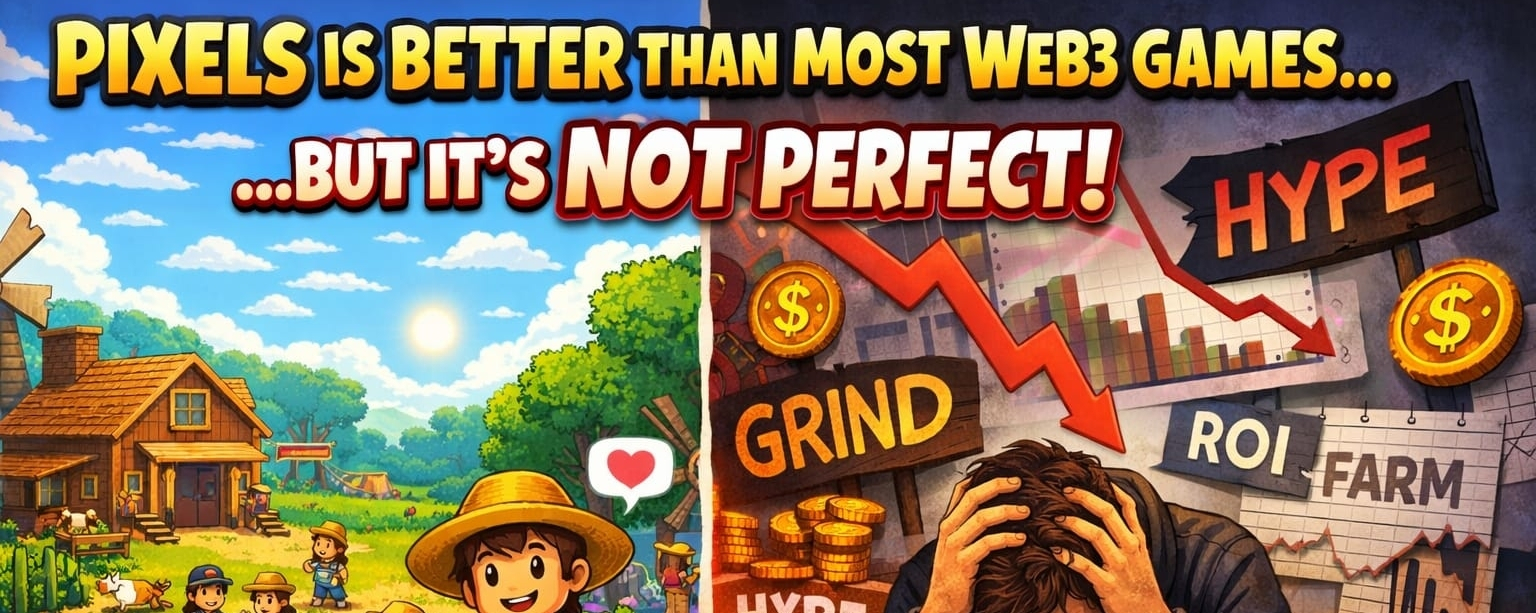
Most Web3 games have the same problem. They talk big, promise everything, and then give you a game that feels empty after ten minutes. Too much hype, not enough fun. That is why Pixels catches people off guard a little. It is still a crypto game, yes, and it still comes with the usual baggage, but at least it feels like there is a real game underneath all the noise.
Pixels runs on the Ronin Network and builds itself around farming, exploration, and social play. On paper, that does not sound exciting. Farming especially sounds like the kind of thing that should get boring fast. Plant crops, wait, harvest, repeat. But somehow that simple loop works better than you expect. It gives the game a chill rhythm. You log in, do a few things, move around, maybe trade, maybe run into other players, and before you know it, you have spent more time there than you planned.
That is probably the biggest reason Pixels stands out. It does not feel like it was made only for token farming. A lot of blockchain games feel like money systems wearing a game costume. Pixels is not fully free from that problem, but it is less obvious here. The world actually feels active. You see people around. The social side is not fake. It is not just a chat box sitting in the corner while everyone grinds alone. There is a real sense that other players matter to the experience.
The art style helps too. It has that simple pixel look that makes the whole thing feel lighter and less try-hard. It is easy to get into. Easy on the eyes. It does not scream, “Look at us, we are building the future.” And honestly, that is a good thing. The game works best when it stops trying to sound important and just lets people play.
Still, it is not all good. The grind is there. The repetition is there. And once money gets involved, people start treating everything like a strategy chart instead of a game. That is the part that drags Web3 games down again and again. Pixels has not escaped that. Some players are there for the world. Others are there for the economy. You can feel both sides pulling at the game.
But even with that, Pixels deserves some credit. It is one of the few projects in this space that feels playable first and “Web3” second. That should not be rare, but it is. It gives players a world they can actually spend time in without feeling like they signed up for unpaid work.
So no, Pixels is not some perfect example of the future of gaming. That would be a stretch. But it is proof that if a Web3 game is going to survive, it needs to remember one basic thing. People will stay for fun. They will not stay for hype forever.