
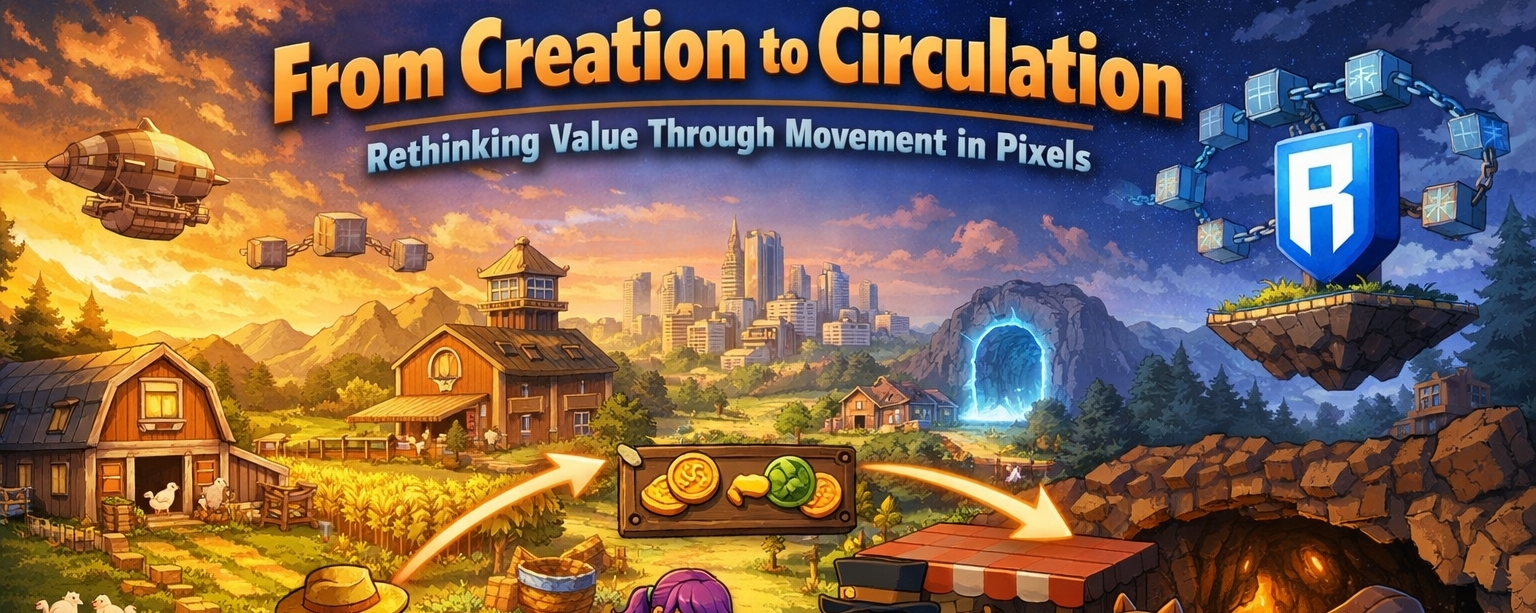

I used to look at projects like Pixels on the Ronin Network and think the story was already complete the moment something was built. A functioning game, a token, an open world that felt like enough. In my head, creation itself was the milestone. If it existed, it had value. Oh, yeah, that was the surface-level narrative I bought into without questioning what came next.
But that perspective started to feel incomplete the moment I began asking a more uncomfortable question: what actually happens after something is created? Not in theory, but in motion. Does it circulate, does it get reused, does it embed itself into behavior, or does it just sit there waiting for attention?
That shift changed everything for me. I stopped looking at what systems claim to enable and started observing how they behave when no one is watching closely. Because in reality, most systems don’t fail at design. They fail at integration. They can create assets, economies, interactions but those things often don’t sustain themselves once the initial excitement fades. Okay, so the real test isn’t creation. It’s continuity.
When I look at Pixels now, I don’t see just a farming game or a Web3 experiment. I see a system attempting to simulate an economy. Players farm, gather resources, craft items, and interact with each other in a shared environment. On the surface, it resembles a small digital society. But the real question is whether those activities translate into ongoing economic loops or if they remain isolated actions.
Think of it like a real-world marketplace. Growing crops only matters if someone needs them. Crafting tools only matters if they’re used repeatedly. If everything produced ends up sitting idle like unsold goods in a warehouse then the system isn’t alive, it’s just decorated with activity. That’s where the gap between creation and usage becomes obvious.
Structurally, Pixels does something interesting. It allows participants to interact directly through shared tasks and economies. Players don’t just play individually; they rely on each other’s outputs. One player’s resource becomes another player’s input. That’s the foundation of any functioning system interdependence. But interdependence alone isn’t enough. The outputs need to be reusable and relevant over time. If resources are consumed once and forgotten, the loop breaks. If they become part of a larger cycle, the system starts to resemble infrastructure rather than a game.
Network effects come into play here, but not in the exaggerated sense people often describe. Real network effects are quiet. They show up when each new participant increases the usefulness of the system for others without needing incentives to do so. If more players make the economy more efficient, more liquid, more engaging then you’re seeing something organic. If growth only happens during reward events or token distributions, then it’s not a network effect, it’s a temporary spike.
From a market perspective, Pixels sits in an interesting position. It has visibility, especially because of its association with Ronin, which already has a gaming-focused user base. But positioning is not maturity. Activity needs to be consistent, not just event-driven. If engagement rises sharply during reward campaigns and drops afterward, that’s a signal of incentive dependency rather than genuine usage. Participation also matters in distribution. If most of the activity comes from a small group of highly engaged users, then the system hasn’t fully expanded it’s concentrated.
This is where the distinction between potential and proven adoption becomes clear. The potential is obvious. A persistent world where digital labor translates into value, where users own and trade what they create that’s compelling. But proven adoption only exists when people return without being pushed, when they engage because the system itself is useful, not because it’s temporarily rewarding.
The core risk is simple, but easy to ignore. Is the usage continuous and self-sustaining, or is it driven by external incentives that eventually fade? Because real strength comes from repetition. A system that people use once is a product. A system that people use repeatedly without thinking becomes infrastructure.
And that brings me back to the real-world question. Why would anyone a player, a developer, even an institution keep using this system over time? Does it solve a problem, or does it just create an experience? There’s nothing wrong with experience, but infrastructure requires necessity. It needs to become part of routine, something that integrates into daily behavior rather than something people visit occasionally.
So now my framework is different. I’m not impressed by what gets built. I’m watching what keeps moving. If I see consistent interaction between users that doesn’t rely on rewards, if outputs from the system are being reused in meaningful ways, if participation keeps expanding without heavy incentives my confidence increases. If activity feels cyclical, tied to events, or concentrated among a small group, I get cautious.
In the end, I’ve stopped asking whether something works. I’m asking whether it lives. Because systems that matter are not the ones that simply create something they are the ones where that thing keeps moving, keeps being used, and quietly integrates into everyday activity without needing constant attention.