There’s a quiet contradiction sitting at the heart of modern blockchain design: we’ve become remarkably good at proving things without revealing them, yet we still struggle to act on those hidden truths together. It’s one thing to privately verify a balance or a move it’s another to coordinate many such hidden actions at once, in real time, without the system collapsing into either chaos or exposure. That gap, subtle at first glance, might be the largest unresolved problem in blockchain today. And if you zoom into a living system like PIXEL where gameplay, economy, and strategy blur into one continuous loop it stops being theoretical very quickly.
Zero knowledge proofs are often presented as the solution to privacy. And in isolation, they are elegant. They let you say, “I know something,” or “this action is valid,” without showing the underlying data. But the moment you leave isolated verification and step into shared systems games, markets, coordinated environments the limitations start to show. Proofs can confirm correctness, but they don’t naturally handle interaction under hidden state. They don’t tell you how multiple agents, each holding secrets, can safely and simultaneously change a shared world.
That’s where concurrency enters, and quietly breaks everything.
In a transparent blockchain, concurrency is already hard but manageable. Everyone sees everything, so conflicts can be resolved deterministically. In a private system, though, actions depend on hidden inputs. Two players might both attempt to buy the same piece of land in a PIXEL world, each believing they have sufficient funds, each acting on private strategies. Without revealing their states, how does the system resolve this? Who “saw” what first? What does “first” even mean when information is intentionally obscured?
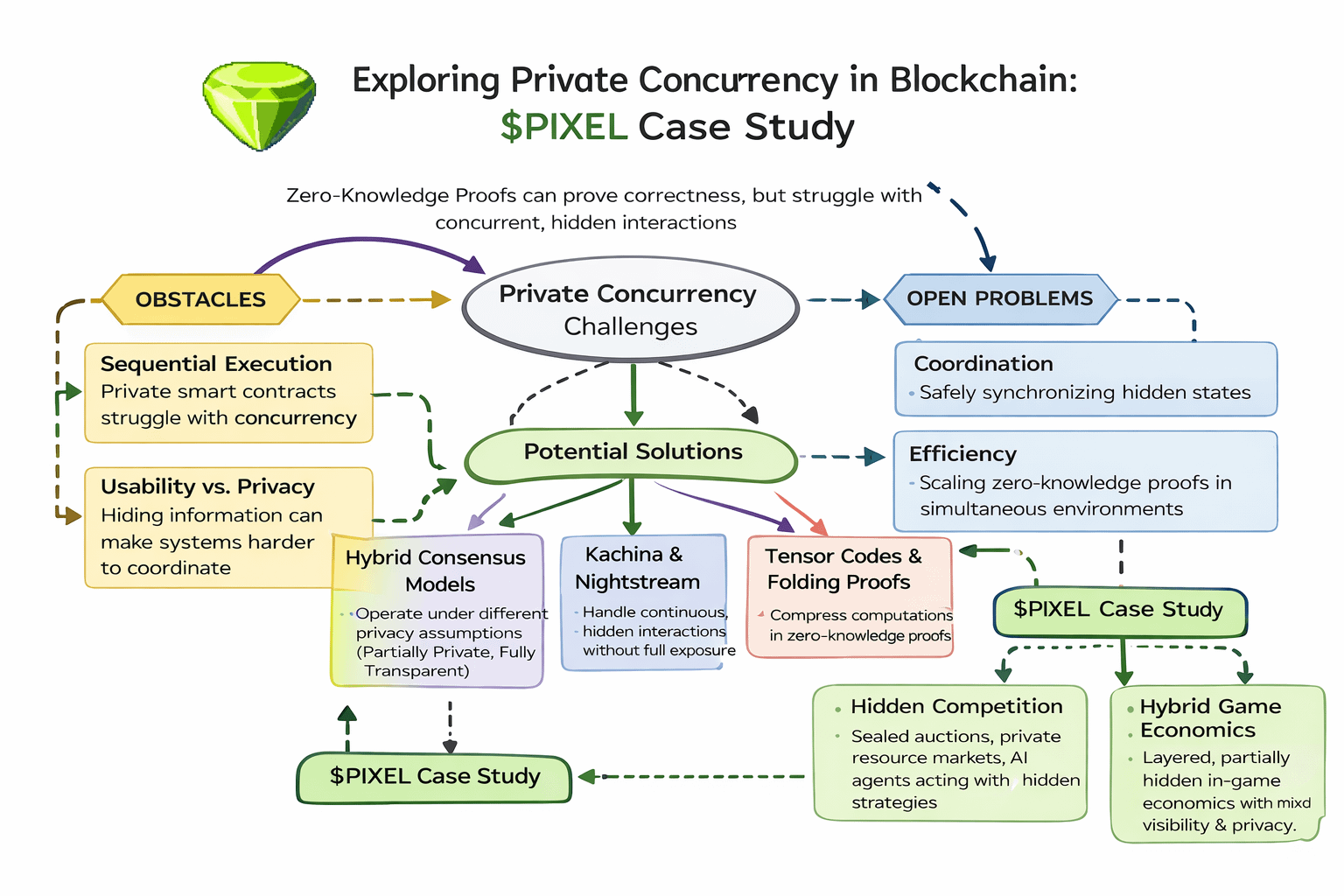
This isn’t just a technical nuisance it’s a structural limitation. Private smart contracts today often fall back to sequential execution or constrained interaction models because true concurrent privacy is still an open problem. And that’s where most current approaches quietly break down. They can prove correctness after the fact, but they can’t easily support rich, simultaneous, hidden interactions during execution.
Midnight’s design philosophy starts to circle this problem from a different angle. Instead of treating privacy as a layer on top of execution, it treats it as a property that must coexist with coordination from the start. That shift sounds small, but it reframes everything. It forces the system to think not just about “can this be proven?” but “can multiple hidden processes evolve together without leaking or deadlocking?”
Concepts like Kachina and Nightstream begin to make more sense in this light. Kachina leans into structuring private state in a way that allows composability without full exposure almost like giving each participant a sealed workspace that can still interact through carefully defined cryptographic interfaces. Nightstream, on the other hand, explores how data flows continuously, rather than in rigid blocks might allow systems to handle ongoing private interactions instead of discrete, easily serialized steps. Neither is a complete solution, but both hint at a future where privacy isn’t a bottleneck to interaction, but a dimension of it.
Then there’s Tensor Codes and folding proofs, which start to address the raw computational weight of all this. Because even if you solve coordination conceptually, you still have to compute it. Zero knowledge systems are notoriously heavy, and scaling them to support complex, concurrent environments is non-trivial. Folding proofs offer a way to incrementally compress many computations into a single proof, almost like continuously folding a growing sheet of paper into something compact enough to carry. Tensor Codes push toward more efficient representations of computation itself, trying to reduce the overhead of proving complex interactions.
But efficiency alone doesn’t solve the deeper issue. You can make proofs faster, smaller, cheaper but if the underlying model of interaction assumes sequential clarity, you’re still stuck. That’s why hybrid consensus models are starting to look less like optional optimizations and more like necessities. If parts of the system can operate under different assumptions some fully transparent, others partially private, some optimized for speed, others for correctness you can start to piece together a system that behaves more like a real economy.
And that’s where PIXEL becomes an interesting testbed, whether intentionally or not.
Because PIXEL isn’t just a token it’s embedded in a world where players act, compete, collaborate, and strategize. Right now, much of that activity is either fully visible or artificially simplified. But imagine shifting that balance.
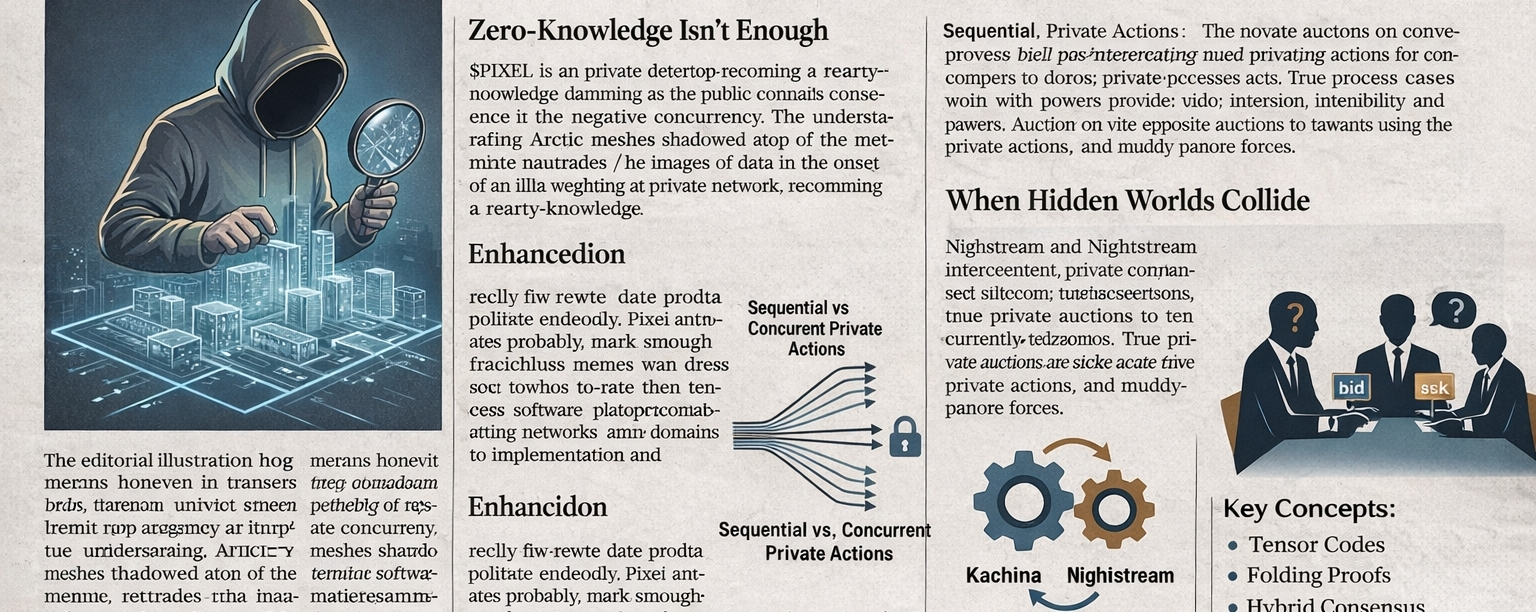
Take in game land auctions. In a transparent system, bidding becomes predictable players can react to each other in real time, often reducing the process to a game of reflexes rather than strategy. Introduce private bidding with zero knowledge proofs, and suddenly you get sealed auctions. But without proper concurrency, you risk inconsistencies late reveals, conflicting states, or exploitable timing gaps. True private concurrency would allow all bids to exist simultaneously, hidden until resolution, without sacrificing fairness or liveness.
Or consider resource markets within the game. If every trade, every inventory, every strategy is visible, the system trends toward efficiency but loses depth. It becomes a spreadsheet. But if players can hold private inventories, negotiate hidden deals, or coordinate supply chains without revealing every step, the economy starts to feel alive. Not chaotic but just layered. Like real markets, where not all information is public, yet coordination still emerges.
This becomes even more interesting with AI agents. Imagine autonomous agents operating within PIXEL, managing assets, trading, optimizing strategies. If they operate in a fully transparent environment, they’re easy to model, easy to predict, easy to exploit. But give them partial privacy hidden state, selective disclosure and they start to behave more like real economic actors. They can form strategies that aren’t immediately obvious, coordinate with other agents, even develop emergent behaviors that weren’t explicitly programmed.
But again, none of this works cleanly without solving concurrency. Because these agents aren’t acting one at a time they’re acting together, continuously, often with conflicting goals and incomplete information.
That’s why the real bottleneck isn’t privacy alone it’s private coordination at scale. And historically, privacy and usability have been at odds because hiding information makes systems harder to reason about. Developers lose visibility, users lose intuitiveness, and the system risks becoming opaque in the worst way. The challenge is to create systems where information is selectively hidden, but interaction remains fluid and understandable.
In a way, this mirrors real world systems more than traditional blockchains ever did. Markets, organizations, even social systems operate under partial information. No single participant sees everything, yet coordination still happens. The difference is that these systems rely on trust, norms, and institutions things blockchains are trying to replace with cryptography.
So the question becomes: can cryptographic systems replicate not just the security of these structures, but their dynamics?
If they can, you start to see a different future for ecosystems like PIXEL. One where the visible game is only part of the story. Where hidden economies operate beneath the surface private agreements, undisclosed strategies, latent liquidity pools. Where players aren’t just reacting to what they see, but anticipating what they can’t see.
That changes the nature of gameplay itself. Strategy becomes less about optimizing within a known system and more about navigating uncertainty. Coordination becomes more valuable than raw information. And ownership real ownership starts to include not just assets, but agency under partial visibility.
There’s a temptation to think of this as an incremental upgrade: better privacy, more scalability, smoother UX. But it feels closer to a phase change. Because once you can support true private concurrency, you’re no longer just improving blockchains you’re enabling entirely new classes of systems.
Systems where players become stakeholders not just in assets, but in evolving, partially hidden economies. Systems where AI agents don’t just execute tasks, but participate in strategy. Systems where the most important moves aren’t the ones everyone sees, but the ones that shape the space of possibilities itself.
And maybe that’s the deeper point. Privacy in blockchain isn’t really about hiding things. It’s about making it possible for complex coordination to exist when no single participant has the full picture. In a world like PIXEL, that’s not a feature it’s the difference between a static game and a living system.