
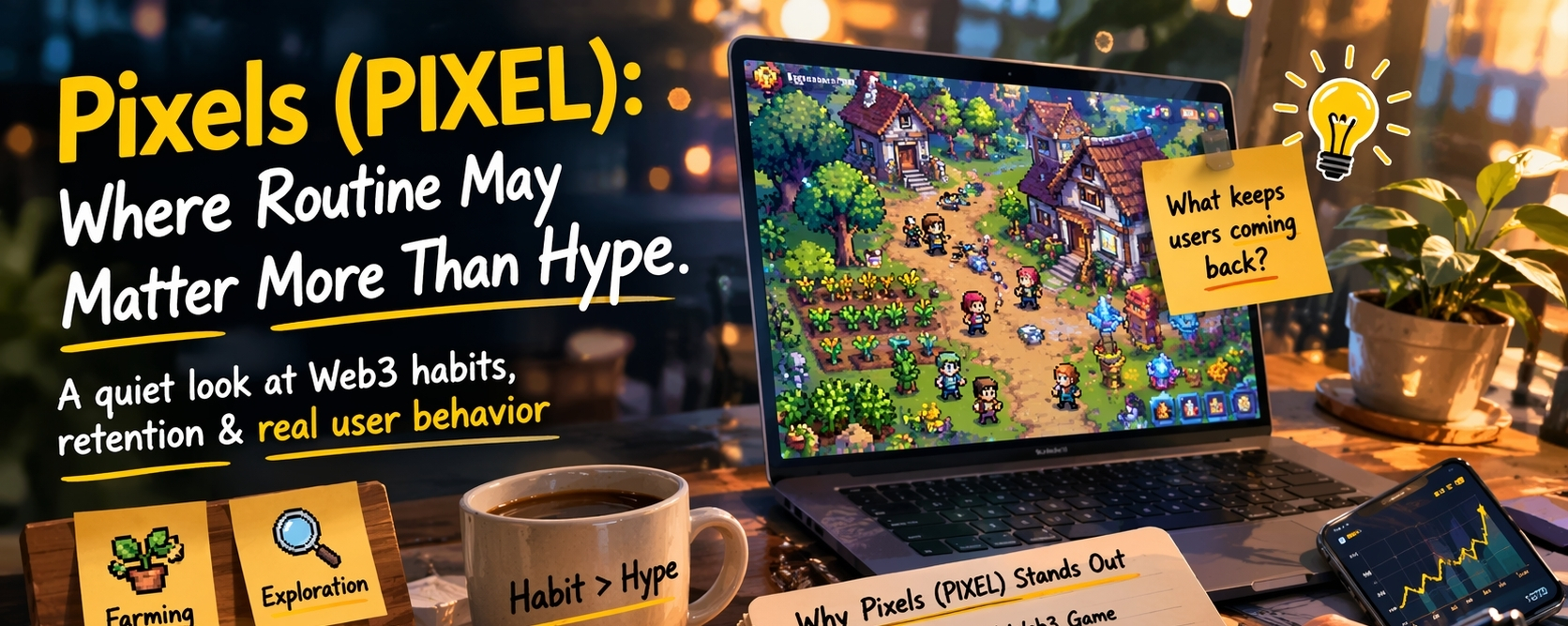
I’ve been noticing something for a while now. In crypto, people talk a lot about scale, narratives, and big moves, but very few stop to look at what actually keeps people coming back. Not just for a trade, but for a habit.
That gap feels bigger than most people admit. A lot of projects can attract attention for a few days. Very few can build something people want to return to when the noise dies down. Retention is still one of the hardest problems in this space.
That’s probably why Pixels stayed in the back of my mind. Not because it feels flashy, and not because it comes with some grand promise, but because it seems to be working in a quieter direction. It’s a social casual Web3 game on Ronin, built around farming, exploration, and creation.
At first glance, that might sound too simple for this market. Crypto usually likes things that feel technical, fast, and expensive to understand. But simple doesn’t always mean weak. Sometimes simple is the only thing that survives.
What makes this interesting to me is not the game loop itself. It’s the kind of behavior it encourages. When people log in regularly, build slowly, and interact naturally, you start getting something crypto rarely manages to create well, which is real user memory.
Memory matters more than people think. Users do not stay because of slogans. They stay because a place starts to feel familiar. A routine forms. Progress becomes personal. That kind of attachment is quieter than hype, but usually more durable.
I think that is where Pixels might matter structurally. The space has spent years trying to financialize attention, but attention is unstable. Trust is different. Trust comes when users stop feeling like they are being pushed and start feeling like they belong somewhere.
Ronin also plays a role here, and maybe a bigger one than people casually assume. Networks that reduce friction tend to matter most when users don’t have to think about them. Good infrastructure usually becomes invisible inside a smooth routine.
Main abhi bhi is bare mein unsure hoon, to be honest. Maybe I’m overthinking this. But I keep coming back to the idea that Web3 gaming does not need to win through spectacle. It might win through products that feel normal enough to become part of everyday digital life.
I’m not fully convinced the market knows how to price this yet. A lot of people still look at gaming tokens through a very old lens. They ask whether it can create fast excitement, but they spend less time asking whether it can create lasting behavior.
There is also a regional angle here that I think people overlook. In places where digital communities, side economies, and social identity already blend together, games like this can travel further than expected. Not because they dominate headlines, but because they fit naturally into how people already spend time online.
That does not mean Pixels is guaranteed to become something major. It just means it may be touching a deeper issue than most projects do. Crypto has not really solved the problem of keeping users engaged without constantly leaning on speculation.
So when I look at Pixels, I don’t immediately think about upside targets. I think about a quieter question. What if some of the strongest crypto products end up being the ones that people don’t just use for profit, but return to because it slowly becomes part of their day?