
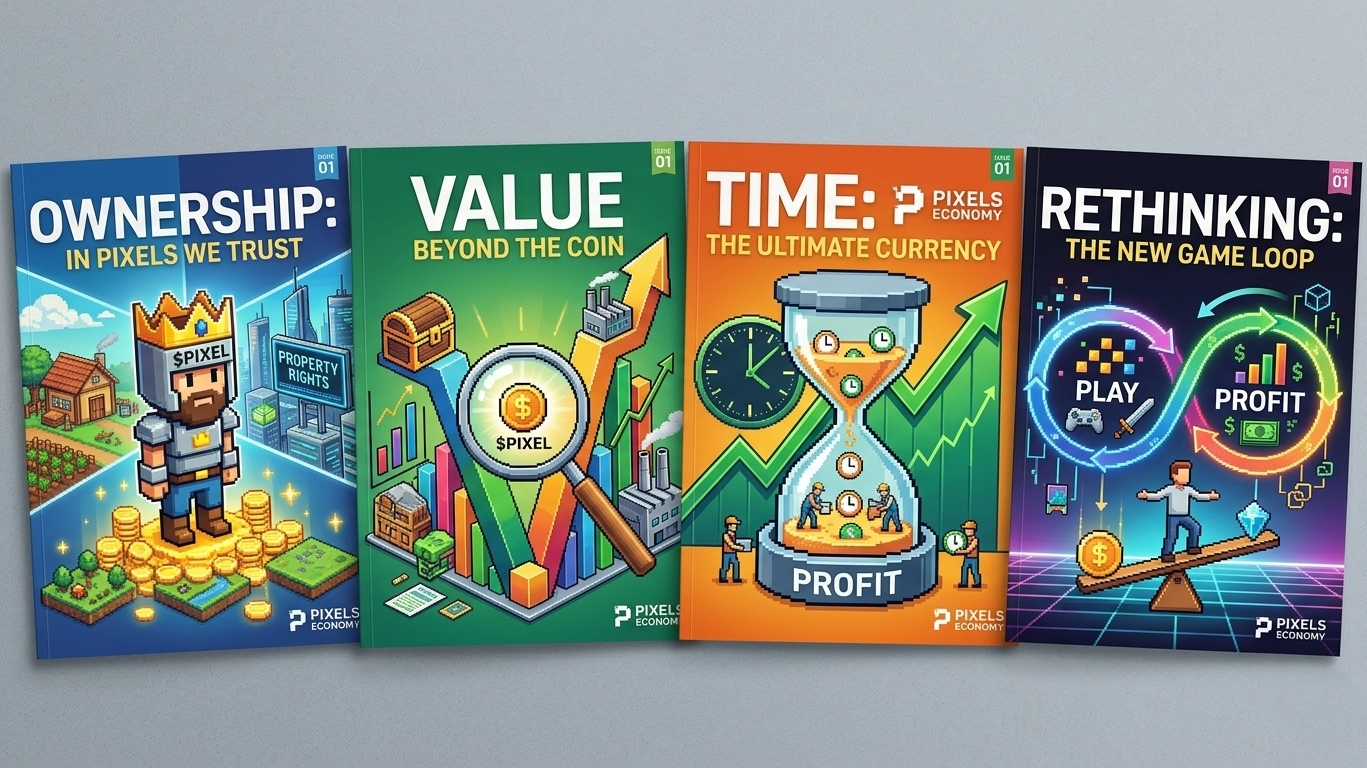
I still remember the moment I planted my first crop in Pixels. At first, I didn’t think much of it. I’ve played enough farming games to know the loop plant, wait, harvest, repeat. It’s familiar, almost comforting in its predictability. But something about this felt slightly different, though I couldn’t immediately explain why. It wasn’t the graphics or the mechanics; those felt intentionally simple. It was more like a quiet realization creeping in: I wasn’t just playing a game—I was participating in something that extended beyond it.
As I spent more time in Pixels, I began to notice how naturally it pulled me in. There was no aggressive push to understand blockchain, no overwhelming jargon thrown at me. I was just farming, exploring, crafting, and interacting with other players. Only later did it start to click that the items I was collecting, the resources I was managing, and even the land I was walking on had a different kind of significance. They weren’t just in-game objects. They existed in a system where ownership actually meant something.
That realization changed how I approached everything. Suddenly, my time didn’t feel disposable. In traditional games, I’ve always known whether I admit it or not that everything I earn stays locked inside the game. If I quit, it all disappears into memory. But here, there was this subtle shift. My effort had a form of persistence that felt unfamiliar. It wasn’t just progress; it was participation in a broader economy.
Still, I found myself questioning that feeling. Was this empowerment, or was it just a cleverly designed illusion? Because the moment real world value enters a game, things start to get complicated. I noticed it in my own behavior. I started thinking more strategically, more efficiently. Instead of wandering aimlessly, I caught myself optimizing—choosing actions based on potential returns rather than curiosity. That’s when I realized something important: the presence of value doesn’t just change the system, it changes me.
I’ve read about the failures of earlier play to earn games, where the focus on profit drained the life out of the experience. Players weren’t playing because they enjoyed it; they were working because they needed to. And when the economic structure collapsed, so did the community. Pixels seems aware of that history. It doesn’t aggressively sell the dream of earning. Instead, it builds a world first and lets the economic layer sit quietly beneath it.
But even with that approach, I can’t ignore the tension. I feel it every time I log in. There’s a part of me that wants to just enjoy the game to farm, explore, and interact without thinking about outcomes. And then there’s another part that’s constantly calculating, measuring, evaluating. It’s a strange duality, and I’m not sure which side will ultimately win.
What fascinates me most is how Pixels reflects something much bigger than itself. It’s not just a game it’s part of a larger shift toward digital ownership. For years, we’ve been living increasingly online lives, but we’ve never really owned anything in those spaces. Our accounts, our items, our achievements they’ve always been controlled by centralized systems. Pixels challenges that idea, even if only partially. It suggests a future where digital spaces might not just be places we visit, but places where we have a stake.
At the same time, I can’t help but think about the risks. Economies, whether digital or physical, are fragile. They depend on balance, trust, and continuous participation. If too many players focus on extracting value rather than contributing to the ecosystem, things can quickly spiral. Inflation, imbalance, collapse it’s all possible. And unlike traditional games, where imbalance might just mean a bad experience, here it could mean real loss.
I’ve also started thinking about the idea of digital labor in a way I never did before. When I’m playing Pixels, am I relaxing, or am I working? The line isn’t as clear as I’d like it to be. In some moments, it feels like pure enjoyment. In others, it feels like I’m managing tasks, almost like a job disguised as a game. And that raises a question I don’t think we’re asking enough: if games start to resemble work, what happens to the idea of play?
Yet despite all these questions, I keep coming back. There’s something compelling about the uncertainty, about being part of something that feels experimental and unfinished. Pixels doesn’t present itself as a perfect system. If anything, it feels like a prototype a glimpse into what might be possible rather than a final answer.
I think that’s why it stays with me. It’s not just about farming or earning or even owning. It’s about exploring a new kind of relationship with digital worlds. One where my actions might carry weight beyond the screen, where my time might translate into something tangible, even if that tangibility is still evolving.
And maybe that’s the real reason I find Pixels so interesting. It forces me to confront how I value my time, my effort, and my presence in digital spaces. It makes me question whether I’ve been underestimating the significance of the hours I spend online, or overestimating the value of systems that promise to reward them.
I don’t know if Pixels will succeed in the long run. I don’t know if its economy will stabilize or if its community will grow in a sustainable way. But I do know that it has already done something important it has made me think differently. Not just about games, but about ownership, value, and what it means to participate in a world that exists somewhere between virtual and real.
