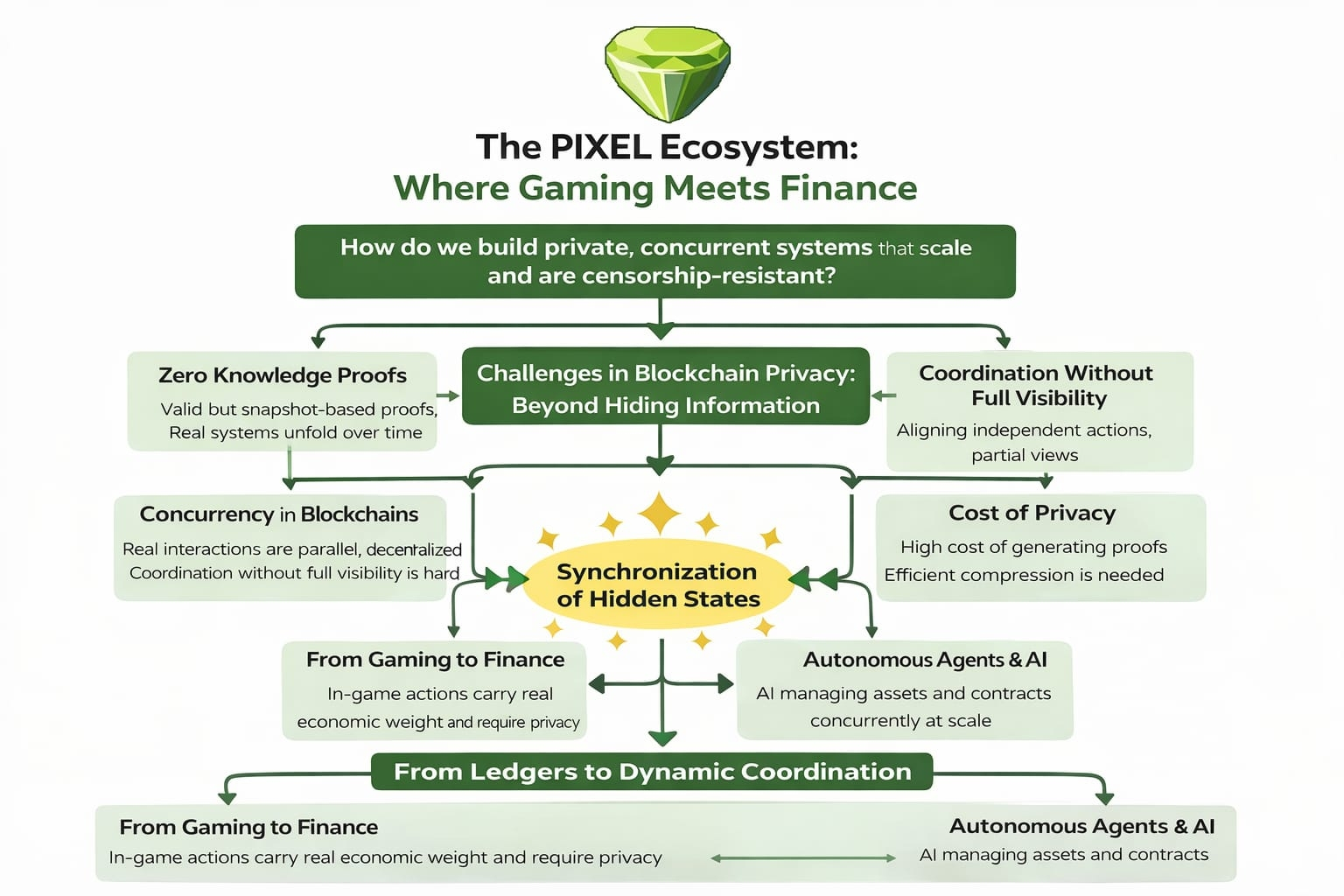
There’s a quiet assumption that keeps slipping into blockchain conversations: that privacy is mostly about hiding things. Encrypt the data, add zero-knowledge proofs, shield transactions and the problem feels solved. It’s a neat story. Clean. Technical. Satisfying. But it’s also incomplete. Once you move beyond simple examples and try to build something that behaves like a living system, the cracks start to show. The real challenge isn’t just hiding information. It’s coordinating it especially when no one can fully see what anyone else is doing.
Zero knowledge proofs are, in many ways, beautiful. They let you prove something is true without revealing the underlying data. You can confirm a transaction is valid without exposing balances. You can prove you meet certain conditions without giving away your identity. But there’s a catch: these proofs are snapshots. They tell you that something is correct at a specific moment. Real systems don’t live in moments they unfold over time, with multiple actors doing things at once, often unpredictably.
Think about something simple like a sealed bid auction. Everyone submits encrypted bids, and a system determines the winner without revealing the bids themselves. On paper, it works. But now add reality. What if two bids arrive at nearly the same time? What if someone tries to infer patterns from when others act? What if timing itself becomes a signal? Suddenly, privacy isn’t just about hiding values it’s about controlling how information leaks across time.
Most blockchain systems, even the ones that claim to support privacy, quietly rely on a simple idea: everything happens in order. One transaction after another. A clean, linear timeline. But that’s not how real interactions work. In any meaningful system whether it’s a market, a game, or a network of agents things happen simultaneously. People act independently. States evolve in parallel. Decisions overlap. That’s concurrency, and once you introduce it into private systems, things get messy fast.
You run into race conditions, conflicts, and unclear ordering situations where two valid actions can’t both exist, but neither side can fully see why. In a transparent system, you can at least inspect what went wrong. You can trace events, analyze logs, reconstruct history. In a private system, that visibility disappears. You’re trying to coordinate without ever seeing the full picture.
This is why some newer approaches feel different. Not because they rely on stronger cryptography, but because they shift the focus. Instead of forcing everything into a single shared pipeline, they explore what happens when private states are allowed to evolve independently and only synchronize when necessary. That idea sounds simple, but it changes the shape of the system. You move away from rigid, block-by-block execution and toward something more fluid, continuous, and asynchronous closer to how real world systems behave.
One of the more subtle shifts here is how time is treated. Traditional blockchains give you a shared sense of time because everything is publicly recorded. Private systems can’t rely on that. They need a different kind of time one that isn’t globally visible, but still consistent enough to allow coordination. If time leaks too much information, privacy breaks. If it hides too much, coordination fails. Balancing that tension is one of the hardest problems in this space.
There’s also a practical side to all of this: cost. Generating zero knowledge proofs isn’t cheap, especially as systems grow more complex. But new techniques like recursive or folding proofs are starting to shift that equation. Instead of verifying every step individually, you can compress entire sequences of computation into a single proof. If that becomes efficient enough, privacy stops being something you opt into and starts becoming a default assumption. But that only works if concurrency is handled correctly.
At its core, the difficulty comes from a simple tension. Transparent systems are easy to coordinate because everyone sees the same thing. Private systems are hard because no one does. Each participant operates with their own partial view of reality. The challenge is aligning those views without forcing anyone to reveal more than they want to. This tension shows up everywhere in finance, supply chains, identity systems anywhere coordination and confidentiality intersect.
Now add autonomous agents into the mix. If AI systems start managing assets, negotiating contracts, or interacting on behalf of users, privacy becomes non negotiable. An agent can’t function properly if its strategy is constantly exposed. But at the same time, these agents need to interact with each other, with markets, with systems and they’ll be doing it concurrently, at scale, and at machine speed. This creates a kind of pressure that existing blockchain designs weren’t built for.
If you zoom out, you can see the bigger shift happening. Blockchains are slowly moving away from being just ledgers and toward something more dynamic. They’re becoming coordination layers systems where not everything is visible, but things still need to work together. In that context, privacy isn’t just about secrecy. It’s about enabling interaction without exposure.
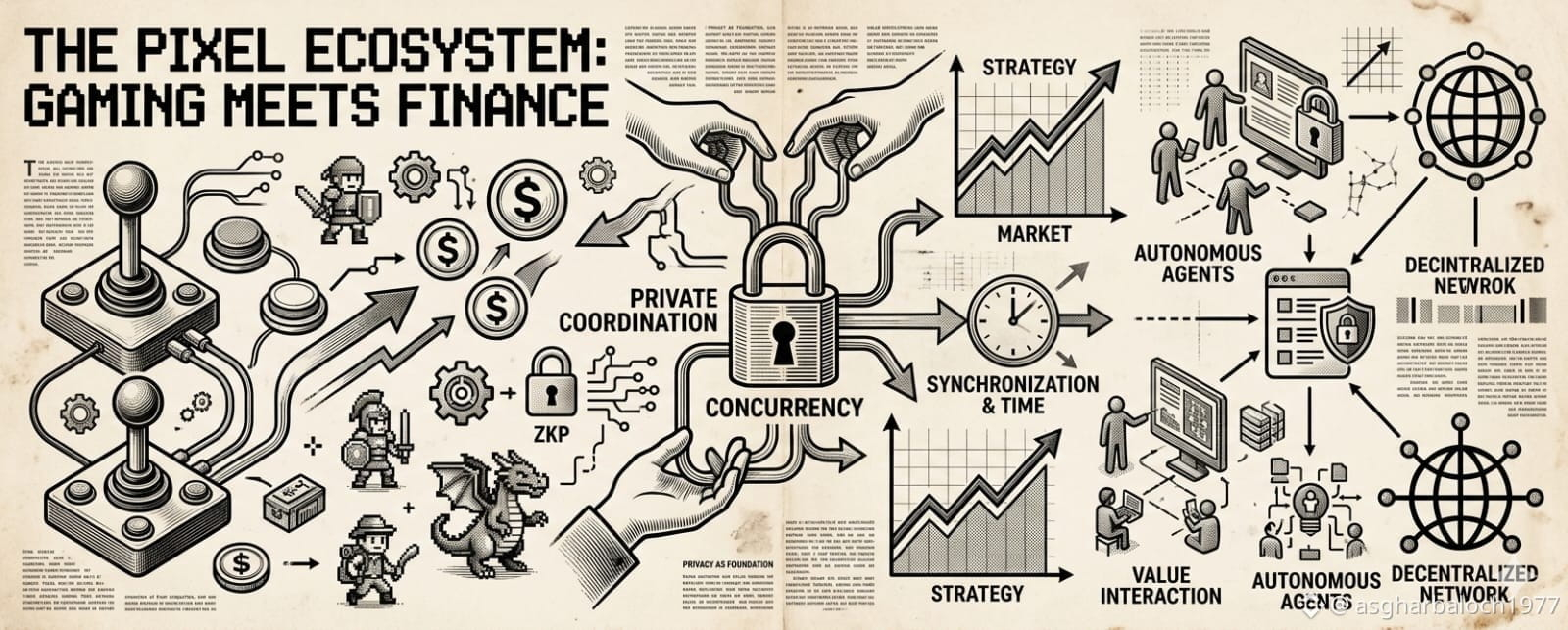
The PIXEL ecosystem hints at this shift in a subtle way. At first glance, it looks like a gaming economy players earn, trade, build. But when in-game actions start to carry real economic weight, and when those actions need to stay partially hidden to preserve strategy and fairness, you’re already dealing with private coordination. Gaming becomes a testing ground where financial logic, human behavior, and system design all collide in real time.
And unlike traditional finance, games naturally involve concurrency. Players act simultaneously. Worlds evolve continuously. Outcomes depend on interactions, not just isolated actions. In that sense, ecosystems like PIXEL aren’t just applications they’re early environments where deeper coordination problems begin to surface.
It’s tempting to think the next big breakthrough in blockchain privacy will come from better encryption or more efficient proofs. But that’s probably not where the real shift lies. The harder and more important problem is synchronization: how hidden states interact, how independent actors align, and how complex systems stay coherent when no one sees the whole.
Until that’s solved, private systems will always feel a bit fragile. They’ll work in controlled scenarios, but struggle under real world complexity. Solve it, though, and something changes. Privacy stops being a constraint and becomes a foundation not just a way to hide information, but a way to build systems that can grow, adapt, and coordinate without exposing everything inside them.