
It’s not the crops that break you. It’s the moment your loop stops scaling and you realize the bottleneck isn’t effort, it’s position.
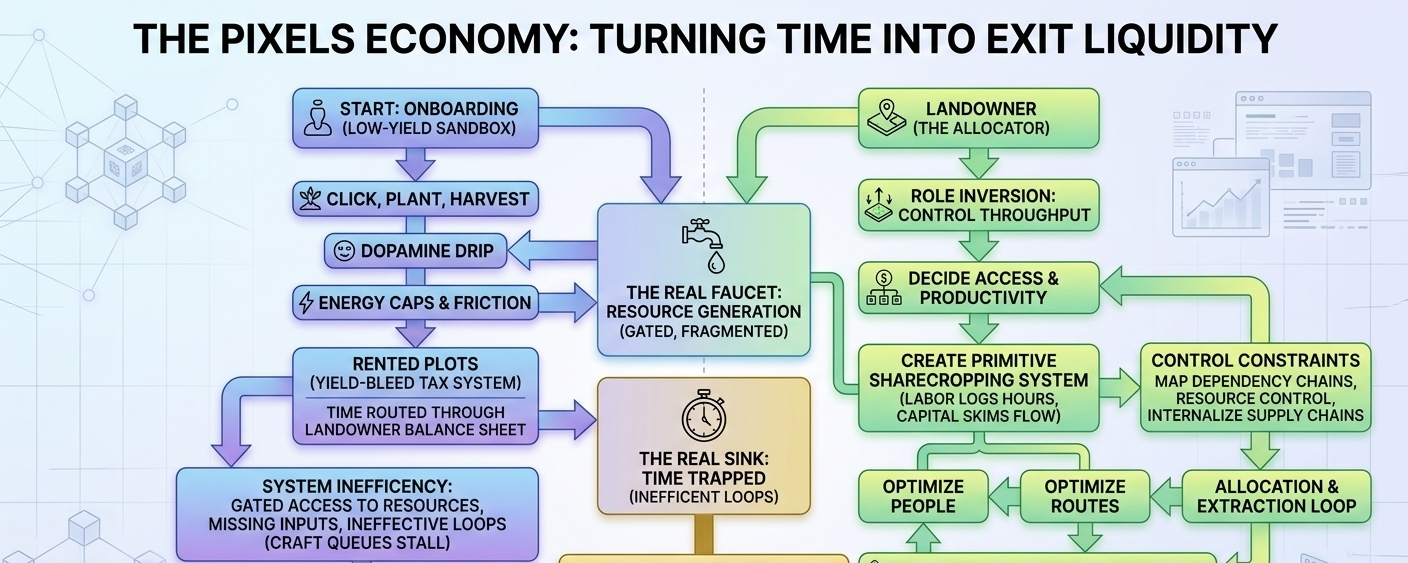
Everyone starts in the same lie. Click, plant, harvest, dopamine drip. The onboarding is clean on purpose. “Specks” feel like freedom, but they’re just a controlled environment, a low-yield sandbox where you can burn time without touching real throughput. You’re not early. You’re isolated.
Then the friction shows up.
Energy caps. Missing inputs. Craft queues stalling because the one component you need lives behind someone else’s land tier. That’s when it clicks: the game isn’t starving you of rewards, it’s starving you of access. And access in Pixels is a priced asset.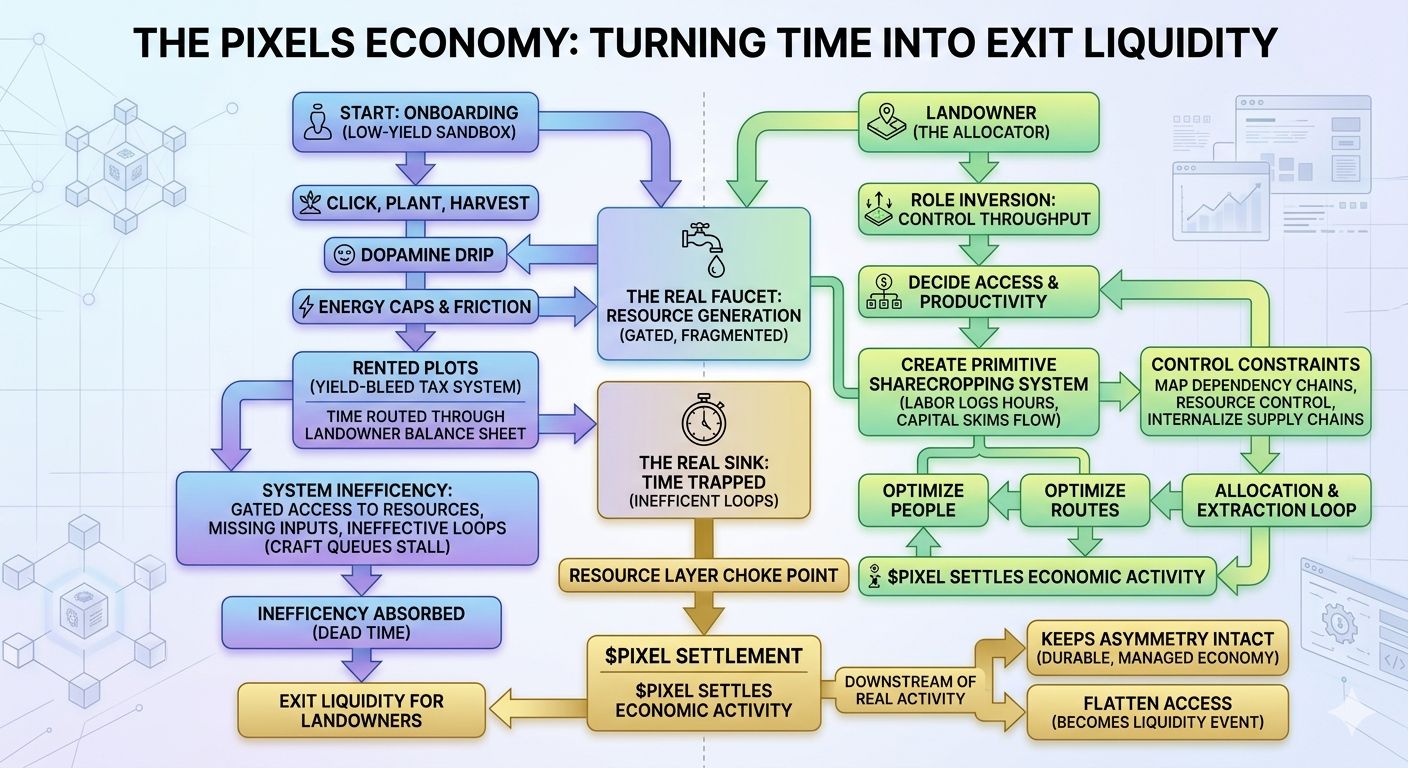
Rented plots are where most people think they’ve “leveled up.” Better output, more space, slightly less friction. But look closer, it’s a soft tax system. Everything you produce leaks. Yield-bleed by design. You’re effectively routing your time through someone else’s balance sheet, paying rent in perpetuity while convincing yourself you’re progressing.
Owned land flips the entire model. Not in a “more rewards” sense in a role inversion. You stop being throughput. You start controlling it.
Now you decide who gets access, who produces, and how much of that output you capture. It’s not gameplay anymore, it’s allocation. A primitive, on-chain sharecropping system where labor logs hours and capital skims flow. The cleanest extraction loop in the whole design.
And this is where most people miss the plot. They’re staring at $PIXEL emissions like it’s a standard P2E faucet, trying to model inflation curves, debating sinks vs sources. Wrong layer.
The real faucet is resource generation.
The real sink is time trapped in inefficient loops.
Resources aren’t evenly distributed, they’re gated, fragmented, and intentionally inconvenient. High-tier inputs sit behind ownership, progression trees, or logistical headaches that force coordination. You don’t just farm them. You negotiate for them. Or you pay.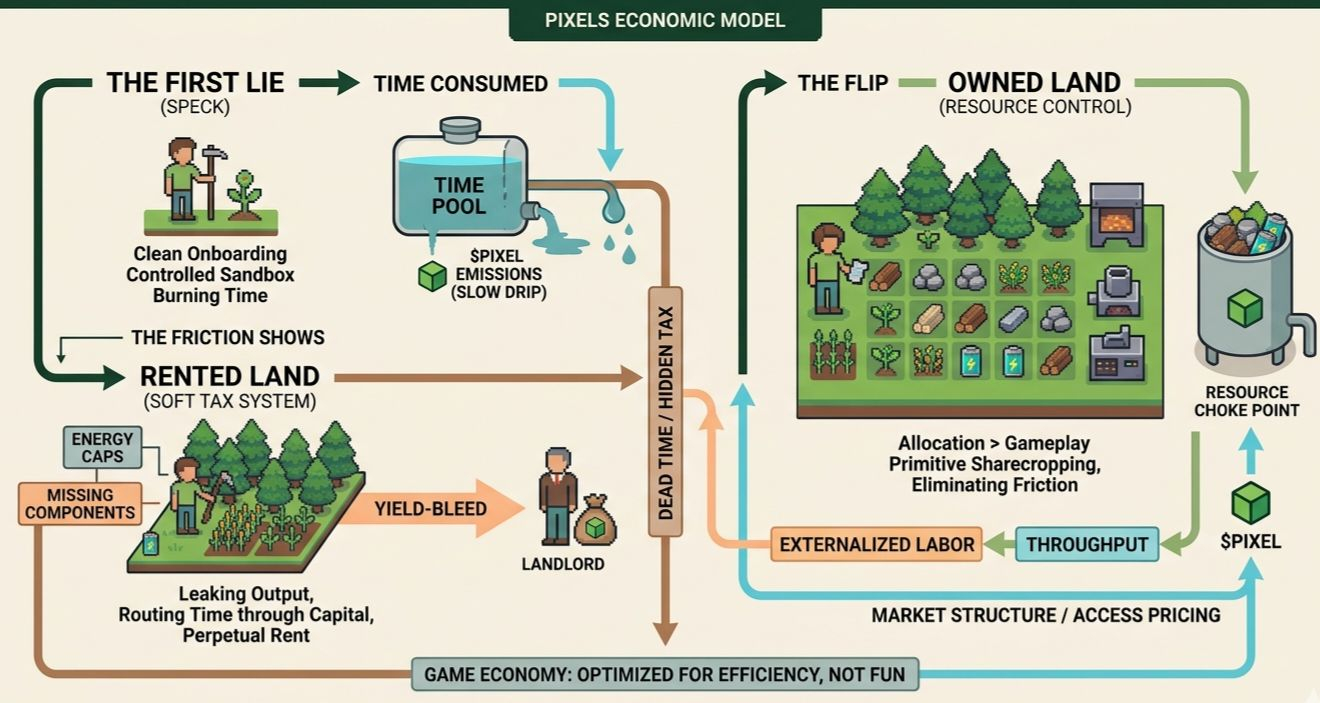
That’s not bad balancing. That’s market structure.
Because once resources become the choke point, everything else reorganizes around them. Crafting becomes a latency problem. Movement becomes routing optimization. Players start specializing not because they want to but because the system punishes generalists with dead time and broken loops.
And dead time is the quiet killer here. It’s the hidden tax nobody models. You think you’re earning, but half your session is spent waiting, traveling, or compensating for missing inputs. That inefficiency doesn’t disappear, it gets absorbed by whoever sits closest to the resource layer.
Landowners.
They don’t grind more. They eliminate friction. They internalize supply chains. They turn other players into externalized labor and compress the entire loop into something that actually scales. Everyone else is just patching holes in a system they don’t control.
That’s why $PIXEL hasn’t imploded like every other emission token dressed up as “gameplay.” It’s not carrying the economy, it’s settling it. The token is downstream of the real activity, not the reason it exists. As long as resources stay uneven and access stays priced, $PIXEL has somewhere to flow.
Kill the scarcity, flatten the access, and yeah it dies fast. Becomes another liquidity event with a farming minigame attached. But keep the asymmetry intact, keep the friction just high enough, and you get something more durable. Not a game economy. A managed one.
The uncomfortable part? This isn’t trending toward “fun.” It’s trending toward efficiency.
Players optimizing routes.
Operators optimizing people.
Capital optimizing both.
Most of the player base is still stuck optimizing crop cycles, arguing over marginal gains in output per hour. Meanwhile, a smaller cohort is mapping dependency chains, locking in resource control, and turning the rest into throughput.
That’s the land war. Quiet, slow, and already mostly decided.
You don’t win this by playing better. You win by owning the constraint everyone else has to route around.
