
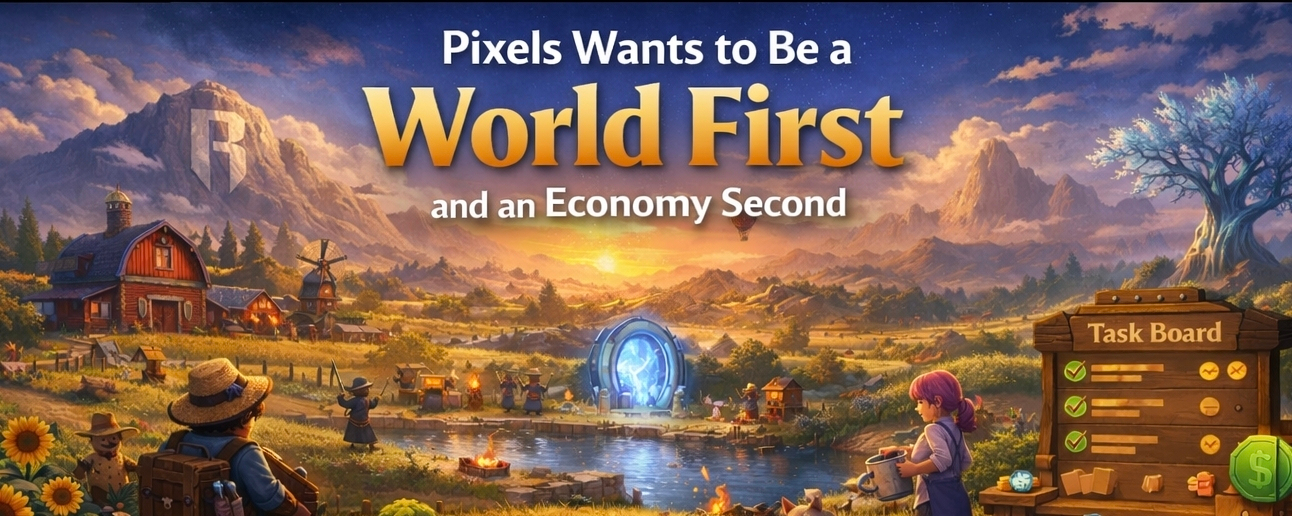

What keeps pulling me back to Pixels is not the farming, not the token, and not even the usual Web3 promise of ownership. It is the feeling that, for a little while, the game lets you forget what industry it belongs to. That may sound like a small compliment, but in crypto gaming it is a huge one. Most Web3 games still arrive with the same awkward energy. They want you to admire the rails before you care about the ride. They explain the economy before they create attachment. They treat financial logic as the hook, then wonder why the world itself never feels alive. Pixels, at its best, does the opposite. It lets the world make the first impression and keeps the machinery slightly out of focus.
That is why I think Pixels matters. Not because it “onboarded users” or “proved product market fit” or any of the other phrases people use when they want to make a game sound like a dashboard. It matters because it stumbled into a more human truth about Web3 design. Most players do not want to feel like they are entering an economy when they log in. They want a mood. They want rhythm. They want lightness. They want a world that feels easy to step into, easy to understand, and easy to return to tomorrow. Pixels gets closer to that than most crypto games because it is built around repetition that feels soft rather than extractive. You move, plant, harvest, craft, complete tasks, and socialize in a way that feels casual enough to lower your guard. By the time the economy becomes visible, the habit is already forming.
To me, that is the real meaning of “entertainment first” in Web3. It does not mean incentives disappear. It means they arrive later, after the player has already built some emotional tolerance for the system. Pixels does not remove financial logic. It times it better. That may be the smartest thing it ever did.
The Task Board captures this perfectly. A lot of people look at it and see a reward engine, which it obviously is. But when I look at it, I see a design decision about psychology. The Task Board gives shape to your session. It turns a potentially messy open economy into a guided day. It tells you where value is flowing without making the game feel like a spreadsheet. That is a subtle achievement. In most onchain environments, optimization shows up too early. The player starts asking, “What is the fastest route? What is the most profitable behavior? What should I farm?” In Pixels, those questions still come, but they come after a softer layer of routine has already formed. The system is not less economic. It is just better disguised.
And I think “disguised” is the honest word here. People often talk about Pixels as if it escaped the old play-to-earn trap. I do not think it escaped it. I think it delayed it, softened it, and wrapped it in something friendlier. That is different. It is still impressive, but it is different.
Because if you stay with Pixels long enough, the pleasant illusion starts to thin out. The more seriously you engage, the more clearly you can see that not every player is moving through the same world. Some are playing a lighter, smoother, more profitable version of the game than others. VIP changes the quality of your loop. Reputation determines what doors open. Marketplace activity, withdrawal freedom, guild creation, earning efficiency, and broader participation are all shaped by invisible filters that become visible only after you care enough to notice them. Early on, Pixels feels like a cozy social world. Later, it begins to reveal itself as a system that sorts, qualifies, and ranks.
That is the part I find most interesting, because it says something larger about Web3 design. The real tension is not between fun and finance. It is between immersion and legibility. The more legible the economy becomes, the harder it is for the world to remain just a world. Once players can clearly see where value sits, how access is structured, and which behaviors pay better, the atmosphere changes. The game is still playable, still charming, still social. But a different part of the brain turns on. You stop simply inhabiting the world and start positioning yourself inside it.
Pixels has already lived through the consequences of that shift. The $BERRY issue is the clearest example. I actually think the project deserves credit for how revealing that moment was. It showed that even a game that feels more playful than financial can still get pulled back toward extraction once players learn the system too well. Soft currency inflation was not just a tokenomics problem. It was proof that the world had become economically readable enough for people to pressure it at scale. And that is the curse of Web3 games that work. The better they are at creating consistent behavior, the more likely that behavior is to be optimized.
This is where my view on Pixels departs from the usual praise. I do not see it as the game that solved Web3 gaming. I see it as the first major example of a crypto game that understood the emotional sequencing of retention, but still could not escape the structural gravity of financialization. That is a much more interesting story than either bullish celebration or easy skepticism.
Because if you look at Pixels’ more recent direction, you can feel the project responding to that reality. More controlled reward routing, more emphasis on participation frameworks, more staking logic, more effort to shape how value moves rather than letting it spill freely. Features like union-based competition and newer extensions like Stacked suggest to me that Pixels is slowly discovering its own deeper identity. It may look like a cozy farming game on the surface, but underneath it is becoming something closer to an operating system for reward coordination. That is both its opportunity and its risk.
The opportunity is obvious. If Pixels can build systems that make onchain participation feel light, social, and habitual, that logic can travel far beyond one game world. It can become a broader layer for engagement across experiences. But the risk is just as real. The more successfully Pixels turns itself into reward infrastructure, the harder it becomes to preserve the original magic that made the game feel human in the first place. A world can survive a hidden economy. It struggles once the hidden economy starts becoming the main reason the world exists.
That is why I keep coming back to one simple thought: Pixels works best when it feels like it is slightly embarrassed by its own crypto-ness. I mean that as a compliment. Its strongest moments are the ones where the chain fades into the background, where the game trusts routine more than rhetoric, and where progression feels like texture instead of financial strategy. Its weakest moments are the ones where the optimization layer becomes too visible and the player starts feeling less like a resident and more like a participant in a managed system.
Maybe that is unavoidable. Maybe every successful Web3 game eventually becomes readable as an economy because blockchains are very good at turning play into measurable behavior and measurable behavior into strategic behavior. But that is exactly why Pixels deserves to be studied seriously. It is not a perfect success story. It is a very revealing compromise. It shows that crypto games become more compelling when they stop talking like crypto products and start behaving like places people can casually inhabit. But it also shows that once value, access, and status harden underneath the surface, the old tensions return.
My own takeaway is not cynical. If anything, Pixels made me more convinced that entertainment first is the right direction. I just think people misunderstand what it can actually solve. Entertainment first does not eliminate the economy. It buys the game time before the economy takes over the feeling of play. That is still valuable. In fact, it may be the only realistic path Web3 gaming has. But it is not a final victory. It is an ongoing balancing act.
Pixels is compelling to me because it feels like a game constantly trying to protect its own softness from the systems underneath it. Sometimes it succeeds beautifully. Sometimes the architecture shows through. And maybe that is the most honest way to describe it. Pixels is not proof that Web3 can become invisible. It is proof that invisibility, when it works, is what makes Web3 finally feel tolerable, maybe even enjoyable, to ordinary people. The challenge is that once the player learns where the value is, the spell weakens. The farm is still there. The friends are still there. The world still has charm. But somewhere in the background, the spreadsheet has started breathing again.