
Most projects in this space tend to follow the same pattern. New token, new reward loop, familiar promises about ownership and earnings. It often feels like different packaging around the same idea, and over time that repetition makes it harder to take any single project seriously at first glance.
That’s why something like Pixels doesn’t immediately stand out for what it shows, but for what it’s slowly trying to become.
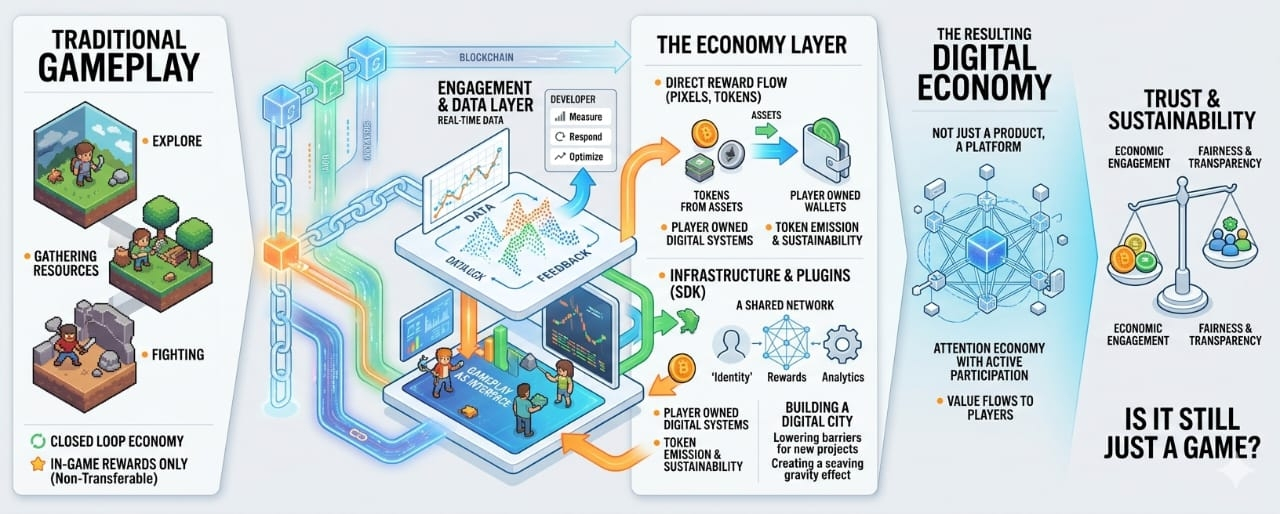
On the surface, it still looks familiar. There are rewards, tokens, data systems, SDKs. Nothing there feels entirely new. But when you step back a little, the framing changes. It starts to look less like a game trying to monetize engagement and more like a system trying to turn engagement itself into an economy.
That shift is subtle, but it changes everything.
Traditionally, a game is a contained experience. You play, you progress, you leave. Even when there are in game economies, they are usually closed loops. What you earn only matters inside that world. Pixels seems to be pushing beyond that boundary, treating the game not as the product, but as the entry point into a broader network.
In a way, it feels similar to how media evolved. A movie used to be just a story. Now it sits inside a much larger system where data, distribution, user behavior, and monetization all interact. The content is still there, but it is no longer the whole picture. Pixels appears to be moving in that same direction, where gameplay is just one layer of a bigger structure.
The first layer most people notice is the reward system. It looks simple. You play, you earn something. But underneath that simplicity is a deeper idea about value flow. On today’s internet, users create value indirectly. You spend time, platforms capture attention, and that attention is sold elsewhere. Here, the attempt is to push some of that value directly back to the player.
So your time inside the game is no longer just engagement. It becomes something measurable, something that can be priced.
At first, that feels empowering. But over time, it introduces a different kind of pressure. When rewards become central, the reason for playing can slowly shift. Instead of asking is this fun, the question becomes is this worth it. And when that happens, the experience starts to feel less like a game and more like a loop you optimize.
Behind that sits the data layer, which is probably the most important part of the whole system. It does not just track what players do. It learns from it. Every action feeds into a structure that can understand patterns, adjust incentives, and even anticipate behavior.
From a developer’s perspective, this is incredibly powerful. You are no longer guessing what players want. You can see it, measure it, and respond to it in real time. But there is also a tradeoff. The more a system becomes predictable, the less room there is for surprise. And surprise is a big part of what makes games feel alive.
Then comes the infrastructure side, which is where things start to expand beyond a single game. Pixels is not just building for itself. It is building a framework that other developers can plug into. Identity, data, rewards, everything becomes shared across a network.
It is like building a city instead of a single shop. Once the roads and systems are in place, others can come in and build on top of it.
For developers, this lowers barriers. You do not have to start from zero. You get access to users, analytics, and economic systems from day one. But it also creates a kind of gravity. Once you are inside that system, leaving it is not so simple.
Over time, they have also tried to bring more structure into the economy itself. Things like reward dashboards, staking models, emission control. These are not just features. They are attempts to solve one of the biggest problems in this space, which is sustainability. Instead of rewards being an uncontrolled cost, they become something that is actively managed.
And when you zoom out far enough, the whole model starts to resemble something bigger than gaming. It looks a bit like an attention network, but with a different interface. Instead of ads, you have gameplay. Instead of passive scrolling, you have active participation. And instead of all the value flowing to the platform, some of it is redirected back to the user.
That is where things get interesting, but also where they get complicated.
Because once behavior, data, and money are all connected, trust becomes the central issue. People are naturally cautious when systems start to feel like they are watching, predicting, and rewarding them at the same time. Add token volatility on top of that, and the uncertainty grows.
If rewards fluctuate too much, engagement becomes unstable. If everything feels engineered, people start to question fairness. And if trust is not there, even a well designed system can struggle to hold attention over time.
So the question comes back again. If a game evolves to this point, is it still just a game
Maybe not.
It starts to feel more like a digital economy that uses games as its interface. The gameplay is still there, but it is no longer the full story. It becomes the way people enter, interact, and generate value inside a much larger system.
But this is still an experiment. Nothing here is fully proven. The real challenge is not the technology or the design. It is whether people actually want this kind of experience in the long run.
Do players want games to become part of their economic life, or do they still want spaces that exist purely for play
Right now, there is no clear answer. Just a lot of attempts, a lot of iteration, and a slow shift in how we think about what a game can be.
And maybe that uncertainty is the most honest part of all this.
