
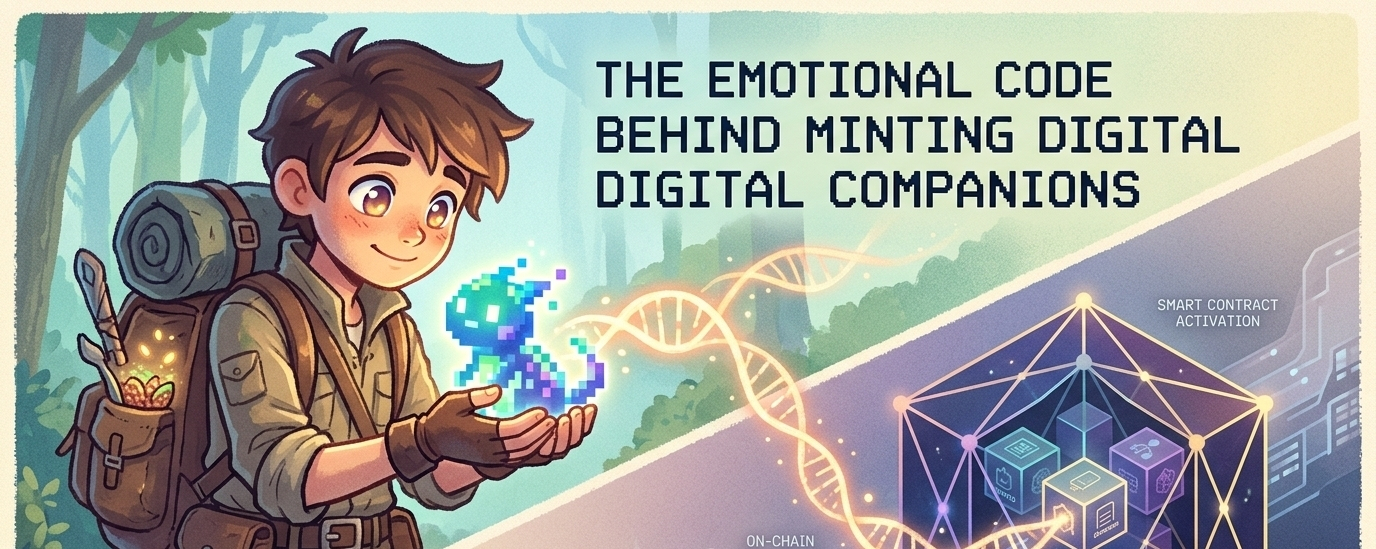
It starts quietly. You enter a simple world made of soft colors and slow rhythms. Nothing feels urgent. You plant, you wait, you explore. At first, it feels like any other casual game, the kind you open just to pass time. But something subtle begins to happen. The longer you stay, the more you realize this world is remembering you. Not just your progress, but your choices, your effort, your consistency. And before you even notice it, you’re no longer just playing. You’re building something that feels like it matters.
That’s the space where Pixel Pets are born. Not as a flashy feature or a forced mechanic, but as a natural extension of everything you’ve already been doing. You don’t begin with the intention of owning one. Instead, you slowly grow into the idea. You gather resources, you learn systems, you invest time. And somewhere along that journey, the option appears to create something that doesn’t just exist inside the game, but belongs to you in a deeper way.
Minting a Pixel Pet is not a single moment. It’s a process that unfolds gradually. You prepare for it without even realizing it at first. You collect items through gameplay, you craft what’s needed, you engage with systems that require patience rather than speed. There’s a sense of buildup, a quiet anticipation that forms as you move closer to the final step. And when that moment finally arrives, it doesn’t feel like pressing a button. It feels like completing a journey.
Behind that experience, something much more technical is happening. The game tracks your actions off-chain, allowing everything to remain smooth and responsive. There are no interruptions, no friction pulling you out of the experience. But when the pet is finally ready to be created, a different layer activates. A smart contract takes over, finalizing the process, assigning traits, generating uniqueness, and minting the pet onto the blockchain. At that point, it becomes permanent. It moves beyond the boundaries of the game and into your control.
What makes this design powerful is how invisible it feels. You’re not constantly reminded that you’re interacting with blockchain technology. You’re simply playing, progressing, building something step by step. And then suddenly, that progress solidifies into something real. Something you can hold, trade, or keep for as long as you want. That transition from invisible systems to tangible ownership is where the experience changes emotionally.
In most digital environments, nothing truly belongs to you. You spend hours, sometimes years, building accounts, collecting items, reaching milestones. But deep down, there’s always an understanding that it’s temporary. That it exists only as long as the system allows it. Pixel Pets challenge that idea in a quiet but meaningful way. When you create one, it becomes part of your digital identity. Not just an object, but a reflection of the time and effort you’ve invested.
And that’s where the emotional connection begins to form. Because it’s not just about owning something rare. It’s about knowing how it came to exist. You remember the steps. The waiting. The decisions you made along the way. That memory becomes attached to the asset itself. So when you look at your pet, you’re not just seeing data stored on a blockchain. You’re seeing a piece of your own journey.
The economy surrounding this system reinforces that feeling. Nothing is given freely without reason. Resources are earned through effort. Decisions carry weight because they involve trade-offs. If everything were easy to obtain, it would lose meaning almost instantly. Instead, the system creates just enough friction to make each step feel important. You think before you act. You plan before you commit. And because of that, the outcome feels more valuable.
At the same time, the system avoids becoming overwhelming. By keeping most interactions off-chain, it preserves the simplicity and flow of gameplay. You’re not calculating transaction fees or worrying about delays. You’re focused on what you’re building. That balance between complexity and simplicity is what allows the experience to remain engaging without becoming exhausting.
As more people enter the system, patterns begin to emerge. Some players focus on growth, investing time into developing their pets and strengthening their position. Others explore trading, seeing value in the marketplace dynamics. And some simply enjoy the routine, logging in each day to maintain what they’ve created. These behaviors tell a deeper story than any price chart ever could. They show that the system is not just functioning, but resonating.
Still, there’s an underlying fragility that can’t be ignored. If too many pets are created without control, their uniqueness begins to fade. If rewards become too predictable, curiosity disappears. And if the focus shifts too heavily toward profit, the sense of connection weakens. These are challenges every Web3 ecosystem faces, and they require constant adjustment. Balance is not something that can be achieved once and left untouched. It has to evolve alongside the players themselves.
Looking ahead, the possibilities stretch far beyond what exists today. Pixel Pets could become more than companions. They could evolve based on long-term behavior, developing traits that reflect not just how they were created, but how they’ve been cared for over time. They could move across different environments, becoming part of a broader digital identity that exists beyond a single game. The foundation is already there. What comes next depends on how that foundation is expanded.
What makes all of this truly compelling is not the technology itself, but the feeling it creates. You begin by exploring a simple world, expecting nothing more than a casual experience. But over time, you find yourself caring in ways you didn’t expect. You check in regularly, not because you have to, but because you want to. You make decisions carefully, knowing they have lasting impact. And without realizing it, you become emotionally invested in something digital.
That shift is small, but it’s powerful. It suggests a future where digital experiences are no longer disposable. Where time spent in virtual worlds carries weight that persists beyond the moment. Where what you build stays with you, instead of disappearing when you move on.
