
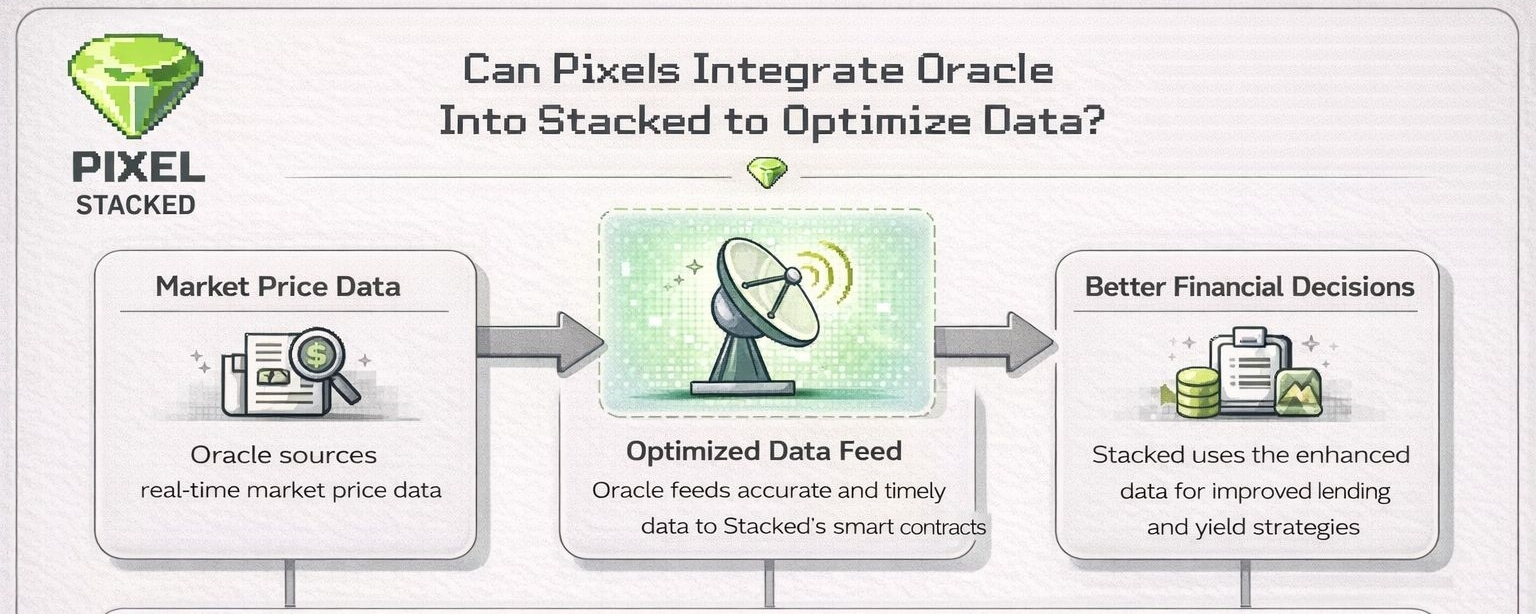
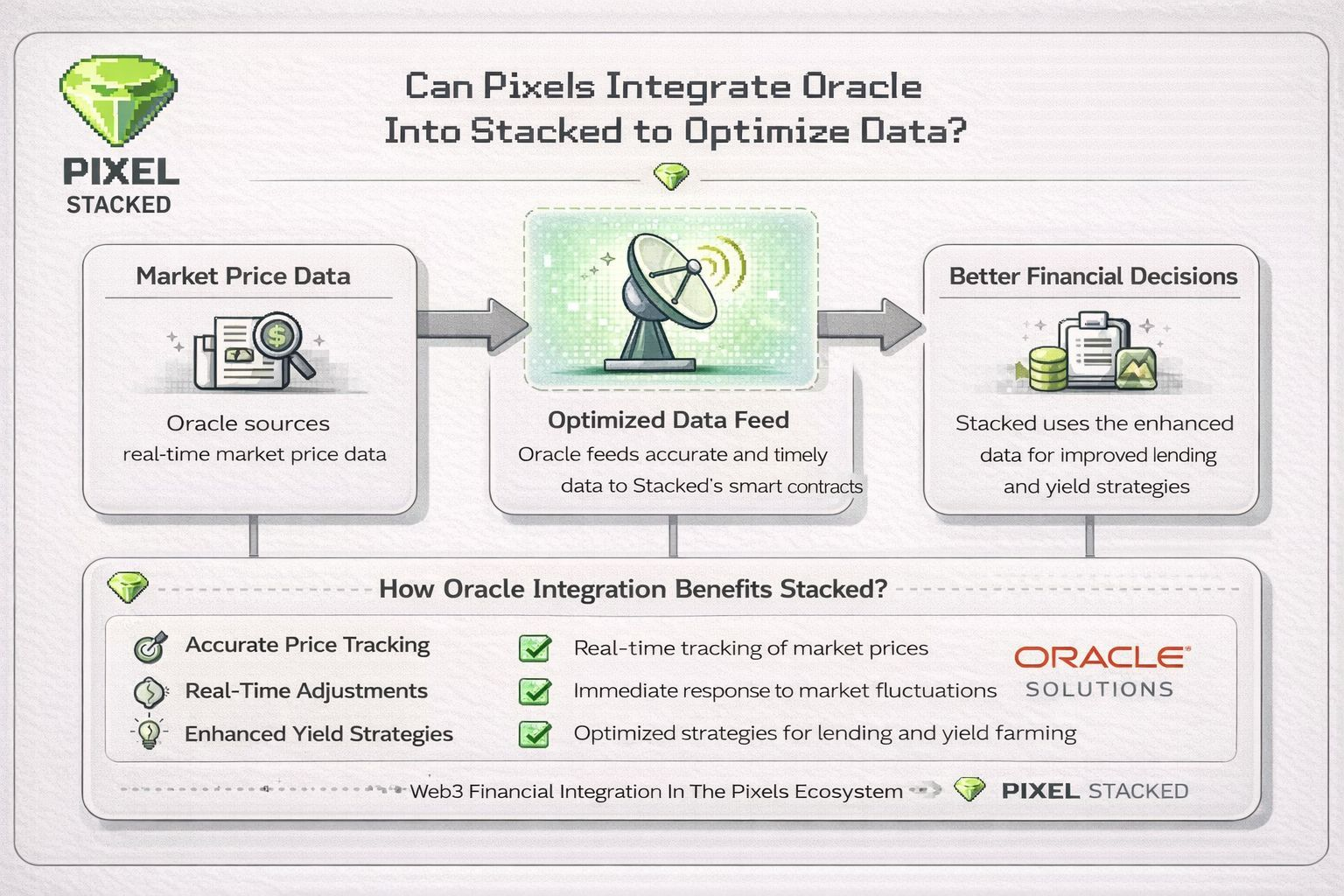
 Tonight I was revisiting how Stacked functions inside the Pixels ecosystem, and one question stood out to me: if they push further, could Pixels integrate an oracle into Stacked to improve data optimization?
In my view, the answer is yes—and it actually feels like a logical next step if Stacked is meant to evolve from an incentive engine into a more advanced financial layer.
Right now, Stacked already does something very important: it uses behavioral data to distribute rewards more efficiently. This is no longer theoretical, as systems powered by Stacked have already contributed more than 25 million USD in revenue to the Pixels ecosystem. That proves it can optimize value in a real environment.
However, most of the data Stacked currently depends on is still internal—mainly tied to player behavior and in-game activity. If the system wants to expand further, especially across multiple games or deeper financial layers, then data accuracy and reliability become much more critical.
This is where oracles start to make real sense.
To me, an oracle is not about making the system more complicated, but about bringing trusted external data into the decision-making process. That could include asset prices, liquidity conditions, market volatility, or even information from other chains.
If Stacked integrates oracle infrastructure, it would no longer rely only on internal activity. It could combine player behavior with broader market conditions to make smarter incentive decisions.
For example, during periods of high volatility or low liquidity, Stacked could reduce reward pressure to avoid unnecessary token selling. When liquidity improves, it could increase incentives again to support stronger growth momentum.
I think this would be a very meaningful upgrade.
What matters most is that oracles do not just help Stacked “know more”—they help it “know better.”
In any financial system, bad data is often more dangerous than having less data. If rewards are distributed based on inaccurate signals, the entire economy can become distorted very quickly.
When Stacked is already managing value flows worth tens of millions of dollars, reliable input data becomes a necessity, not an option.
I also believe oracle integration would make it much easier for Stacked to grow beyond Pixels itself.
It has already been mentioned across systems like Pixel Dungeons and Chubkins, which shows the first steps toward a multi-game infrastructure. But if Stacked wants to become a broader platform for gaming economies, it needs a data layer that is not dependent on one specific game.
The oracle becomes that bridge.
It allows Stacked to pull data from multiple environments, across chains and ecosystems, and create incentive structures that fit each unique context.
That said, I also think this only works if it is done carefully.
More data is not automatically better. If too much information enters the system without proper filtering, complexity becomes a problem. And if the oracle itself is unreliable, the damage can be worse than having no oracle at all.
For a financial layer like Stacked, the real question is not how much data exists, but which data actually improves decisions.
That is why I think Pixels should stay aligned with Stacked’s original philosophy: optimize behavior and value, not maximize data.
The oracle should support the system, not replace its core logic.
Its role should be to improve context and decision quality—not overload the engine with unnecessary signals.
Another interesting possibility is that successful oracle integration could move Stacked much closer to becoming a true financial layer for Web3 gaming.
At that stage, it would not just distribute rewards—it could actively respond to market conditions, similar to how DeFi protocols adjust liquidity or interest rates.
That would be a major shift.
The in-game economy would no longer be a closed loop, but part of a larger financial network connected to the broader market.
To me, that changes the entire story.
Stacked would move from being a reward mechanism inside a game to becoming infrastructure for value coordination across gaming ecosystems.
In short, I believe integrating oracles into Stacked is absolutely possible and could create a major advantage—but only if it helps the system make better decisions instead of making it unnecessarily complex.
If done correctly, this would not just be a technical improvement.
It could be the step that pushes Stacked closer to becoming real financial infrastructure for games.
And that is the moment when Pixels stops being just a game—and starts becoming a digital economy connected to the outside world.