

Honestly… I think I’m just tired.
Not in a dramatic way. Just that slow, dull exhaustion you get from watching the same thing happen over and over again in crypto. New cycle, new buzzwords, new “this time it’s different.” AI gets stapled onto everything, influencers start yelling again, timelines fill up with threads that all sound suspiciously the same. And somehow, despite all the noise, most of it still feels empty.
There are just too many coins now. Too many promises. Too many projects trying to convince you they’re not like the last ones that quietly disappeared. And the worst part is, after a while, you stop reacting. Even the “good” ideas feel like reruns.
Then something like Pixels shows up. And instead of feeling excitement, I just feel… cautious curiosity.
Because we’ve been here before with crypto games.
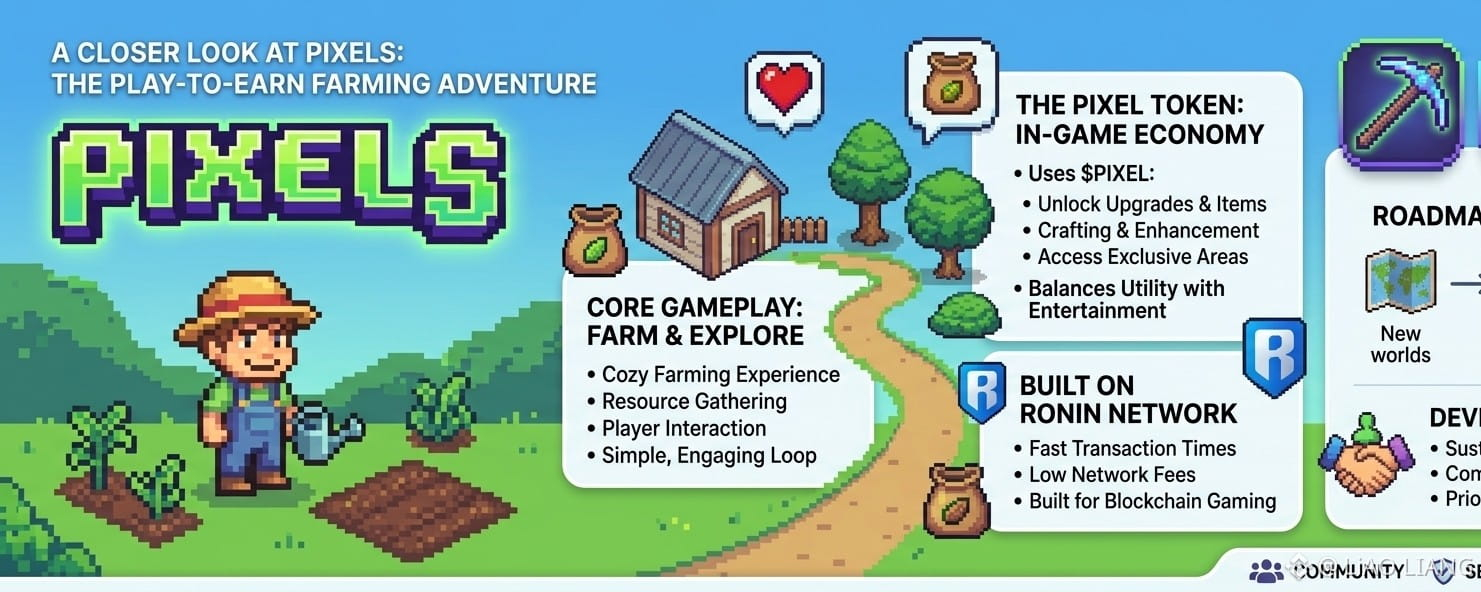
Pixels, at its core, is simple. A farming game. You plant things, harvest them, wander around, interact with other players. It leans into that cozy, familiar loop that people already understand. There’s no attempt to overwhelm you with complexity. No immediate sense that you’re stepping into some grand economic experiment. It feels almost… normal.
And maybe that’s intentional.
Let’s be real… most crypto games failed because they forgot to be games. They turned into systems. You weren’t playing, you were optimizing. Clicking, grinding, extracting. The moment money became the main reason to log in, everything else started to collapse. We all saw it happen, and we all kind of pretended we didn’t.
So Pixels tries to take a step back from that edge. It focuses more on gameplay first, at least on the surface. It doesn’t shove the token in your face immediately. It lets you ease into the world before you start thinking about value extraction.
And yeah… I can respect that.
But I’ve been around long enough to know that the token is never really “in the background.”
That’s the part that worries me.
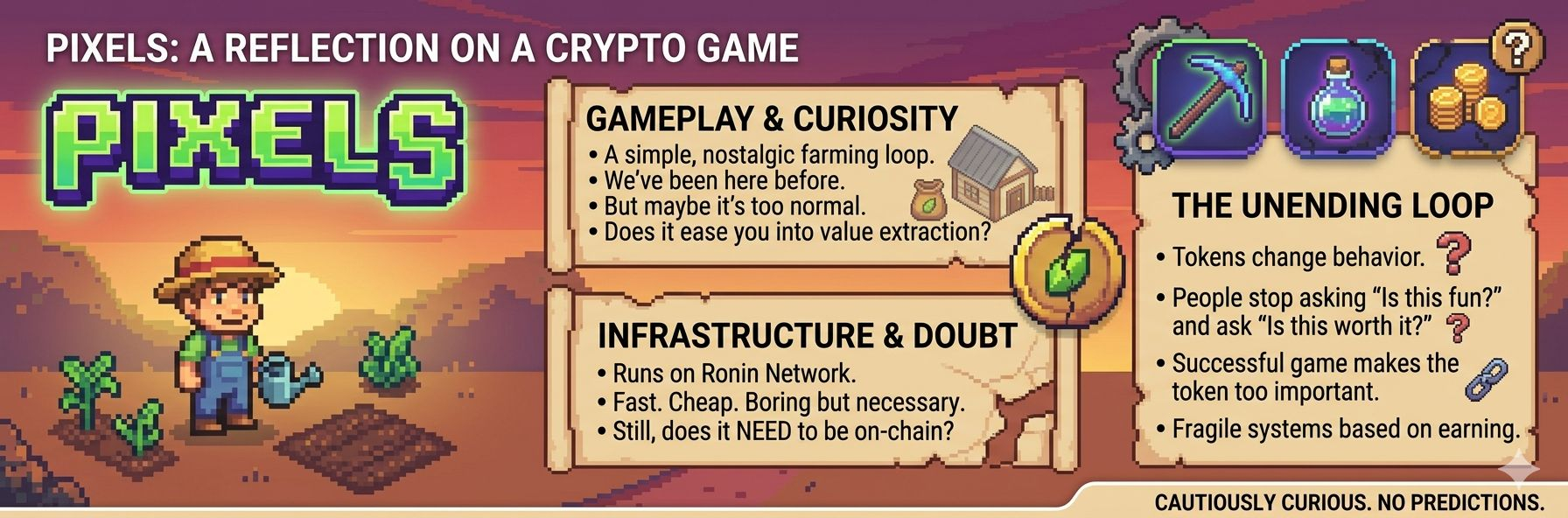
The PIXEL token exists. It’s used for upgrades, for crafting, for accessing certain parts of the experience. Which sounds reasonable, until you think about what usually happens next. Once a token becomes part of the loop, it changes how people behave. Slowly at first, then all at once.
People stop asking “is this fun?” and start asking “is this worth it?”
And that shift is subtle, but it’s everything.
Maybe Pixels handles it better. Maybe it finds a balance that other projects couldn’t. But honestly… we’ve heard that before too. Every Web3 game thinks it’s going to solve that equation. Most of them don’t.
There’s also the infrastructure side of things. Pixels runs on the Ronin Network, which, to its credit, actually makes sense. It’s fast, it’s cheap, it’s built for games. None of that is exciting, but it’s necessary. It’s the kind of boring foundation that should exist if this whole “blockchain gaming” thing is going to work at all.
And I’ll be honest… I trust boring infrastructure more than flashy narratives at this point.
Still, infrastructure alone doesn’t fix the bigger issue.
Because the real question isn’t whether Pixels works technically. It’s whether anyone actually needs this to be on-chain in the first place.
If you strip away the token, the NFTs, the ownership angle… what you’re left with is a farming game. A decent one, sure. But not something that exists in a vacuum. It’s competing with an entire industry of polished, well-designed games that don’t have to deal with wallets, tokens, or any of the friction that crypto quietly introduces.
That’s a tough comparison.
And I’m not sure Pixels wins it.
The social aspect is another thing people like to point to. Shared spaces, player interaction, community-driven gameplay. It sounds good, and sometimes it even feels good. But I’ve seen “community” used as a crutch more times than I can count.
Community doesn’t fix a weak core.
People don’t stay because something is on-chain. They stay because it’s fun, or meaningful, or at least habit-forming in a way that doesn’t feel forced. And if the only thing holding the system together is the idea that you might earn something, then it’s already fragile.
That fragility is always there, even if you don’t see it right away.
And then there’s the token again… because it always comes back to that.
I keep asking myself whether PIXEL actually needs to exist, or if it’s just there because this is crypto and every project is expected to have one. Sometimes it feels like it fits naturally into the system. Other times it feels like an extra layer that complicates something that could have been simpler without it.
That ambiguity doesn’t go away.
If anything, it grows over time.
Because if the game succeeds, the token becomes more important. And if the token becomes more important, the game risks turning into the very thing it tried to avoid. That loop is hard to escape once it starts.
Maybe Pixels finds a way around it. Maybe it evolves differently. Or maybe it just delays the inevitable.
I don’t know.
And I think that’s the most honest place to land.
Because despite all the skepticism, I can’t fully dismiss it either. There’s something about Pixels that feels… less aggressive than other projects. Less desperate to prove itself. It doesn’t scream for attention in the same way. It just kind of exists, building quietly in a space that usually rewards noise over substance.
Or maybe I’m just projecting.
Maybe I want it to be different because I’m tired of seeing the same failures repeat.
Either way, I’m not excited. I’m not convinced. But I’m also not ignoring it.
It sits in that uncomfortable middle ground where something might actually work, but there’s enough history behind you to know how easily it can go wrong.
So yeah… Pixels is interesting.
Not groundbreaking. Not some revolution in gaming. Just a project trying to navigate a space that’s already littered with things that didn’t make it.
Maybe it finds its footing. Maybe it fades like the others.
At this point, I’m not making predictions.
I’m just watching… a little more carefully than I expected.
