Most people still approach @Pixels like it’s just another Web3 farming game.
Plant. Harvest. Earn. Repeat.
And to be fair, that’s exactly what it looks like in the beginning. Nothing flashy. No aggressive onboarding. No pressure to “optimize” from the first minute. It almost feels too simple for a space that usually tries to prove itself immediately.
That’s why a lot of people misread it early.
Pixels doesn’t try to impress you fast. It lets you stay long enough to notice what’s actually changing underneath.
And that’s where things start to shift.
At some point, you stop just playing and start observing.
You realize not every action carries the same weight anymore.
You can still farm, craft, and move through the same loops… but only certain actions actually push your state forward. Others just exist as activity. That difference is subtle, but once you see it, you can’t ignore it.
This is where Pixels separates itself from most GameFi systems.
Most games reward everything equally to keep players engaged. Pixels is starting to filter that. It’s not asking “did you play?” It’s asking “did what you did actually matter?”
That’s a completely different approach.
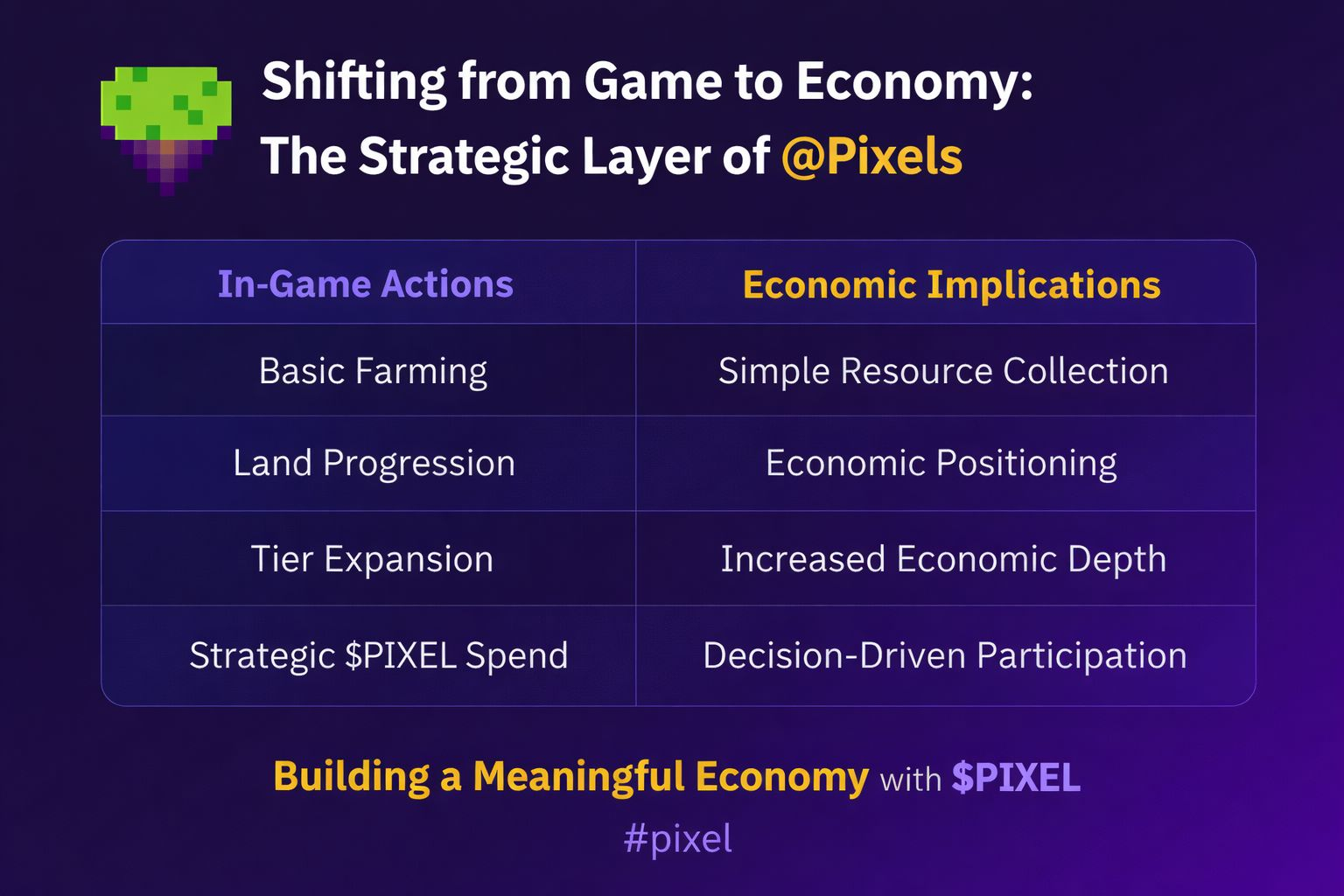
The recent updates around land progression, Tier expansion, and deeper production systems are reinforcing that direction.
Land is no longer just a place you interact with. It’s becoming a layer of strategy. Where you position yourself, how you structure your production, and how efficiently you use your resources is starting to define outcomes more than raw time spent.
Tier expansion adds another layer on top of that.
Instead of just increasing rewards, it increases complexity. More recipes, more industries, more dependencies between actions. You’re not just grinding anymore, you’re managing a system.
And systems behave differently than games.
They reward structure, not noise.
This is where $PIXEL starts to feel different too.
In most Web3 games, the token is the end goal. You earn it, you sell it, and you move on. That loop is familiar, but it’s also the reason most game economies collapse over time.
Pixels is slowly shifting that dynamic.
$PIXEL is becoming less of a payout and more of a decision layer.
You don’t just receive it, you choose how to use it. Upgrades, crafting, expansion, coordination. Every use has a tradeoff. Every decision affects your position inside the economy.
That creates friction.
And friction, when designed properly, creates meaning.
There was a moment where more PIXEL was going into the system than coming out.
That’s rare in this space.
Most economies are built on constant extraction. Players farm, tokens flow out, and the system relies on new users to sustain itself. It works temporarily, but it’s not stable.
Pixels showed a glimpse of something different.
A system where players are willing to reinvest instead of immediately exiting.
That doesn’t happen because of hype. It happens when the system itself gives you a reason to stay.
But this is also where the real test begins.
Because no matter how well the system is designed, external factors still exist.
Market cycles, token price movements, new listings, and speculation can all shift behavior quickly.
If pixel starts moving primarily because of external hype instead of in-game demand, the entire dynamic changes.
Players stop thinking about progression.
They start thinking about timing.
And once that mindset takes over, the system doesn’t break instantly. It slowly loses its meaning.
You still play, but for different reasons.
That’s the balance Pixels needs to protect.
On one side, you have a system that’s becoming more structured, more intentional, and more dependent on real decisions.
On the other side, you have the natural pull of speculation that exists in every crypto environment.
The challenge isn’t building the system anymore.
It’s maintaining alignment between player behavior and economic design.
What I find interesting is that Pixels isn’t rushing this.
There’s no loud narrative trying to force attention.
No exaggerated claims about “revolutionizing GameFi.”
It’s just iteration.
Small changes. Gradual improvements. Quiet adjustments to how value moves through the system.
That kind of approach doesn’t always go viral.
But it’s usually what lasts.
If you step back and look at it from a wider lens, Pixels is starting to feel less like a game and more like a small digital economy in progress.
A place where actions don’t just generate rewards, they create outcomes.
Where time spent isn’t enough, positioning matters.
Where pixel isn’t just earned, it’s deployed.
And where not everything moves forward… only what actually deserves to.
That’s not something most people notice on day one.
But if you stay long enough, it becomes hard to ignore.
And that’s probably the strongest signal Pixels has right now.
Not hype.
Not marketing.
Just a system that slowly starts making sense the deeper you go.
Pixel is not trying to hook you instantly.
It’s trying to change how you think about value inside a game.
And if they keep refining this direction without breaking the balance, pixel could end up representing more than just rewards.
It could represent participation in a system that actually works.