
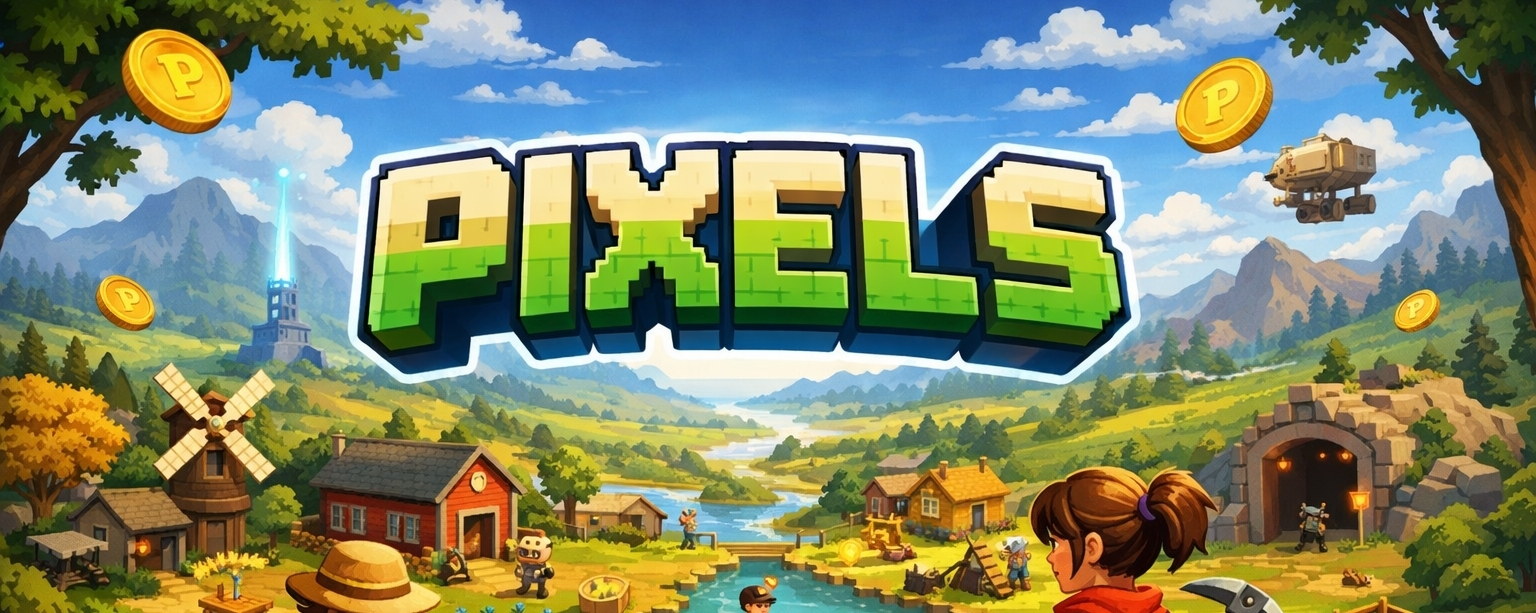

I’ve spent enough time around crypto projects to recognize the familiar rhythm: a new idea wrapped in language about ownership, community, and revolution, usually followed by a token that promises to align everything. So when I first came across Pixels, I didn’t feel excitement as much as a kind of quiet curiosity mixed with skepticism. A farming game on the Ronin Network, leaning into social interaction and open-world design—it sounded almost disarmingly simple compared to the usual avalanche of “next-gen metaverse” claims.
But sometimes simplicity is where things get more interesting. Or at least, more honest.
As I started exploring Pixels, what struck me first wasn’t the blockchain component. It was the game itself—or more precisely, the attempt to make something that feels like a game before it feels like a financial instrument. That alone sets it apart from a lot of what I’ve seen in this space. Most Web3 games begin with tokenomics and then try to retrofit gameplay around it. Pixels, at least on the surface, seems to be attempting the reverse: build something people might actually want to spend time in, and then layer economic mechanics on top.
Of course, intention and execution are two very different things.
The core idea revolves around a persistent world where players farm, gather resources, craft items, and interact with others. It borrows heavily from the aesthetics and loops of traditional casual games—think Stardew Valley, but stretched into a shared online environment. There’s something almost nostalgic about it, which is probably intentional. Familiarity lowers the barrier to entry, especially in a space that often feels intimidating or overly technical.
Underneath that, though, sits the architecture that makes it a Web3 project: assets that can be owned, traded, and theoretically held independently of the game itself. Land, items, and the PIXEL token all play roles in this ecosystem. And this is where I start to slow down and look more carefully, because this is also where most projects begin to unravel.
The problem Pixels claims to address isn’t new. It’s the idea that players should own their in-game assets, that their time and effort should translate into something transferable and valuable beyond the confines of a single game. It’s a compelling narrative, and one that has been repeated so often in crypto that it almost feels like doctrine. Traditional games lock you into closed economies; Web3 promises to open them.
But I’ve learned to ask a different question over time: even if ownership is technically possible, does it actually matter in practice?
In most games, the value of an item isn’t just about ownership—it’s about context. A sword is valuable because it helps you progress, because it fits into a system of challenges and rewards. Remove that context, and ownership becomes abstract. Pixels seems aware of this, at least partially. The emphasis on social interaction and a shared world suggests that value is meant to emerge from participation rather than speculation alone.
Still, there’s a tension here that I can’t ignore. On one hand, the game wants to feel like a relaxed, social experience. On the other, it introduces economic incentives that inevitably change how people behave. Farming, in a traditional game, is often meditative—a repetitive but calming loop. In a tokenized environment, it risks becoming labor.
I’ve seen this pattern before. Early play-to-earn games leaned heavily into the idea that players could generate income, especially in regions where even small earnings made a difference. But over time, many of those systems collapsed under their own weight. Rewards were inflated, new players were needed to sustain the economy, and the gameplay itself became secondary.
Pixels doesn’t position itself as aggressively in that direction, which is probably a good sign. It feels more like it’s trying to strike a balance between utility and enjoyment. But balance is fragile, especially when financial incentives are involved. The moment players start optimizing for profit instead of experience, the entire tone of a game can shift.
What I find interesting, though, is the choice of the Ronin Network as its foundation. Ronin has its own history, particularly tied to gaming, and that context matters. It suggests that Pixels isn’t just experimenting in isolation—it’s part of a broader attempt to build an ecosystem where games can coexist and share infrastructure.
That raises another question: is the real product here the game itself, or is it the network effect of multiple games and assets interacting within the same environment?
If it’s the latter, then Pixels becomes something like a testing ground. A way to explore how players behave when given ownership, how economies evolve over time, and whether any of it can sustain itself without constant external input. That’s a more ambitious goal than it first appears, and also a more uncertain one.
Because the truth is, the crypto industry has a habit of overestimating how much people care about ownership in abstract terms. Most players don’t wake up thinking about asset portability or decentralized marketplaces. They want experiences that feel engaging, rewarding, and, above all, fun. If those things exist, ownership can enhance them. If they don’t, ownership becomes irrelevant.
As I spent more time with Pixels, I found myself paying attention to the small details. How intuitive the mechanics feel. Whether interactions with other players happen naturally or feel forced. Whether progression feels meaningful or just incremental. These are the things that determine whether a game has staying power.
And to its credit, Pixels does seem to understand that retention matters more than initial hype. The pacing feels slower, less aggressive. There’s no immediate pressure to “optimize” your gameplay for maximum returns, at least not in the early stages. That creates space for players to უბრალოდ exist in the world, which is surprisingly rare in Web3 environments.
But I can’t shake the sense that this calm surface is only part of the story. As the ecosystem grows, as more players join and more assets are introduced, the dynamics will inevitably change. Scarcity, speculation, and competition will start to play larger roles. And that’s where things tend to get complicated.
One of the recurring issues in crypto is the assumption that incentives can be perfectly aligned. That if you design the right tokenomics, everyone—from developers to players to investors—will naturally act in ways that benefit the system as a whole. In reality, incentives often diverge. What’s good for early adopters isn’t always good for new players. What drives short-term engagement can undermine long-term sustainability.
Pixels doesn’t escape this challenge. If anything, it highlights it in a more subtle way. By embedding economic elements into a casual, social game, it creates a layered experience where different players may be engaging for entirely different reasons. Some might be there to relax and explore. Others might be calculating returns, optimizing strategies, and treating the game as a source of income.
Those two modes of engagement can coexist for a while, but they don’t always align.
I also find myself մտածing about the broader implications of projects like this. If Pixels succeeds—if it manages to build a stable, engaging world with a functioning economy—what does that mean for the rest of the industry? Does it validate the idea that Web3 gaming can work, or does it simply show that certain design choices are more viable than others?
And if it fails, what kind of failure will it be? A slow decline in player interest? An economic imbalance that spirals out of control? Or something more subtle, like a gradual shift in player behavior that erodes the original vision?
These aren’t questions with easy answers, and I don’t think Pixels pretends to have them. That’s part of what makes it interesting. It feels less like a finished product and more like an ongoing experiment—one that’s trying to navigate the messy intersection of gaming and finance without leaning too heavily on either side.
At the same time, I remain cautious. I’ve seen too many projects start with thoughtful intentions only to drift toward short-term incentives. The pressure to maintain token value, to attract new users, to generate attention—it can distort even the most carefully designed systems.
So where does that leave me?
Somewhere in the middle, I think. I don’t see Pixels as a breakthrough that will redefine the industry overnight. But I also don’t dismiss it as just another iteration of the same old playbook. It sits in an in-between space, where the ideas are familiar but the execution feels a bit more grounded.
If nothing else, it reminds me that the future of Web3 gaming probably won’t come from grand, sweeping visions. It will come from smaller, more iterative experiments—projects that focus on experience first, and let the economic layers evolve more organically.
Whether Pixels can sustain that approach over time is an open question. But for now, it’s enough to make me pay attention. Not because it promises something revolutionary, but because it seems to be asking the right questions, even if it doesn’t have all the answers yet.
And in crypto, that’s rarer than it should be.