
@Pixels I didn’t really expect to find anything worth slowing down for when I first started looking into Pixels pets. It felt like it would follow the usual pattern—generate a set of traits, randomize them, mint the NFT, and present it as something rare. That formula has been repeated so often that it almost feels automatic at this point. But the more I explored it, the more I realized there’s a bit more thought behind this system than I initially gave it credit for. I’m still careful about drawing strong conclusions, though, because ideas can sound solid until they’re tested at scale.
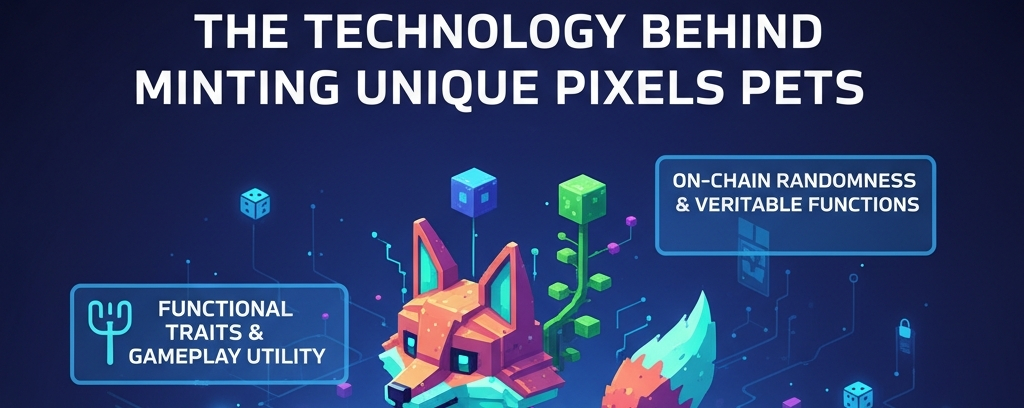
At a basic level, these pets are minted as NFTs on the Ronin network, each carrying a mix of traits that define both how they look and how they function. That second part is where things begin to separate from the usual approach. In many NFT-based games, pets are visually unique but don’t actually change gameplay in any meaningful way. Here, traits seem to influence farming performance and utility, which means the pet you mint can affect your in-game experience in a practical sense. That shift from purely cosmetic value to functional impact adds a layer of depth that most similar systems never reach.
The minting process relies on on-chain randomness, which is where things become a bit more complex. Randomness on blockchain systems isn’t as simple as it sounds, since everything operates in a deterministic environment. Projects typically rely on techniques like verifiable random functions or structured reveal methods to create fairness. Whether Pixels has implemented this in a way that’s truly secure and unpredictable is something that would require deeper inspection, ideally through audited smart contracts. Without that transparency, it’s hard to fully measure how resistant the system is to manipulation.
Trait rarity follows a familiar structure, with common attributes appearing more frequently and rare ones being harder to obtain. That alone isn’t particularly innovative, but what matters is how that rarity connects to gameplay. If rare traits actually improve performance in specific farming tasks, then they carry real value beyond appearance. From what can be observed, Pixels is trying to make sure that rarity and usefulness move together. If that balance holds, it could create a stronger link between the in-game economy and the NFT market, something that many projects struggle to achieve.
Another layer comes from the fact that these pets exist on-chain, meaning they belong to the player rather than the game server. This gives a sense of ownership that extends beyond the platform itself. At the same time, it raises an important reality—if the game were to lose relevance or shut down, the NFT would still exist, but its value would depend entirely on context. That’s something worth thinking about before attaching real financial expectations to any digital asset.
The breeding system adds a more dynamic element to everything. By allowing pets to produce offspring with inherited and occasionally mutated traits, the system starts to feel less like a static collection and more like a living ecosystem. It introduces strategy, experimentation, and the possibility of creating value through combinations rather than just acquisition. This kind of structure hints at a longer-term vision, where the economy evolves based on player interaction rather than staying fixed after launch.
Overall, I didn’t expect to find this level of design consideration in what initially looked like a standard NFT setup. There’s still a lot that needs to be proven, especially as more users participate and the system grows. For now, though, it feels like Pixels is at least trying to build something that connects ownership, utility, and gameplay in a more meaningful way. I’m watching it closely, but with the kind of caution that makes sense for anything still finding its footing.