

keep coming back to one simple feeling when I look at this network now: it is trying to become harder to farm loosely and easier to trust structurally.
For a long time, a lot of game economies let activity and extraction sit too close together, and that usually works only until users realize the system cannot tell the difference between contribution and throughput.
What caught my attention here is that the recent direction seems less interested in celebrating raw participation and more interested in classifying who should be allowed to do what, at what cost, and under which trust assumptions.
The friction is not really too many fees or “too many gates.” It is a more basic design problem.
If open access to trading, withdrawals, task extraction, and marketplace liquidity arrives before the system has a durable way to score trust, then the economy starts rewarding traffic before it rewards reliability.
That creates a familiar imbalance: the fast account benefits first, the honest account proves itself later, and the network absorbs the cost through inflation pressure, bot exposure, unstable pricing, and weaker social confidence.
The reputation rework is important to me because it openly treats this as an anti-botting and anti-coin-inflation problem, not just a user-interface tweak.
It feels less like opening a market square and more like gradually turning on different valves in an irrigation system.
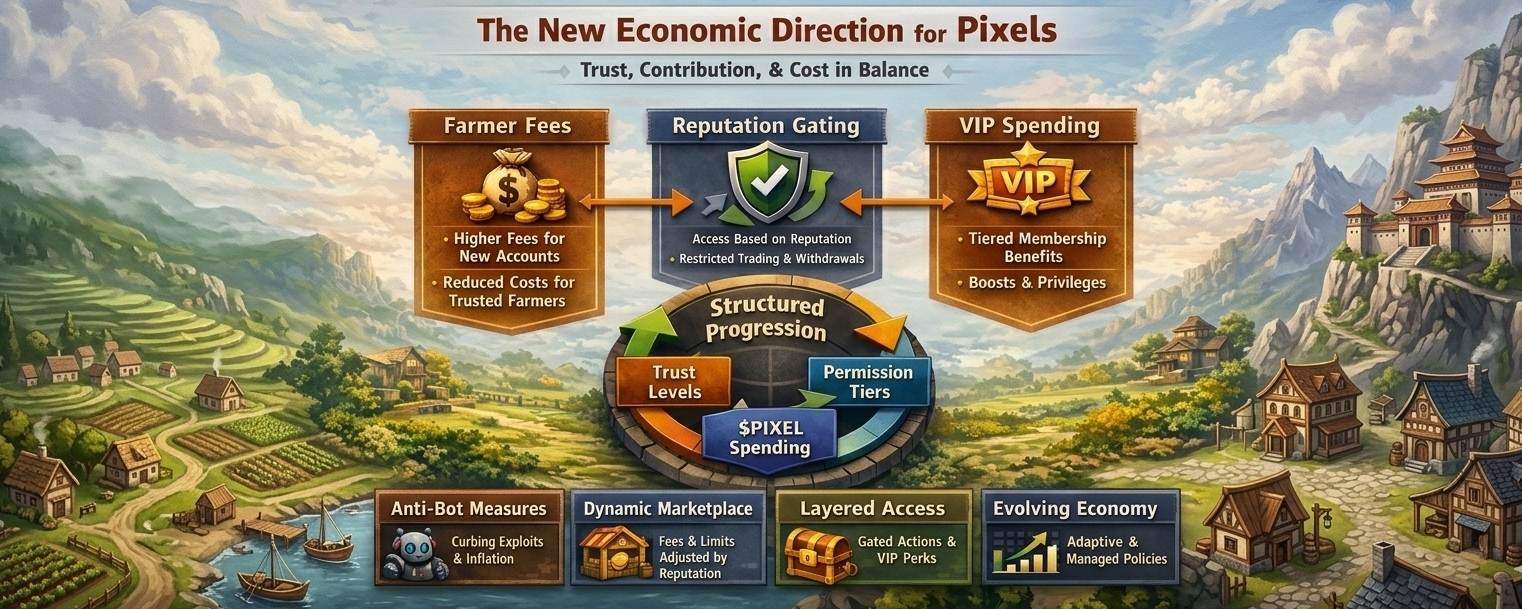
That is why farmer fees, reputation thresholds, and VIP spending make more sense when read together instead of separately.
Higher reputation reducing marketplace fees is not only a perk. It is a pricing signal about who the system expects to create less toxic flow.
The same logic appears in the thresholds for buying, selling, trading limits, guild creation, and withdrawals.
Access is being shaped as a function of accumulated trust, not merely account existence.
In plain terms, the network is moving from a simple reward loop toward a negotiated economy where permissions, costs, and convenience are all adjusted by reputation and spending-linked status.
I think that matters because most game economies break when every participant is treated as economically equivalent at the moment of entry.
They are not equivalent. Some bring labor, some bring capital, some bring coordination, and some just test the edge of extraction. A system that prices everyone the same at every stage often ends up subsidizing the least aligned behavior. Here, fees appear to become selective.
Friction is not removed for everyone. It is negotiated downward for accounts that accumulate trust and maintained for accounts that have not yet proven enough.
That is a stronger economic statement than it first appears.
From the way the official help material is framed, I read the architecture as working in layers.
At the access layer, thresholds define which actions are even available, such as marketplace use, trading bands, guild creation, and withdrawals.
At the pricing layer, marketplace fees become variable and can decline as reputation improves.
At the membership layer, VIP grants a baseline bundle of economic advantages, including reputation points, marketplace listing expansion, task access, and energy-related convenience.
Then above that, the tiering system links continued $PIXEL spending to a score that upgrades membership tiers instantly, while still allowing the score to decay over time. These are not isolated features. They are a state machine for economic privilege.
That state model is the part I find most interesting.
An account is no longer just a wallet plus inventory. It increasingly looks like a bundle of changing economic attributes: reputation, permission thresholds, VIP status, VIP score, task access, fee profile, and trade capacity. When those variables update, the user’s cost surface changes too.
One player meets the reputation requirement and unlocks an action. Another spends into VIP and receives an immediate functional advantage.
Another lets score decay and loses some of that edge. The economy stops being a flat field and becomes a layered profile system.
I would describe the negotiation element very carefully here. It is not price negotiation in the usual sense of two parties bargaining over a quote.
It is protocol-side negotiation through status. Spend more, sustain VIP, improve trust, participate in the approved ways, and the system responds with better access, lower effective marketplace friction, broader task availability, and more room to operate.
In other words, the chain is letting behavior and spend history negotiate conditions on behalf of the user.
That is a more programmable form of pricing than a single fixed fee schedule.
The cryptographic flow is not presented in the help pages as some dramatic new primitive, and that is fine.
The important point is simpler: acount -linked activity, spend, and qualification feed into a permissions and pricing model that can be enforced consistently at the application and transaction level.
I do not read this design as trying to make every user equal. I read it as trying to make every economic action conditional on an auditable profile of trust and contribution.
That may feel stricter, but in crowded economies stricter often means more legible.
There is also a governance implication hiding inside this. Once fees, access, and progression depend on reputation and spend-linked membership, the real question is no longer whether the economy has incentives. Every economy has incentives.
The real question is whether the scoring model stays intelligible, updateable, and defensible as participant count rises.
The official notes already show threshold changes, rollback history, fee variability, and tier logic with decay and protection windows. That tells me this is becoming an actively managed economic policy layer, not a static reward table.
My honest read is that this direction is less playful than earlier versions, but probably more serious.
The project seems to be saying that a sustainable economy cannot rely on volume alone; it has to sort users by trust, price access by alignment, and make convenience something earned or maintained rather than universally granted.
I think that is the real meaning of farmer fees, reputation gating, and VIP spending living in the same design.
They are not separate monetization knobs. They are the beginning of an economy that wants contribution, credibility, and cost to speak to each other before liquidity gets to comfortable.
