
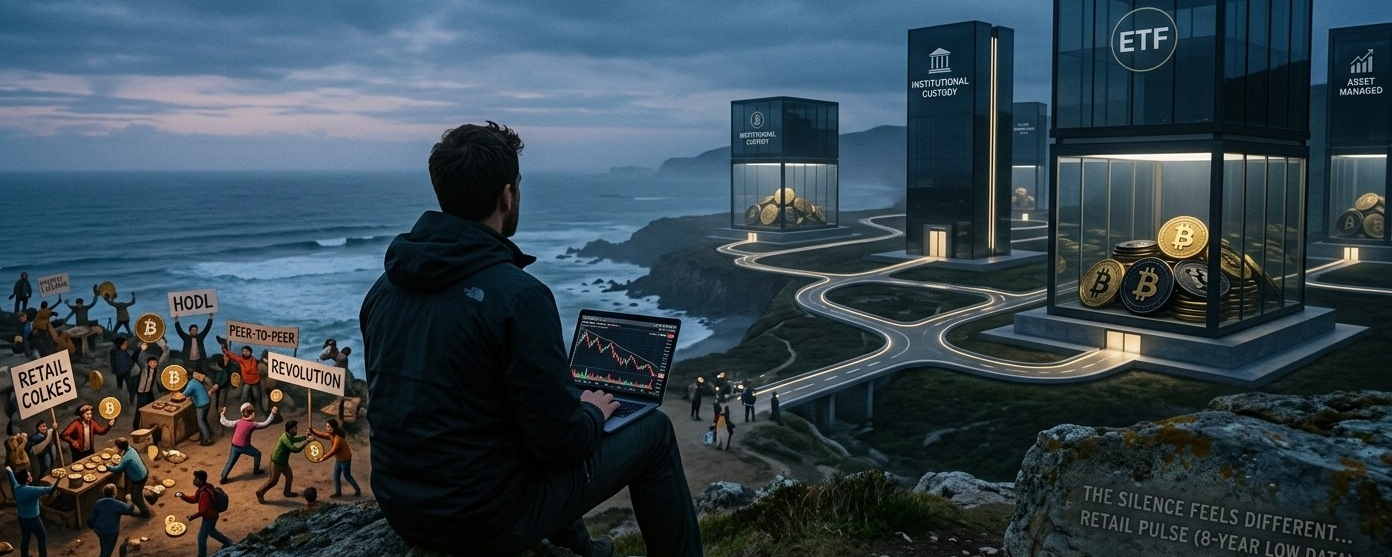
I have been watching Bitcoin long enough to remember when it didn’t feel like a “market” at all. It felt more like a movement — messy, loud, unpredictable, and full of people who weren’t just investing, but participating. Back then, every spike in activity told a story. You could almost sense the emotion behind each transaction — excitement, fear, curiosity, even desperation. It wasn’t polished, but it was alive.
Lately, though, something feels different. Not in a dramatic, headline-grabbing way — more like a quiet shift you only notice if you’ve been paying attention for a long time. I have been watching the data closely, and when I saw network activity drop to levels we haven’t seen in nearly eight years, it didn’t feel like just another statistic. It felt… quiet. Unusually quiet.
So I spent time on research, trying to understand what that silence actually means.
At first, I thought maybe interest was fading. But the more I looked into it, the less that explanation made sense. The price hasn’t collapsed, institutional products are growing, and Bitcoin is still being talked about globally. It’s not disappearing — it’s evolving. And that’s where things get interesting.
What I keep coming back to is how much the participants have changed.
There was a time when retail investors drove everything. People buying small amounts, moving coins between wallets, reacting instantly to news or hype — all of that created constant on-chain activity. It gave Bitcoin its pulse. You could feel it beating through transaction volume and wallet growth.
Now, that pulse feels slower. Not weaker — just slower.
And I think a big part of that comes down to who’s holding the coins.
Wall Street didn’t rush into Bitcoin overnight. It crept in, cautiously at first, then with growing confidence. Large institutions, hedge funds, and asset managers started accumulating positions that most individuals simply can’t match. But they behave differently. They don’t chase every price move or panic over every dip. They buy, they store, and they wait.
That kind of behavior doesn’t generate noise. It doesn’t create constant transactions. It creates stillness.
I have been watching how this plays out on the network itself. When institutions hold large amounts of Bitcoin in custody — often through third parties or cold storage — those coins don’t move much. They just sit there. So even if more value is locked into the system than ever before, the visible activity can actually decline.
At the same time, access to Bitcoin has changed. With the rise of ETFs and other financial products, a lot of people no longer need to touch the blockchain at all. They can invest in Bitcoin the same way they’d buy a stock — through familiar platforms, without ever creating a wallet or sending a transaction. It’s convenient, but it also creates distance.
And that distance matters.
Because part of what made Bitcoin feel revolutionary was that direct interaction — the sense that you were actually using something new, not just gaining exposure to it. Now, for many people, that connection is fading. Bitcoin is starting to feel less like a tool and more like an asset class.
I have been watching sentiment shift along with it. When the network gets quieter, the energy changes. Retail investors thrive on momentum and excitement, and when that fades, so does their presence. It doesn’t mean they’re gone — it just feels like they’re waiting on the sidelines, watching for a reason to jump back in.
And if history has taught us anything, it’s that they usually do come back. Just not during the quiet phases.
So I don’t think this is the end of retail participation. It feels more like a pause — one of those stretches where the market is catching its breath. The kind of moment that only makes sense in hindsight.
Still, I can’t ignore the bigger question sitting underneath all of this: has Bitcoin fundamentally changed?
I don’t think it’s as simple as saying Wall Street has “replaced” retail. But it does feel like the balance has shifted. The market feels more structured now, more controlled, less chaotic. In some ways, that’s a sign of maturity. In other ways, it feels like something raw and original is slowly being smoothed out.
I have been watching closely, and what stands out to me isn’t fear — it’s transition.
The network isn’t dead. It isn’t even weak. It’s just… different. Quieter in a way that suggests something is settling into place, even if we don’t fully understand what that place is yet.
Maybe this is what Bitcoin looks like when it grows up. Or maybe it’s just another phase before the noise returns.
Either way, I’m still watching.