
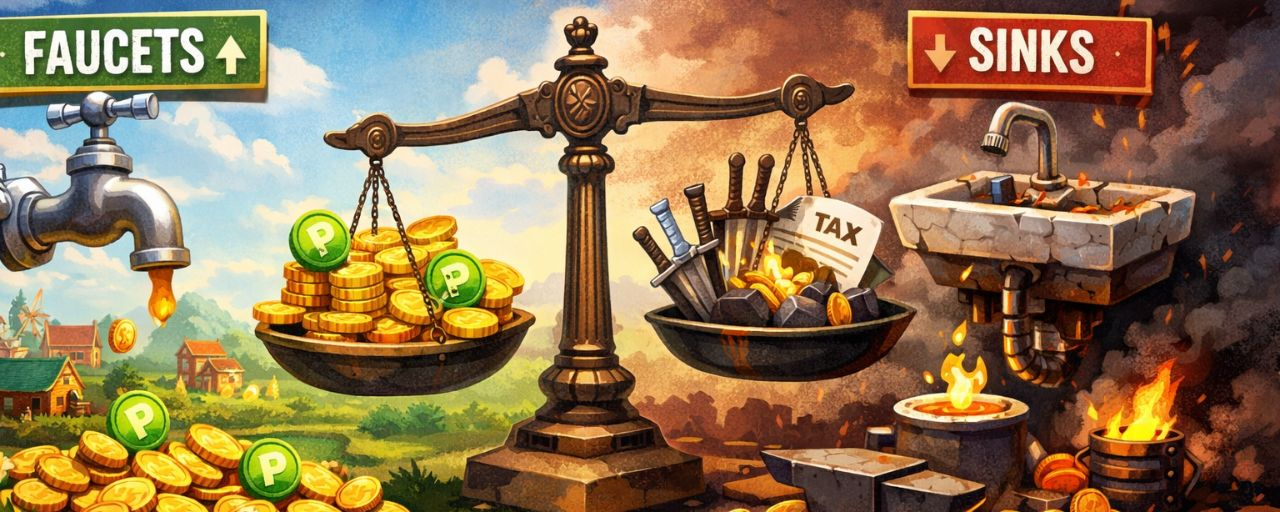

The first time I heard someone explain a game economy with the words faucets and sinks, I honestly rolled my eyes a little. It sounded like one of those phrases people use to make a normal idea sound smarter than it is. Then I sat with it. And the annoying part is, it actually makes perfect sense. Now I can’t really unsee it.
Because once you look at Pixels that way, the whole economy becomes easier to read.
A faucet is simple. It’s anywhere value comes in. PIXEL rewards. Crops. items. activity payouts. things players can earn through play.
A sink is the opposite. It’s where value goes out. Crafting costs. upgrades. fees. taxes. burns. all the stuff that removes value from circulation.
That sounds basic. But I think this is where most Web3 game economies start looking good on the surface and then quietly fall apart underneath. Too many faucets, and the economy gets flooded. Too many sinks, and players start feeling like the game is taking more than it gives.
That’s the balance. And I don’t think it’s something a team solves once and then forgets. I think it has to be adjusted all the time.
That’s what makes Pixels interesting to me. Not because it has solved the problem. Because it at least looks like the team understands the problem exists. And that already puts it ahead of a lot of projects.
A lot of Web3 games felt like they were built around faucets first. Reward the player. pay the player. keep emissions going. keep people excited. Then later they add some weak sinks and hope that fixes everything. Usually it doesn’t.
Pixels feels more deliberate than that. You can see the structure. PIXEL comes in through gameplay. It goes out through crafting, upgrades, and other mechanics that are supposed to keep the economy from getting too loose.
So the design logic is there. What I’m less sure about is whether the calibration is actually right. That’s the part I keep getting stuck on. Because an economy can look smart in theory and still break under real player behavior. And player behavior is where things get messy.
When the game was hot and activity was high, the system had more people feeding both sides of the economy. More players earning. More players spending. More movement everywhere.
Then the hype cooled down a bit. Some of the speculative crowd left. And that changes everything.
Because when player numbers shift, the faucet and sink balance shifts with them. Less activity means fewer rewards going out. But it also means fewer upgrades, fewer purchases, fewer reasons to spend. So the question stops being “does the system have sinks and faucets?” The real question becomes whether the ratio still works when the crowd changes. That’s where I’d want real data. Not vibes. Not nice diagrams. Actual numbers.
Then there’s land. And honestly, this is where it gets even more interesting. And a little uncomfortable.
Because land adds another economic layer that makes the experience feel different depending on who you are. If you own land, you can benefit from other people using it. If you don’t, part of your economic activity can end up flowing toward someone who does.
That creates a split. Not just between active and inactive players. Between players with economic leverage and players without it.
I get why that exists. It gives land utility. It creates long-term value. It rewards ownership. All fair.
But it also makes the economy feel a little two-tiered. And I think that matters. Because once a game starts feeling too tilted toward asset holders, the casual player starts asking a very simple question:
am I actually playing, or am I feeding someone else’s position?
That question can become a problem fast.
Seasonal events are another piece of this. And I actually think they’re smart. Temporary events can work really well as sinks. They create urgency. They get people to spend. They pull resources out during moments of high engagement. That’s good design.
But only up to a point. Because if temporary events are doing too much of the heavy lifting, then they stop being a boost and start becoming a patch. And patches are not the same as a healthy base economy.
That’s the difference I keep thinking about. Is Pixels using events to strengthen the economy? Or to help cover the parts that still don’t balance naturally on their own? I don’t think that’s a small question. I think it’s one of the main questions.
What I do respect is that Pixels seems willing to adjust. That matters more than people admit. Live economies are messy. No team gets this perfectly right from day one. So I care less about whether every number was perfect at launch. I care more about whether the team is paying attention when the numbers stop making sense. And Pixels has changed things before. That tells me they’re at least watching.
Still, I think the core tension is the same one every play-to-earn style game runs into. The players who are there to earn want faucets to feel generous. The players who are there to play want sinks to make progress and rewards feel meaningful. Those two things push in opposite directions. And both groups are using the same economy.
That’s why this is hard. And that’s why I keep coming back to it.
So yeah, I think Pixels understands sinks and faucets better than a lot of its competitors. I also think understanding the framework is not the same as mastering it. The real test is whether the economy can stay healthy when attention drops, when player behavior changes, and when the people trying to earn and the people trying to have fun start pulling the system in different directions.
That’s the part I’m still watching.