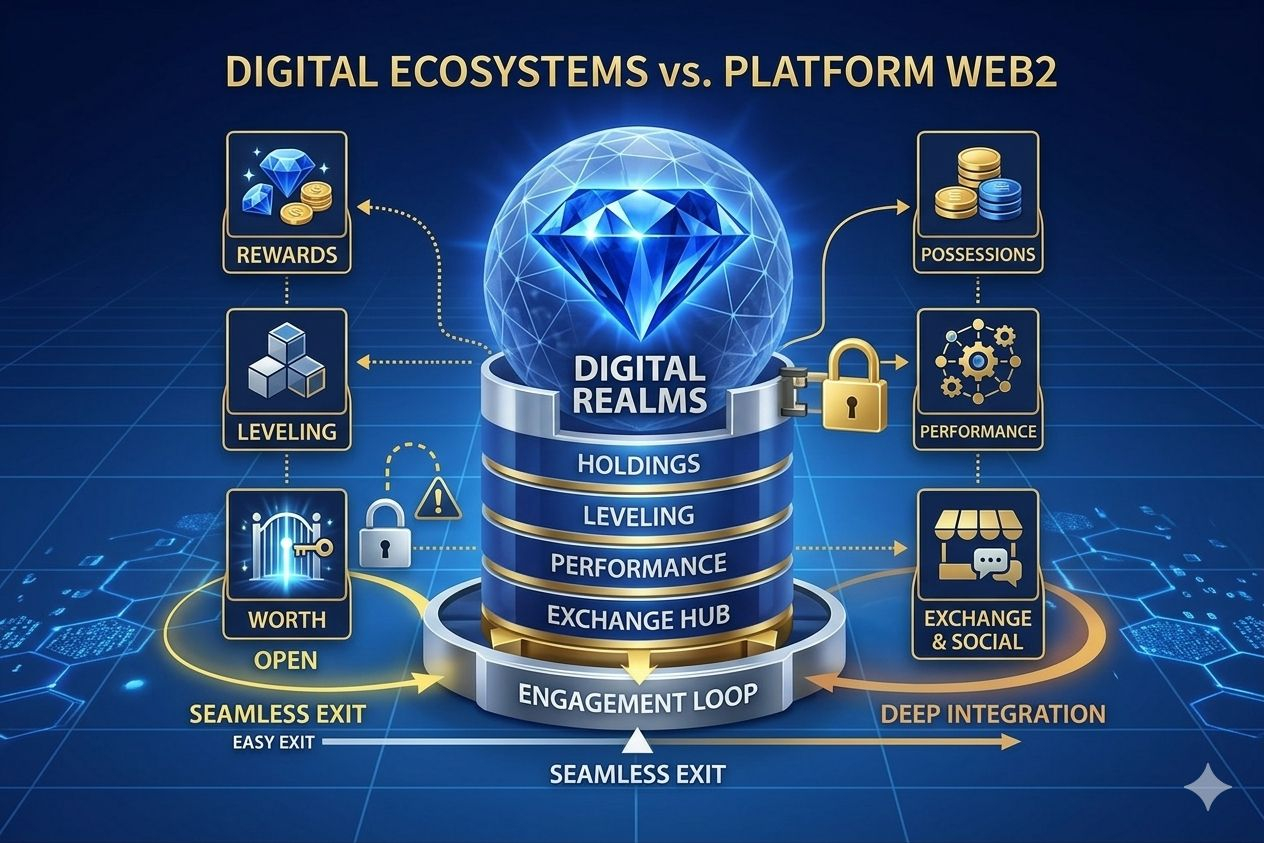
If we strip the question down — “Can Pixels create a true commitment loop?” — it stops being about gameplay mechanics or reward structures. Instead, it becomes something more fundamental: can the system make users feel that leaving actually costs them something?
At first glance, this sounds similar to retention, but there’s an important difference. Retention is about users returning. Commitment is about users hesitating to leave.
Viewed this way, Pixels seems to be evolving beyond a simple participation model — where users join for incentives — into something deeper: a commitment-driven system, where users stay because they have something embedded within it. Once you start thinking along these lines, many of Pixels’ design decisions begin to make more sense.
At its core, commitment is built on accumulated investment — not just time, but also assets, positioning, and system understanding. Pixels appears to be layering these elements together deliberately. Assets are tied to progression, progression connects to optimization, and all of it feeds into social and marketplace dynamics. Individually, these layers may not be enough to anchor a user, but together they begin to create real staying power.
At that point, it stops feeling like just a game. It becomes a system where leaving means walking away from something you’ve gradually built.
However, not all accumulation leads to real commitment. If everything a user gains can be easily converted or withdrawn, then commitment becomes fragile — almost optional. In that case, users aren’t truly anchored; they’re simply choosing not to exit yet.
This highlights a key tension within Pixels. On one side, it promotes an open economy where players own their assets and can freely exit. On the other, building a strong commitment loop requires some degree of friction — or at least a sense that leaving is not the optimal choice.
In traditional Web2 games, commitment often comes from non-transferable elements — accounts, progress, relationships. You can leave, but you can’t extract that value. This creates a powerful, albeit implicit, form of commitment.
Pixels operates differently. When nearly everything can be priced and transferred, the decision to stay becomes more transactional. The system doesn’t lock you in — it has to continuously justify why you should remain.
That’s where the distinction lies: Web2 systems enforce commitment through restriction, while Pixels must earn it through value.
Still, Pixels seems to be exploring a middle ground. It’s introducing layers whose value isn’t purely liquid — things like gameplay efficiency, marketplace positioning, and accumulated knowledge. These are harder to extract and may create what can be called “soft commitment.”
It’s not just about what you own, but how effectively you can use it — and that edge isn’t instantly transferable or easily monetized.
The open question is whether these softer forms of commitment can hold up under pressure. When incentives weaken or market conditions shift, will efficiency, experience, and understanding be enough to keep users engaged?
Ultimately, the challenge is finding balance. Too much openness, and the system risks becoming purely extractive. Too much friction, and it undermines the very principles that make it appealing.
This brings us to an important realization: commitment isn’t something you can directly engineer. It emerges from how different layers of a system interact. You can design conditions that encourage it, but you can’t force it into existence.
Pixels may not have fully achieved a strong commitment loop yet, but it’s clearly moving in that direction — by stacking multiple forms of user investment, from assets to knowledge. This doesn’t guarantee long-term retention, but it does make the decision to leave more deliberate.
So maybe the better question isn’t “Does Pixels have a commitment loop?” but rather: “Where should the balance between liquidity and commitment exist?”
Because if commitment is too weak, the system becomes a place for extraction. If it’s too strong, it loses the openness that defines it.
Whether Pixels can resolve this tension is still uncertain — but that’s exactly what makes it worth paying attention to. It’s attempting something few systems have managed before: keeping users engaged without actually locking them in.