
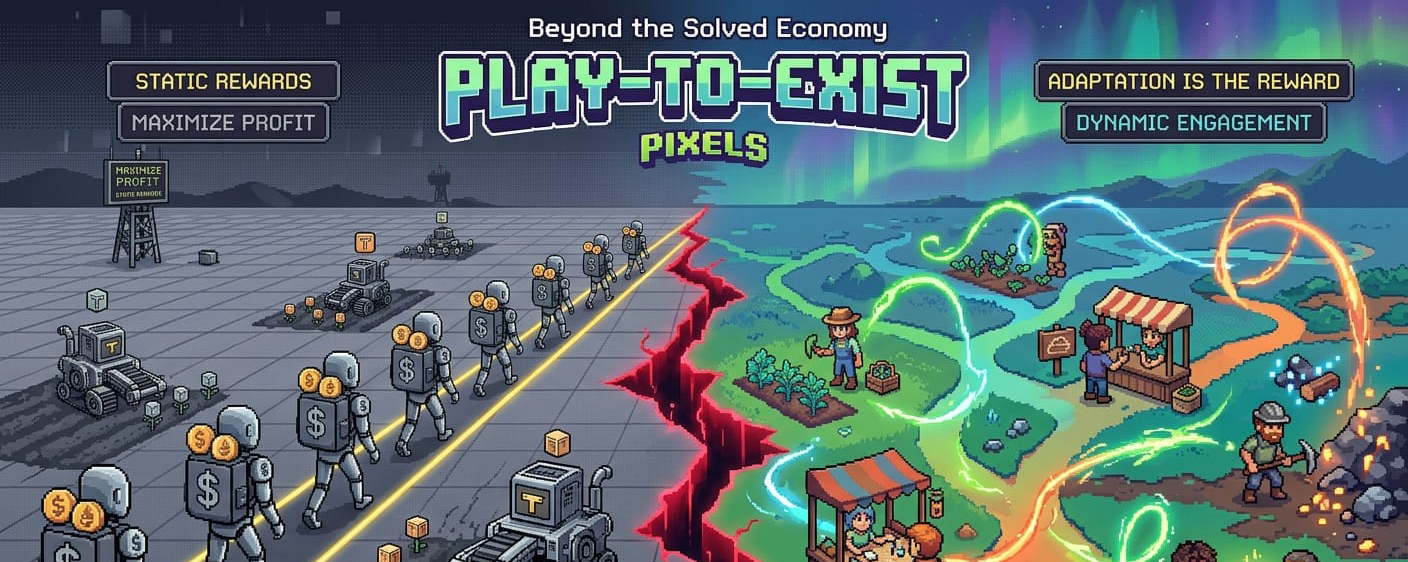

Pixels is often described in simple terms: a Web3 farming game with token incentives and on-chain economies. That description isn’t wrong, but it misses what actually makes it structurally different from earlier play-to-earn experiments.
The real shift isn’t in graphics, mechanics, or even token design. It’s in what the game assumes about player motivation.
Earlier Web3 games assumed players would stay because rewards were strong enough. Pixels assumes something more fragile: that rewards only work if the underlying activity is already worth doing without them.
That sounds obvious in hindsight, but most systems were built in the opposite order.
Pixels tries to anchor itself in routine gameplay first. Farming, crafting, trading, land interaction—these systems are not just reward vectors. They are meant to function even when stripped of financial context. Whether they fully succeed at that is another question, but the direction is clear: the game is trying to survive as a game, not just as an economy.
What changes immediately is how players behave inside it.
In older systems, once a dominant loop was discovered, everything else collapsed around it. I remember this very clearly from early farming economies—there was always a point where someone would post a “this is the optimal route” guide, and after that, the game basically stopped being a game. It became repetition with slightly different inputs.
Pixels tries to avoid that collapse by refusing to lock into a single permanent “best path.” Instead, multiple roles coexist, and their value shifts depending on conditions. Farming might be strong one week, then suddenly less efficient when supply spikes. Trading becomes more relevant. Then it shifts again.
Sometimes even something as unglamorous as raw resource collection becomes the pressure point. I’ve seen moments in similar systems where markets get flooded with a single crop—say watermint-style items—and suddenly the players who ignored farming entirely and just moved goods around are the ones controlling leverage. That kind of flip matters more than it looks like on paper.
Nothing stays dominant for long enough to fully solve the system.
That instability isn’t accidental—it’s the point. If players can fully map the “best path,” they stop exploring. They just execute. And once execution replaces discovery, engagement becomes mechanical.
Pixels tries to keep that from happening by shifting reward relevance based on behavior patterns. It doesn’t treat rewards as fixed outputs for time spent. It reacts to what the ecosystem is doing and adjusts incentives accordingly.
Of course, players don’t stop optimizing. They just change what they optimize against. Instead of finding one stable loop, they start chasing whatever currently looks underpriced in the system. That keeps moving.
And that movement is where the game either stays alive or becomes exhausting.
Because uncertainty cuts both ways. A system that never stabilizes can feel alive, but it can also feel like it never fully explains itself. Some players adapt quickly to that. Others just leave after a few sessions because they can’t tell whether they’re early, late, or simply off-track.
There’s no clean resolution to that tension.
Underneath all of this, Pixels behaves less like a fixed economy and more like a reactive structure. Player behavior feeds back into how value is distributed, which then reshapes behavior again. It’s not a straight loop—it’s more like a loop that keeps slightly deforming while it runs.
And that’s the real experiment: not whether Web3 games can reward players, but whether they can avoid becoming “solved” systems where reward logic eventually replaces play.
Because once a game is fully solved, nothing inside it is surprising anymore. And once that happens, players don’t really leave because it’s bad—they leave because it’s finished.
Pixels is trying to stay unfinished for as long as it can.
